India will be judged on whether manufacturing scale becomes industrial depth and technological capability. The number of factories built cannot settle that.
India can build clean energy factories faster than it can acquire the technology and capabilities to compete globally. That gap is the real test of its green industrial policy, in a world where industrial policy is back. The United States subsidizes domestic clean-energy manufacturing through tax credits, Europe aims to meet 40 percent of its clean technology needs from domestic production by 2030, and China remains the benchmark for state backed scale.
India shares the objective but not the means. It has a large market and ambitious energy targets, yet less fiscal room than advanced economies and a heavy dependence on imported technology and components. Whether it can move from deploying technology to manufacturing it, and eventually mastering it, will depend less on what India builds than on what its firms learn while building. The distinction matters because decarbonization and industrialization are separate projects. A country can install vast renewable capacity and capture little of the value: solar parks built with imported cells, hydrogen projects running on imported electrolysers, electric vehicles carrying offshore battery technology.
The reason is structural. The three largest producers hold at least 70 percent of global manufacturing capacity in each mass-manufactured clean technology, with China dominant in all of them, and China alone accounts for around 85 percent of solar supply-chain capacity and 95 percent of PV wafers. A country that only installs buys its transition from someone else. India’s policies increasingly acknowledge this. Its Production Linked Incentive scheme for high-efficiency solar photovoltaic modules has an outlay of Rs 240 billion, aimed at manufacturing capacity, advanced technology, integrated production, local sourcing, employment and technological self-sufficiency. Its two tranches awarded 48,337 MW of fully or partially integrated module capacity. The scheme treats renewable energy as an industrial challenge, not only a deployment one, and the shift is overdue: India’s solar capacity has grown from 2.8 GW in 2014 to around 165 GW.
Green hydrogen goes further. The National Green Hydrogen Mission pairs incentives for production and electrolyser manufacturing with pilot projects, research, standards, testing facilities, skills and infrastructure. Its initial outlay is Rs 197.44 billion, including Rs 174.9 billion for the SIGHT programme. Rather than betting on a single subsidy, the government is tackling several constraints at once, which matters because a new industry can fail on any one of them. Emerging industries are harder to support than established ones. Established industries respond to prices using technologies and suppliers that already exist. Emerging ones can’t. Investors face fast-falling costs, and making solar modules, turbines and batteries in India cost up to 25 percent more than in China in 2023, before subsidies. Suppliers must judge whether a market will grow large enough. Governments must decide how long to pay, as India did by tapering its electrolyser incentive from USD 53 to USD 18 per kW over five years. Policy must therefore solve coordination as well as financing, because money alone doesn’t align investors, suppliers and the state.
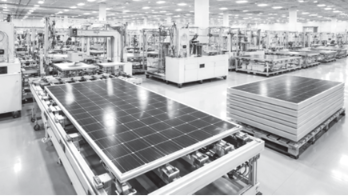
Yet India’s experiment also exposes the limits of industrial policy. Announced capacity is an incomplete measure of success, because a factory can still depend on imported equipment, materials, intellectual property or components. India’s module-making capacity is around 210 GW, but cell capacity is only 27–30 GW, and ICRA puts effective operating capacity nearer 20 GW. Over 99 percent of India’s FY26 imports of undiffused silicon wafers came from China, and reliance on imported cells has moved toward Southeast Asia rather than disappeared. Generous incentives can attract investment without building the capability to compete. The harder question is what happens after the factory is built. Suppliers should grow more sophisticated, firms should acquire engineering and process knowledge, testing and certification should improve, and producers should eventually export rather than depend on protected demand. On that last point the signal is weak: India’s solar cell and module exports fell by about 71 percent year on year in the first quarter of 2026, partly because of US trade barriers.
Precedent for success exists. Research on South Korea’s 1970s heavy and chemical industry drive finds that targeted policy helped build comparative advantage, and ICRA expects module overcapacity to force consolidation while integrated manufacturers benefit over the long term, which suggests that depth, not assembly, survives a shakeout. That demands precision about what support is for. Incentives can carry production and investment milestones, but should also track technology transfer, research spending, supplier development, workforce skills and exports, so that support rewards learning rather than merely capacity. South Korea’s model rested on what Alice Amsden called reciprocity, with strict performance standards imposed on aided firms. India already has a channel for such conditions: its electrolyser scheme requires domestic content to rise from 40 percent in year one to 80 percent by year five, and the hydrogen mission funds pilot projects and research alongside manufacturing incentives.
Trade policy must complement this, not contradict it. Complete self-sufficiency is neither realistic nor desirable, since clean-energy technologies move through international supply chains and foreign machinery, capital and knowledge speed domestic upgrading. The goal is strategic diversification: less dependence in critical areas, continued connection to global technology and markets. The International Energy Agency finds that a supply chain is only as secure as its weakest link, which argues for targeting the weak links, and estimates that Southeast Asia and India account for over 40 percent of the module output outside China that a disruption to Chinese solar exports would put at risk. India’s tariffs show the tension: a 20 percent basic customs duty on solar cells, with anti-dumping duties of up to 30 percent recommended in September 2025 on Chinese-origin cells and modules, protect producers but raise the cost of inputs that firms still import.
India’s greatest advantage may be scale. A large market can attract investment and let firms learn: India added a record 44.6 GW of solar capacity in 2025-26 and is on track for a record 50 GW of solar installations in 2026. But scale is durable only if it yields capabilities that outlast incentives. Otherwise public money produces factories without competitiveness. The implications reach beyond India. Many emerging economies enter the transition after leaders have built scale and supplier networks, and the IEA expects the geography of clean technology manufacturing to change little before the end of the decade. They can’t replicate the trajectories of China, the United States or Europe, and even the European Union legislated a domestic manufacturing benchmark to cut its import reliance. Importing clean technology won’t automatically generate development, because imports deliver technology without the learning.
India’s experiment suggests a practical aim: use the energy transition to build selected capabilities while staying integrated with global markets. The test is whether Indian firms can move from assembling foreign technology to improving, redesigning and eventually exporting it. Around 210 GW of module capacity shows that India can assemble at scale. Cell output nearer 20 GW and wafers sourced almost entirely from China show how far it has to go. What remains to be shown is that it can learn. That is the difference between participating in the green transition and industrializing through it.
*Dr Simran Keshwani is Founder and Research Lead at IndiaForth, a Sydney-based geoeconomic intelligence firm focused on India’s rise and emerging opportunities for governments, businesses and institutions. She is also a Sessional Lecturer at Macquarie University. Janvi Singhi is a Research Fellow at IndiaForth and Research Associate at Asia-Pacific Bureau of Organization for Threat Assessment and Peacebuilding (OTAP).