While immediate relief is necessary, farmers’ problems will not be resolved without a technology-based system
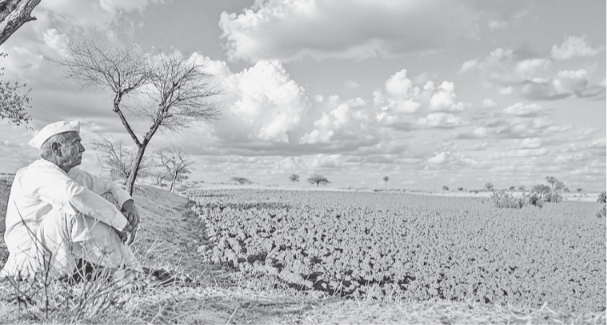
I read the poem ‘Sukha’ by Sarveshwar Dayal Saxena, a great playwright, writer and poet of Hindi literature, in my youth. In the context of the severity of drought in Maharashtra, some lines from that poem keep coming back to my mind. The poem is long, but do read a few lines… they are very emotional: Jalheen koopon ki aankhon mein jhaankta, Jalti dharti ke maathe par, thande haath rakhta, (Shaayad koi ankur uge) Abhyaasvash hee dekhta hoon, sunta hoon, bolta hoon, chup rehta hoon, Khaali zameen ko gherta hoon, aur baade banaane ke liye, kaante utha-uthakar laata hoon, Tum ek bhayaanak sukhe se ghir gaye ho — log mujhse kehte hain. (Shaayad yeh hamdardi hai!) Sukha — Haan, ab mujhmein kuch ugega nahi, ab kahin koi prateeksha nahi hogi, Ek khaali pet ki tarah, meri aatma pichak gayi hai.
As I repeat these lines of the poem, I wonder: Is this the destiny of our farmers? Should we accept this as our misfortune and keep looking towards the sky? Should we just keep praying that the rain never turns its back and makes the crops flourish? But the rain just won’t stop turning its back! It became so estranged that out of 358 talukas in the state, 305 became drought-hit. Out of 36 districts, 31 received deficient rainfall. In many districts, rainfall was 50 per cent below average. The farmers kept watching as soybeans turned yellow, cotton production halted, pigeon pea (arhar) withered and sugarcane dried up before reaching its normal height. It is being said that this is the worst drought in Maharashtra since 1972.
However, I feel that the problem of declining rainfall is constantly growing. Even when it rains, the downpour is sometimes so torrential that it destroys the crops. At other times, the gaps between spells of rain are so long that even if the average rainfall figures are met, the problem for farmers remains unresolved. When the government realises that farmers are in severe distress, it provides some financial assistance, or at times, waives their loans. Our sensitive chief minister Devendra Fadnavis has initiated some relief measures. Farmers will receive an amount of Rs 5,000 before Diwali.
However, we all know that such immediate relief does not offer a longterm solution to resolve this problem. A roadmap needs to be prepared for this. Just as we formulate policies for industries, provide them land at cheaper rates, supply affordable electricity and do a lot to bail them out of crisis, we must formulate a similar policy for our farmers. I have always said that farming should be given the status of an industry. But for all this, we need to move forward with a scientific approach and make some tough decisions as well. Everyone knows that sugarcane cultivation is not suitable for low-rainfall regions like Marathwada because it requires a massive amount of water.
Farmers must be encouraged to cultivate crops like bajra, jowar, pulses and oilseeds, which can yield better production even with less water and during drought conditions. Like Israel, Maharashtra must make drip irrigation and sprinklers 100 per cent mandatory to ensure better crop yield even with less water. Schemes regarding drip irrigation have been formulated in Maharashtra for years, but full implementation has still not been achieved today. For your information, sensor-based irrigation systems are also used in Israel, which release only the required amount of water based on soil moisture. The Jalyukt Shivar scheme, initiated by chief minister Devendra Fadnavis, needs to be expanded in scope. A comprehensive plan must be formulated to recharge groundwater. It is also necessary to prepare an accurate map of groundwater sources so that it can be understood how much water can be extracted from which region.
The point has been raised before that the water of the rivers in the Konkan region flows wastefully into the sea. We should explore the possibility of whether water from there can be diverted towards the Godavari basin through lift irrigation or tunnels? Such systems exist in many places around the world, so this is not impossible. In this age of technology, there should be a system for tehsil and village-level digital weather forecasting so that farmers can change their strategy even at the last minute to cope with drought. Farmers must also be provided with seeds that survive even during low rainfall or prolonged dry spells. Just imagine: If farmers are unable to grow food grains, what will we eat and what will they eat? Therefore, all of us must stand with the farmers! Once again, I would like to emphasise that farming should be given the status of an industry and farmers empowered technically so that the battle against drought can be won.
Why Would anyone burn down their own town hall?
In the French city of Limoges, a 140-year-old town hall was set on fire. I had seen it. It was extremely beautiful. Just one question keeps troubling my mind: Why would anyone burn down the pride of their own city? In France, education is a major issue behind the protests, and in our country too, unrest has begun over education. Education is a very serious matter; it shapes the future. Therefore, it is crucial to resolve this issue with utmost caution and thoroughness, otherwise a lot will be at stake. Naturally, when proud structures like the town hall are reduced to ashes due to rage, it causes deep distress.
*The author is the chairman, Editorial Board of Lokmat Media and former member of Rajya Sabha. vijaydarda\@lokmat.com