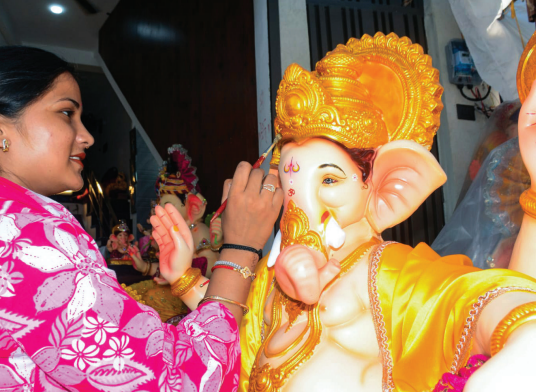
Ganesha Chaturthi falls on 14th Sept, 2026. I was in the marketplace amidst hawkers selling Ganesha idols; some tiny and some large. I heard a little girl say, “Mama, this Ganesha is such a Pookie! Can I buy it?” Well! I had never heard that adjective for Ganesha. Cutie, yes; but Pookie? I smiled as I saw the mother pay for the idol and the girl rejoice gleefully … well, all for a good cause!
Most invites for weddings, Greh-pravesh, inaugurations, etc. begin with salutations to Ganesha. He is worshipped first of all or before starting anything new. Why? Because Ganesha removes all obstacles, both worldly and spiritual, and bestows success upon devotees.
The Shaloka to venerate Ganesha that I taught my children when they were younger is, ‘Vakratunda Mahakaya Surya Koti Sama Prabha; Nirvighnam Kuru Me Deva Sarva Kaaryesu Sarvada’. Meaning: Salutations to the one with a curved trunk and a large body whose splendour is equal to a million suns. Please clear my life’s path of obstacles by blessing all that I do, always.
Ganesh Chaturthi is celebrated with fervour as the birthday of Lord Ganesha, the son of Parvati and Shiva and brother of Skanda/ Kartikeya. The curved shape of Ganesha’s trunk, elephant head and large ears closely mirror the curves of the word Om (ॐ). Perhaps that’s why many artists draw Ganesha in abstract form with just a few pencil strokes. Ganesha’s endearing form is among the most popular to draw and paint.
The scriptures say that Parvati had put an ubtan (body mask) of chandan (sandalwood) on her body. Before going to bathe, she removed the saffron paste from her body and shaped it to make a baby boy. She then breathed life into it, and thus was born Ganesha! She asked him to stand guard while she bathed and not allow anyone to enter.
Ganesha’s commitment to duty was unparalleled. As he stood guard, Shiva came, but Ganesha blocked his way, not knowing Shiva was Parvati’s husband and thus his father. A duel ensued between Shiva and Ganesha, and Shiva severed Ganesha’s head from his body.
Hearing the hue and cry outside, Parvati came running out and was completely devastated to see her son’s body lying headless. Overcome with anger and grief, she told Shiva that he must restore Ganesha’s life. Shiva said it was not possible. Parvati sat lamenting with the headless body of Ganesha in her lap.
At her insistence, Shiva told his Ganas (helpers) to bring the head of the first animal they saw, sleeping with its head to the North. The ganas returned with the head of a baby elephant. Shiva attached the head of the baby elephant to Ganesha’s body, and at that moment Ganesha started to breathe again.
When Rishi Vyasa decided to write the Mahabharata, he knew that the task of writing thousands of verses was humongous. Vyasa asked Brihaspati, the preceptor of the Gods, to give him a suitable scribe to help write the epic. Vyasa also said that the scribe should understand everything while writing.
Brihaspati said that only Ganesha was fit to perform the task. Ganesha agreed while laying his own stipulation that Vyasa would not pause while dictating the verses! Ganesha said that his pen should not stop while inscribing the verses on the palm leaves. His condition meant that Vyasa would orate continuously.
Ganesha wrote the entire Mahabharata in one go. So much so that while writing, when His pen broke, he broke off the frontal part of his tusk without hesitating, and used it as a stylus and continued to write. He understood all that Vyasa was dictating because he was an embodiment of knowledge and wisdom. It was due to Ganesha’s proficiency that Rishi Vyasa accomplished this prodigious task. He was attentive and focused, unlike us, who have very limited attention spans.
Why is he called Pratham Pujya (first one to be worshipped)? It is said that at one time Ganesha and his elder brother Kartikeya/ Subramanium decided to run a race in which they were to go around the world; the one who completed the round first would win the race.
Kartikeya flew off, perched on his peacock’s back to take a complete round of the earth. Understandably, he took a long time to return. Ganesha, meanwhile, sat on his mouse and went round Parvati and Shiva, while they sat together. He completed the circumambulation, bowed and touched their feet.
Ganesha said, “My parents are my world; they represent the entire manifested universe! Having gone around them once, I have completed a circuit of the entire world! Hence I have come first.”
Shiva was impressed and declared Ganesha the winner. He also declared that Ganesha would be the one to be propitiated first, before all kinds of pooja. Ganesha respected his parents, and they blessed him profusely. This is a great learning for us too.
He is also called Gan-Pati (leader of the Ganas) because of his intelligence and leadership qualities.
The Ganesha Visarjan festival is also based on the principle of the formless acquiring a form and then merging back into the formless. Before this Ganesha Chaturthi, idols of Ganesha are made out of clay. Pran Pratishtha is performed. After ten days of worship, on Anant Chaturdashi, the idols are immersed in running water. They lose their form, signifying that the Ganesha Principle has become all-pervasive.
It is a powerful reminder that we are all made of dust (the earth) and to dust we shall return. The creator creates us, and eventually we merge into Him.
Our scriptures say that the vibrations of prayers infused into the idols charge the seawater and purify it. The seawater evaporates to form clouds that come down as rain. This infuses mantras into the atmosphere and the lands too.
But presently, plastic, synthetic materials and colour are used to make idols. Plastic strings are used to make garlands. Metal wires are used to bind large garlands together. When these are immersed in the sea, they harm the fish and pollute the water. This defeats the very purpose of the visarjan.
The festival of Ganesha visarjan is native to Maharashtra, where immersion is done in the Arabian Sea. Presently, it has become popular in landlocked places too. It’s important to understand the scientific reason behind our rituals. It’s good to use simple materials like clay and natural glue to make Ganesha idols.
If you live in a landlocked area or if you are unable to find flowing water for visrajan, just put the Ganesha idol in a tub of water and let it dissolve. The muddy water can be used to water your plants.
I was overwhelmed to see our three-year-old granddaughter make a Ganesha out of clay, with her tiny hands! My nieces in Mumbai made a small Ganesha idol using flour, cornstarch and turmeric. They later dissolved it in water and watered their flower pots with it.
I read about a lady who makes chocolate Ganesha idols. After worship, she dissolves them in milk and serves the milk to orphan children.
All this signifies that God is allpervading. He takes a form and later dissolves into the formless. He takes a form to give us joy. The form invokes devotion and love within us. We feel happy when we can touch the form, talk to it, offer food to it, dress it up, offer PoojaArchna.
God does not need our flowers, fruits and sweets. He only sees the emotion and devotion. So, whether you say pookie or cutie pie or Ganpati Bappa Morya!, if it’s out of devotion and love, it’s all good! Enjoy Ganesha Chaturthi!