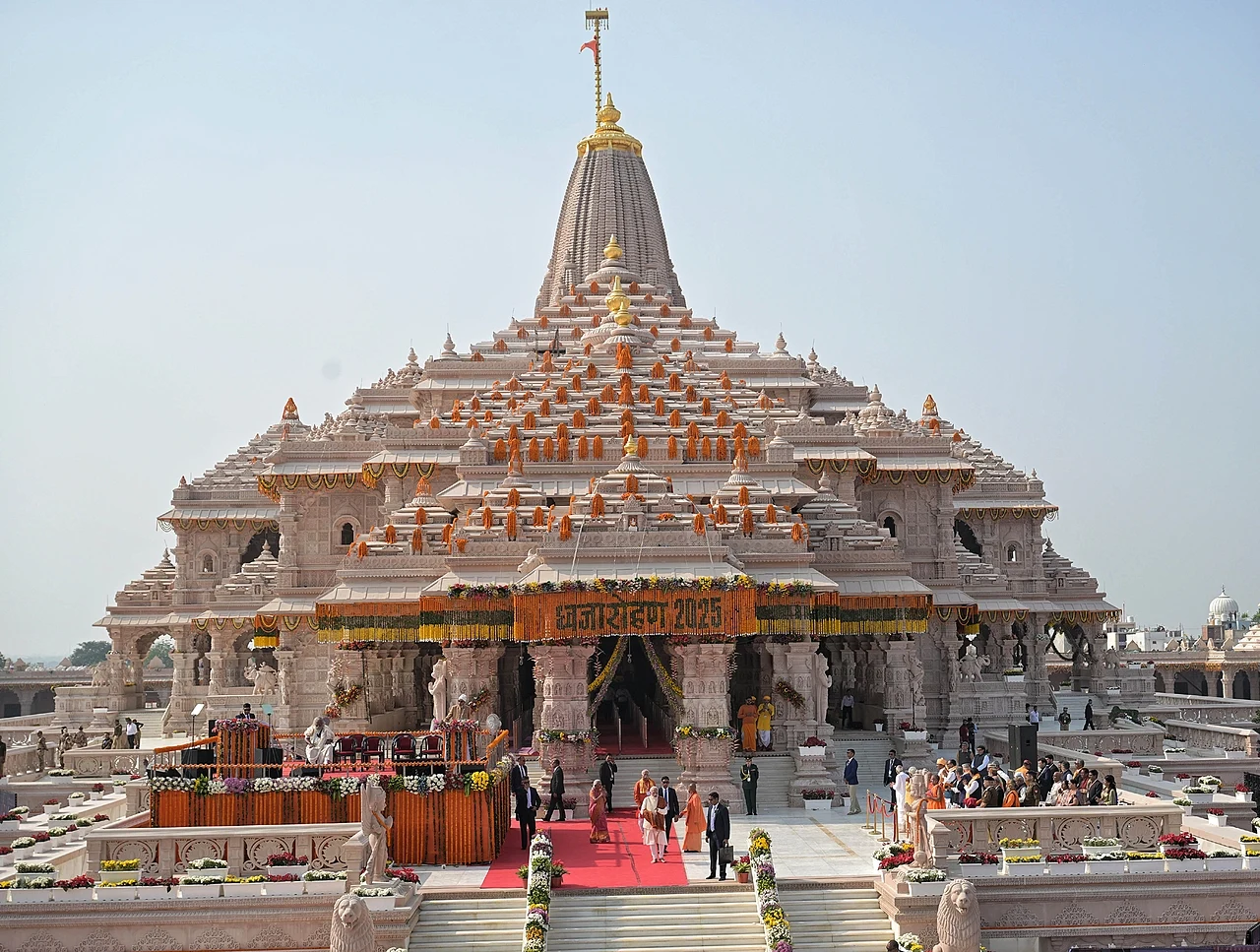
For a long time, I had wished to visit Ayodhya and seek the blessings of Lord Ram Lalla. I had been there earlier when the Babri Masjid still stood at the site. The opportunity to visit again came only after the construction of the Ram Mandir. However, the news of alleged financial misappropriation in the Ram Mandir Trust has been deeply disturbing. Everyone seems to be asking the same question: Who has driven this dagger of betrayal into the sacred trust of people’s faith?
As I travelled from Lucknow to Ayodhya, I found myself reflecting on the long and eventful history of the place. We have all witnessed the long sequence of events and archaeological findings associated with the Ram Janmabhoomi movement. Who can forget the nationwide and global campaign of consecrated stone offerings for the construction of the Ram Mandir? It is difficult to find another example of a faith-based movement on such a scale. Since Ayodhya is revered as the birthplace of Lord Ram, the temple enshrines Ram Lalla, the infant form of Lord Ram. There is no doubt that Prime Minister Narendra Modi and Rashtriya Swayamsevak Sangh chief Dr Mohan Bhagwat played significant role in the realisation of this grand temple. Temple construction had long been a key objective of both the Bharatiya Janata Party and the RSS. Surely, one of the aspirations behind building the temple was also to establish the ideals of governance embodied by Lord Ram’s concept of Ram Rajya.
Ram Rajya signifies a society where justice is available to all, where caste and social discrimination are eliminated, and where the welfare of the neglected and marginalised is ensured. The examples set by Lord Ram – accepting the humble offering of Shabari’s berries and restoring Ahilya from her curse – embody ideals of compassion, inclusion and human dignity. For many believers, these values should serve as the moral compass of a New India. Immersed in such reflections, I finally arrived at the Ram Lalla Mandir. Its grandeur is truly remarkable. The atmosphere was imbued with devotion, serenity and a profound sense of peace, leaving visitors spiritually fulfilled. Most of the construction work has been completed, while the remaining portions are in their final stages. Visitors arrive from every corner of India and from diverse social backgrounds. Among them were many from my home state of Maharashtra, each carrying their own story of faith and expectation. What distinguishes the Ram Mandir from many other monumental projects is the manner in which it was funded. A particularly remarkable aspect of the Ram Mandir is that it was not built with government funds. Rather, it arose from the collective contributions of millions of devotees ranging from humble ten-rupee donations by the poor to contributions worth crores from the wealthy. In that sense, the temple stands as a unique and powerful testament to the depth of public faith and devotion. That is precisely why allegations of financial mismanagement strike such a sensitive nerve.
In Ayodhya, I spoke to a number of people about the controversy. The prevailing sentiment was strikingly uniform. There was also a widespread belief that over time, certain individuals from outside Uttar Pradesh had come to wield disproportionate influence within the temple’s affairs. It was perhaps this growing and unnecessary concentration of influence, some suggested, that ultimately eroded public trust. I asked why a governance model similar to that of the renowned Tirupati temple had not been adopted. At Tirupati, a senior IAS officer oversees the administration, while separate committees are entrusted with financial supersion and accountability. I was told that a delegation from Ayodhya had indeed visited Tirupati to study its management structure, but little appears to have come of that exercise. For now, a Special Investigation Team (SIT) has been constituted to examine the allegations of financial irregularities. Several arrests have already been made. Champat Rai and Dr Anil Mishra have resigned from the trust. Yet as I made my way back to Lucknow, one question lingered in my mind: Who are the real culprits responsible for betraying the trust of ordinary devotees?
A city of culture, craft and cuisine
The journey also provided me the opportunity to spend two memorable days in Lucknow, a city celebrated for its culture, craftsmanship and cuisine. To that list one must surely add architecture, for few structures capture the city’s grandeur as magnificently as the Bara Imambara. Lucknow’s language itself seems infused with courtesy and refinement, while its culinary traditions are legendary. There is a distinctive elegance in the city’s atmosphere, a subtle grace that is difficult to describe yet impossible to miss. I spent some time exploring the Bara Imambara, one of Lucknow’s most iconic landmarks. It was commissioned in 1784 by Nawab Asaf-ud-Daula of Awadh during a devastating famine. The project was conceived not merely as an architectural endeavour but as a means of providing employment to thousands of people affected by the crisis. Historical accounts suggest that the poor worked on the structure during the day, while those who had fallen from prosperity into hardship were employed at night. The arrangement was designed to preserve their dignity by shielding them from public embarrassment. In many ways, it struck me as an eighteenth-century precursor to a public employment programme. The Bara Imambara remains a testament not only to architectural brilliance but also to an unusually compassionate vision of governance.
In the remarkable Haveli of Muzaffar Ali
One of the highlights of the trip was the opportunity to visit the haveli of Padma Shri Muzaffar Ali, a descendant of the royal Kotwara family of Awadh. The prospect alone filled me with excitement. Most people know Muzaffar Ali as the acclaimed filmmaker behind the classic Umrao Jaan, a work that remains one of the finest achievements of Indian cinema. Yet his artistic talents extend far beyond filmmaking. He is an accomplished fashion designer, a poet of rare sensitivity and an exceptional painter. He has also earned recognition for his distinctive contributions to advertising and for his efforts to revive the exquisite craft of Awadhi ‘chikankari’ embroidery. His wife, Meera Ali, is herself a distinguished fashion designer, and together the couple continue to make significant contributions to India’s cultural landscape. What left the deepest impression on me, however, was the warmth and grace with which they welcomed me into their home. Their hospitality reflected the finest traditions of Awadhi etiquette. I found myself captivated by the carefully preserved artefacts and heirlooms that filled the haveli. Every room seemed to hold fragments of history, art and memory. The residence is, in many ways, a living museum, a remarkable repository of rare objects and cultural treasures. Every moment spent there felt like an encounter with a disappearing world of refinement and artistic excellence. The memories of that visit are something I shall cherish for a long time to come.
The author is the chairman, Editorial Board of Lokmat Media and former member of Rajya Sabha. [email protected]