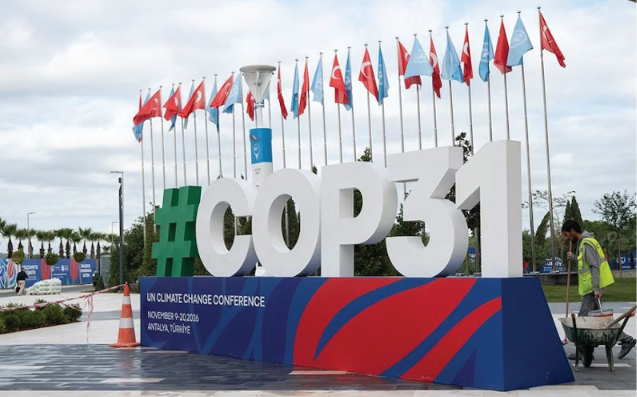
The beginning of COP31 in Antalya, Turkey on 9 November 2026 has revealed the same old divisions in the world climate negotiations where developed countries insist on quick actions while the developing and underdeveloped countries are seeking finance for measures fighting climate change, receiving technologies for promoting climate-friendly initiatives, and just distributing responsibilities.
The disagreements regarding climate finance and the COP agenda seem to be very wide immediately before the start of the meetings, which means that the conflict between the developed countries and the G77 plus China is still taking place. However, for India this meeting is crucial for climate resilience of the Pacific region.
The significance of the issue has increased due to the efforts of Pacific Island countries to make conservation of the ocean, climate finance and the 1.5°C mark the priorities for the negotiations. The opening of the Moana Blue Pacific Pavilion is also important since it makes it possible to easily take into account the ideas coming from Pacific peoples.
According to the Minister of Climate Change of Australia Chris Bowen, the concerns of the Pacific Islands should continue to be taken into consideration in the context of the climate negotiations. In addition, the cooperation with Fiji in climate issues covers ocean cooperation as well as fair distribution of funds for climate financing.
Therefore, it can be predicted that the Pacific will be in the center of attention in the course of the climate negotiations. The stakes are tangible. According to the latest report released in 2024 by the World Bank, the country of Tuvalu has consistently suffered a loss of around 7% of its GDP yearly due to disasters related to climate change.
Similar results can also be noted in the countries of Kiribati and the Marshall Islands, where for each of these countries the loss constitutes between 3% and 4% GDP per year. It is estimated that sometime around 2050 a single climate event will cause an economic damage equal to 50% of Tuvalu’s production.
Rising water levels also pose a threat to fresh water supply, marine life and fishing activities, as well as the livelihood of the local people. Thus, it can be said that climate change is not only a challenge for the environment of the Pacific region but also for the economy and maritime security.
In COP31, Australia is both president and being under questions of credibility. Anthony Albanese, the Australian prime minister acknowledges the importance of the provision of funds to underdeveloped countries in the Pacific area. Meanwhile, the opposition claims that Australia continues the acceptance of new contracts in the sphere of coal and gas energy that contradicts the achieved goals in the Pacific region.
Because of this contradiction Pacific states expect real steps rather than statements. The importance of this issue is emphasized by the fact that the absence of reality was clearly observed at the symposium Partners in Green Transition: Advancing Ambition, Action, and Partnerships for COP31 that was held in September 2026 by Chintan Research Foundation in cooperation with the High Commission of Australia to India and gathered governmental workers and officials to discuss climate problems.
India and Australia are poised for an unforgettable chance to improve ties between one another. Both nations can use Australia’s technical experience, finances, and natural resources to aid in the development of renewable energy systems in India. Nevertheless, it is essential to ensure that the opportunity is not just exploited for economic gain; also, it needs to allow for achievements in terms of regional climate power.
The Climate Infrastructure for Resilient Coastlines and Riverbanks program that was launched by Australia during Pre-COP31 in Fiji has allocated US$ 3 million towards “nature-based” infrastructure initiatives in Fiji, Kiribati, Papua New Guinea, and Tuvalu. The Renew Pacific program is expected to provide renewable energy to at least 75,000 citizens of Fiji and Papua New Guinea annually.
Australia has committed to contributing US$ 2.8 million towards development assistance to 14 island countries through investments in programs aimed at solar electrification, sea wall construction, and coral farm development.
India went on to elaborate its stand on the matter. On October 8, during the PreCOP31 meeting held in Fiji, the Indian Minister of Environment stated that there is a need for higher climate finance, technology transfer, and building capacity, but at the same time for respecting the internationally determined development path.
This signifies the sincere adherence of India to the ideas of climate justice and the concept of Common but Differentiated Responsibilities and Respective Capabilities (CBDR-RC). However, challenges do exist in terms of translating the concepts into more vigorous partnerships in the region.
The partnership between India and Australia is expected to create a global adaptation strategy for the Pacific that will help in obtaining concessional funding for works on coastal construction, satellite-based early warning systems, energy storage devices and capacity building.
The main strengths of India are affordable solar technology; the country has a well-developed approach in dealing with disasters and in advanced satellite monitoring. On the other hand, Australia demonstrates its superiority in finance and research. Most importantly initiatives in these subjects should be devised by the Pacific Islands’ governments rather than by international donors.
It is important to implement real financial instruments for the success of the conference. India can do more than just provide assistance to countries in the region in the fight against climate change, but establish itself as a reputable partner in the development of the Indo-Pacific area in a broader sense of transition from climate change processes to economy and politics.
*Samantha Karmakar is a foreign policy analyst specialising in diplomacy, defence and strategic affairs. She currently serves as Director of International Relations and Affairs at Her Economy, contributing to the organisation’s international engagement and strategic initiatives. Janvi Singhi is a Senior Research Fellow at India Forth, Sydney based geo-economic intelligence firm. She is a Gold Medalist in International Relations. Her research focuses on geopolitics, geoeconomics, strategic affairs, of South Asia and Indo-Pacific.