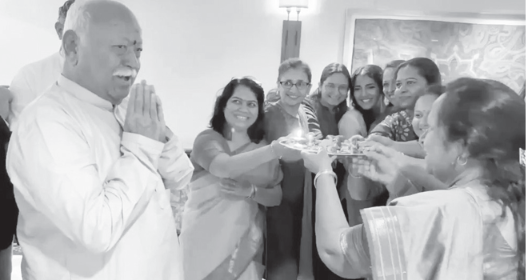
During his recent trip to the United States of America, RSS Sarsanghchalak Dr. Mohan Bhagwat stated something which is deceptively very simple, but a message which is universal. At the Madison Square Garden, New York, speaking to the Indian Diaspora, Dr. Bhagwat said, “We are in America, we live in America, we earn in America. So we are American, and we should behave true to America.” He spoke about how America is the Indian diaspora’s Karmabhoomi and appealed to them to fulfil their responsibilities towards the nation. While it appears to be a message to the Indian Diaspora, its deeper significance, however, is universal in nature. The RSS has always been characterised as a Hindu Nationalist or right wing Organisation by the western media till date and Prime Minister Modi the leader of a Hindu Nationalist Party. Is it time that it be called only a Nationalist organisation after Bhagwat’s recent statement? Because Dr. Bhagwat in his speech, attended by thousands in person, watched online by millions and talked about on social media across the globe has raised an important agenda, About being nationalist, not a Hindu nationalist, not a religious nationalist, but one to the country where they are making a living ! A country is not merely a territory determined by its geography, rather a collective set of people who make a nation together.
While the rules of citizenship differ, merely being in a country, even for the purpose of tourism, is a responsibility towards that country and it is not just about fundamental rights, but also the fundament duties which come along with it. Every Indian who is working in the USA on an H1B1 visa and building his career, earning his bread in a country which is famously called the country of migrants, and is chasing an American dream owes something to the United States. An Indian who is establishing a business in the United Kingdom or Africa owes something to the country. And there is no contradiction on Indian roots and loyalty to a country who has accepted you, welcomed you, and provided education and health facilities to the family. The Janmabhoomi can remain in the heart while the karmabhoomi deserves duty and responsibility. This also raises some very important questions for citizens living in Bharat.
If loyalty to one›s place of work is an obvious moral proposition for the Indian diaspora, the same principle applies to those whose place of birth and place of work are one and the same. While there is always a space for dissent with the government, the ruling party’s policies or the political environment, but criticism and disagreement with the government is different from hostility towards the country. This distinction matters as a confident democracy cannot demand confirmation intellectually and democratic dissent does not provide a licence to undermine the society or country where we live in.
A nation’s interest cannot be viewed only through the prism of party, ideology, religion, caste, region or ethnicity. Former US President John F. Kennedy famously quoted during his 1961 inaugural address, “Ask not what your country can do for you, ask what you can do for your country”. From “what is good for me” to “what is good for the country”, is a transformation the world is seeking.
The basic responsibilities of citizenship cannot be superseded by a mindset or ideology or a political party. The same principle applies to religion, language, caste and regional identities. While these can all be legitimate sources of cultural belonging or deep rooted traditions, none should become an excuse for treating the nation itself as secondary. And this is the junction where the Indian civilisational idea of dharma offers a crucial perspective. Going by the common definition, dharma is not just about worship or a religious practice but It is about the duty evolving from one›s responsibilities. Just as a public servant is responsible towards the country’s citizens, a citizen too has equal duty towards the country. And the interesting part is, that this structure does not expect us to abandon our identities but demands to put duties alongside identity. A country is not merely a territory determined by its geography, rather a collective set of people who make a nation together.
While the rules of citizenship differ, merely being in a country, even for the purpose of tourism, is a responsibility towards that country and it is not just about fundamental rights, but also the fundament duties which come along with it. responsible are obeying laws, paying taxes honestly, respecting public spaces, honouring local places of worship and religious rituals, protecting the dignity of fellow citizens, rejecting violence, respecting institutions, accepting electoral verdicts even when they disappoint, criticising without dehumanising and disagreeing without delegitimizing the country itself. This is what makes the RSS Chief’s message to the diaspora universal, as he did not ask IndianAmericans to forget their roots in India. He asked the diaspora to become responsible citizens of their karmabhoomi while carrying forward the values of their Janmabhoomi. This is an important lesson for Bharat because the best way of honouring our nation is not merely by speaking loudly about it, but by becoming the kind of citizen who make India a better place. Amongst the several ways to be The diaspora living around the world is often reminded to carry Bharat in its heart while becoming responsible citizens of the countries that have become their home. Now is the time to ask this basic question to those of us who live in India, whether we conduct ourselves like a true Bhartiya, as for us, there is no separate karmabhoomi to which that responsibility can be transferred. Bharat should come before the argument we are having about Bharat. Aptly titled “Universal Oneness”, the event at New York has definitely raised many important issues and Dr. Bhagwat categorically evoked “Because Bharat is their Janmabhoomi, if they have an urge to do something and they can do that, after fulfilling their duty to their Karmabhoomi, it is not prohibited. Okay. But it is not obligatory. Your Janmabhoomi expects you to live the values it has imparted on you…” Sister Nivedita (Margaret Noble) & David Sassoon though foreign nationals contributed to India, while Satya Nadella and Sundar Pichai are living examples of how Indians contributed to the world. There is no better Indian civilisational metaphor for this distinction than Krishna himself. Just like Lord Krishna, one can serve in Dwarka, keeping Mathura in the heart.
*The writer is Spokesperson, Bhartiya Janta Party, Chhattisgarh and an alumnus of Columbia University, USA The views are personal.