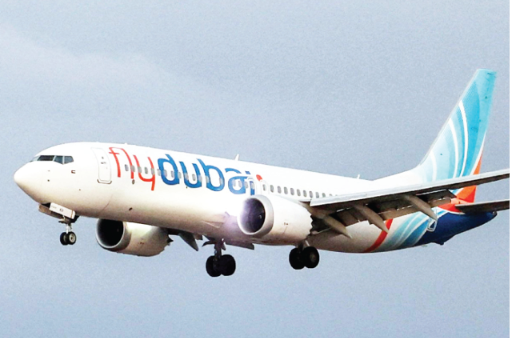
There are moments in aviation when the distance between an ordinary flight and an unimaginable catastrophe is measured not in miles, but in seconds. Flydubai Flight FZ1073 was one such flight. On September 30, 2026, the Boeing 737 operating from Dubai to Tel Aviv suddenly descended by almost 14,000 feet in less than 30 seconds while flying over the region. What followed was not a conventional aviation emergency. It was a violent cockpit confrontation involving members of the flight crew, leaving the captain seriously injured and the aircraft in an extremely dangerous situation. Yet FZ1073 did not become another aviation tragedy. It became a story of courage, instinct, professional training—and remarkably, international human solidarity. The aircraft eventually landed safely at Tabuk in Saudi Arabia. All passengers and crew survived. Flydubai confirmed that the aircraft had experienced an incident en route and that the aircraft was safely diverted to Tabuk, while cautioning against premature conclusions about the causes or motives. That caution is important. The investigation is still unfolding. But the broad facts already reveal lessons that extend well beyond this particular flight.
An Indian captain at the centre of the crisis
At the heart of the episode was Captain Smit Machchhar, an Indian national. According to the available accounts, Machchhar was seriously injured during the cockpit confrontation. Yet, despite his injuries, he managed to open the cockpit door, allowing passengers and other crew members to intervene. Israeli Prime Minister Benjamin Netanyahu publicly described the passengers and crew who intervened as heroes, while Indian Prime Minister Narendra Modi separately praised Machchhar’s courage and resolve. The significance of Machchhar’s action should not be reduced merely to personal bravery.
The reinforced cockpit door, introduced as a central layer of aviation security after 9/11, is designed precisely to prevent unauthorised access. But FZ1073 demonstrates the paradox of every security system: a measure designed to prevent one category of threat can create complications when the threat originates from inside the protected space. The dossier rightly identifies this as one of the most important safety questions emerging from the incident. The challenge for aviation regulators is therefore not to weaken cockpit security. It is to examine whether there are sufficiently robust procedures for the extraordinary circumstance in which the person controlling the aircraft becomes the source of danger.
When the passengers became part of the safety system
Perhaps the most extraordinary dimension of FZ1073 was the role played by passengers. Reports indicate that passengers recognised that something was profoundly wrong and that some moved towards the cockpit. An Israeli passenger, identified in reports as Yaniv Hayoun, was among those who helped overpower the attacker. Israeli Prime Minister Netanyahu later spoke directly about the intervention and praised those who acted. There is an important lesson here. Modern aviation is built around highly trained professionals, sophisticated avionics, multiple layers of redundancy and strict procedures.
Passengers are normally expected to remain passengers. But in an extreme emergency, the human beings inside the aircraft can become an additional—and unpredictable—safety resource. The dossier describes an Israeli plumber stepping into the cockpit and attempting to arrest the aircraft’s descent, followed by off-duty pilots who were travelling as passengers and eventually helped stabilise and land the aircraft. Not every detail of that sequence has yet been independently established. But the broader fact is significant: off-duty aviation professionals were present on the aircraft and were able to contribute to the recovery. In other words, FZ1073 was saved not by one heroic act alone, but by a chain of human interventions.
An unexpected India-Israel story
There is another dimension to this episode that deserves attention in Bharat: the extraordinary human connection between India and Israel embedded within the crisis. The aircraft was flying from Dubai to Tel Aviv with a predominantly Israeli passenger population. At the centre of the emergency was an Indian captain. Among those who intervened were Israeli passengers. An Israeli medical professional was also reportedly among those who provided assistance to the injured captain. The aircraft ultimately found safety in Saudi Arabia. Three countries that occupy very different positions in the region therefore became connected by a single aviation emergency: an Indian pilot, Israeli passengers and a Saudi airport. And that makes FZ1073 more than an aviation story.
It is an unusual illustration of how people-to-people relationships can transcend geography and politics. India and Israel have developed a deep strategic relationship across defence, agriculture, water, technology, counter-terrorism and innovation. But strategic partnerships are ultimately sustained not only by agreements between governments. They acquire meaning through ordinary human encounters. On this flight, an Indian captain was fighting to save an aircraft carrying Israeli citizens. Israel’s Prime Minister publicly saluted the people who intervened. India’s Prime Minister publicly saluted the Indian captain. The symbolism is difficult to miss. The India-Israel relationship is often discussed through the vocabulary of defence systems, intelligence cooperation and strategic convergence. FZ1073 offers a different vocabulary: courage, trust and human solidarity.
Saudi Arabia became the safe Harbour
There is an equally remarkable geographical irony. The aircraft was flying to Israel but had to divert to Saudi Arabia. Tabuk became the emergency destination, and Saudi authorities handled But there is a danger in drawing conclusions too quickly. cy communication system. Flightradar24 confirmed the use of the 7700 and 7500 transponder codes during the crisis. Fifth was air-traffic-control coordination and the availability of a suitable diversion airport. And finally, there was the most unpredictable safety mechanism of all: human courage. This is important because aviation safety is sometimes The motive of the FZ1073 attacker has not been conclusively established. The UAE authorities have ordered an investigation, while Israeli officials have raised questions about whether the episode could have had a terrorist dimension. Flydubai itself has urged everyone to wait for confirmed facts. The distinction matters.
An aviation investigation must establish what happened before deciding why it happened. understood purely as a technological discipline. It is not. Technology can detect an abnormal flight path. An aircraft computer can record altitude and speed. A transponder can communicate an emergency. ATC can provide vectors. the immediate aftermath. Flightradar24’s tracking data records the aircraft’s emergency signals, including the transition from Squawk 7700, indicating a general emergency, to Squawk 7500, the internationally recognised code for unlawful interference, before the aircraft eventually landed safely at Tabuk. This is where aviation’s international character becomes particularly visible. Airspace does not care about political boundaries in the way politics does. When an aircraft is in distress, air traffic controllers, military authorities, airport personnel, pilots and emergency responders have to work across jurisdictions. For the passengers of FZ1073, Tabuk was not a geopolitical abstraction. It was simply the airport that could save them.
The safety system Worked—But only because humans made It Work
The most important question now is not simply: Who attacked whom? It is: Why did the aircraft survive? Several layers of aviation safety appear to have come together. First was the captain’s response. Second was the cockpit access that allowed others to intervene. Third was the presence of additional trained aviators aboard the aircraft. Fourth was the emergenBut technology does not decide to open a cockpit door while injured. Technology does not decide to intervene when fellow passengers are in danger. Technology does not administer emergency first aid. Human beings do.
The Insider threat deserves renewed Attention
The aviation industry has spent decades strengthening aircraft against external threats. Hijacking prevention, reinforced cockpit doors, passenger screening, airport security and intelligence sharing have transformed commercial aviation. But FZ1073 reinforces a different category of concern: the insider threat. Previous aviation disasters have demonstrated that a person already authorised to occupy the cockpit can potentially possess greater access to the aircraft than an external attacker. That makes psychological fitness, background checks, professional grievance mechanisms, peer reporting and behavioural warning systems important areas for scrutiny.
The cockpit door paradox
There is perhaps one safety lesson that regulators should examine particularly carefully. The cockpit door is simultaneously a shield and, in certain circumstances, a barrier. The post-9/11 aviation model assumes that the greatest danger comes from outside the cockpit. FZ1073 demonstrates the possibility of a different scenario: what happens if the danger is already inside? The answer cannot simply be to make the cockpit more accessible. That could create entirely new vulnerabilities. The challenge is to design a system in which legitimate intervention remains possible without compromising cockpit security. Biometric authentication, carefully controlled emergency procedures, dual-authorisation mechanisms, improved crew-alert systems and other technological solutions may deserve examination. But any changes must be evaluated through the same safety philosophy that governs aviation generally: one vulnerability should not be eliminated by creating another.
The Forgotten heroes of Aviation
There is another lesson from FZ1073 that deserves ing processes applied to flight crew, the performance of the aircraft and its systems during the extreme descent, and the coordination between the aircraft, ATC and the diversion airport. to be remembered. Airlines routinely remind passengers that medical professionals should identify themselves during emergencies. Pilots repeatedly emphasise the importance of following crew instructions. Aviation authorities conduct drills for events that passengers hope never happen. FZ1073 demonstrates why preparedness matters. The dossier describes the contribution of an onboard dental surgeon who assisted the injured captain and the presence of off-duty pilots who helped recover the aircraft. A plumber, a dentist, pilots, passengers, cabin crew, air-traffic controllers and emergency responders became part of the same survival chain. No single individual could have guaranteed the outcome. Together, their actions created a possibility of survival.
A story of friendship beyond diplomacy
For India and Israel, the episode carries a particularly human message. The two countries have built a relationship that is frequently described in strategic terms. Yet friendship between nations is also revealed in moments when ordinary citizens find themselves sharing extraordinary circumstances. An Indian captain was at the controls of a flight carrying Israelis. Israeli passengers intervened during the crisis. Saudi Arabia provided the emergency landing point. And leaders in New Delhi and Jerusalem publicly recognised the courage displayed aboard the aircraft. It is an unusual tableau— but a powerful one. Friendship between nations is not merely written in diplomatic communiqués. Sometimes it is written at 35,000 feet, in moments when people have only one objective: to save another human being.
The Investigation now matters As much As the heroism
The temptation after an event like this is to celebrate the heroes and move on. That would be a mistake. The real legacy of FZ1073 should be measured by what aviation authorities learn from it. Investigators need to establish the precise sequence of events, the motives of the attacker, the effectiveness of existing cockpit-security procedures, the psychological and professional screenThe incident should also be studied as a human-factors case. What enabled the captain to act despite his injuries? How did passengers recognise the emergency? How did the off-duty pilots transition from passengers to emergency crew? How did the aircraft’s safety systems and international air-traffic architecture respond? These are questions whose answers could make future flights safer.
At the end, It Was people Who saved people
The statistics of aviation can sometimes obscure its human reality. FZ1073 was a Boeing 737, a flight number, a route and a set of coordinates on a radar screen. But inside that aircraft were human beings. An Indian captain who refused to surrender the aircraft to disaster. Israeli passengers who acted when action was desperately needed. Professional aviators who happened to be travelling as passengers. A medical professional who treated an injured man. Saudi authorities who received a distressed aircraft. And countless others whose professional actions formed the invisible safety net around those 174 passengers and crew. The final lesson is therefore larger than aviation. Technology matters. Procedures matter. Security matters. Training matters. But when systems are pushed beyond their design assumptions, character matters too. At 35,000 feet, Flight FZ1073 came frighteningly close to becoming another name in aviation’s long catalogue of tragedies. Instead, it became a story of an Indian captain, Israeli passengers, an aircraft diverted to Saudi Arabia—and a chain of human beings who refused to let 174 lives become statistics. That is perhaps the most enduring lesson of FZ1073: aircraft may be built from technology, but ultimately, lives are saved by people.
*Dr. Siddhartha Dave, PhD, is an alumnus of the United Nations University in Tokyo and a former Lok Sabha Research Fellow. He writes on foreign affairs and national security.