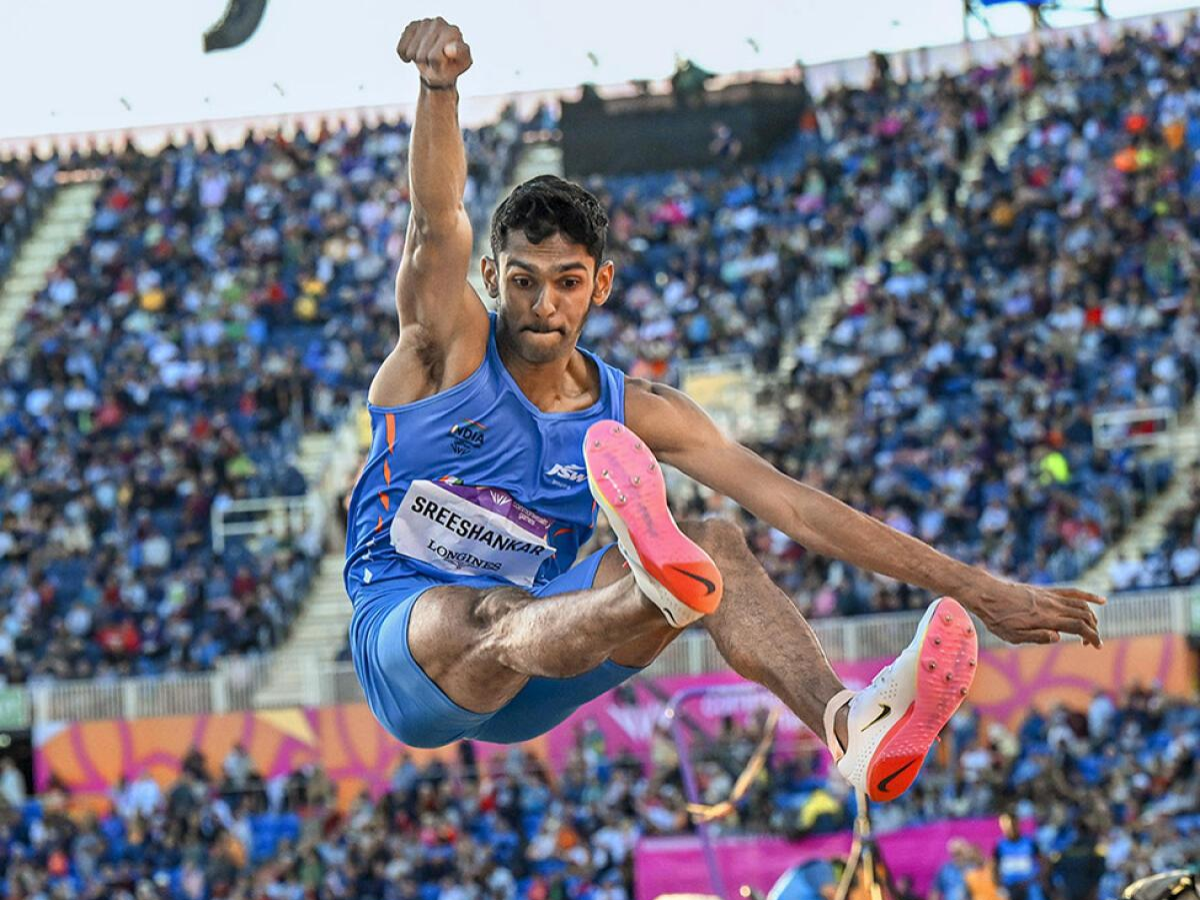
Murali Sreeshankar refers to Kalinga Stadium as his lucky turf. It was on this turf that he achieved his initial 8m jump (8.20m in 2018) as well as his best (8.41m in 2023). Back to his happy hunting ground after recuperating from a career threatening left knee – the surgery has given him a lengthy scar – he required every fortune in the book to triumph in his fourth consecutive contest in five weeks.
Spurred on by a fervent crowd, Sreeshankar jumped 8.13m in his sixth and final attempt to steal the limelight from youngster Shahnavaz Khan, who was poised for victory with his first 8m-plus effort, an 8.04m jump.
“I believe this is Bhubaneswar magic. Whenever I come here, I just do good,” the 26-year-old said. Sreeshankar looked in decent rhythm, two fouls sandwiching attempts of 7.92m, 7.95m, 7.93m before the winning effort to carry his form from Almaty, where he won last week.
ALSO READ: Who Is Senuran Muthusamy? The Spinner Who Claimed Virat Kohli in His First Test Match
“This is the third country that I’m moving past over the past 10 days, so I just need to get some rest before I get ready for a big one at the Inter State (in Chennai). I am happy for Shahnavaz too since we train together and push each other,” the 2023 Asian Games silver medallist, who now trains at SAI Thiruvananthapuram, said.
Rehabilitation and Return to Form
Back in action after over a year, Sreeshankar has hardly got time to sharpen his technique. His routine consists of spending hours in order to regain strength, so that he will have the confidence to believe in the healed knee.
“This season has been all about rehab. From January until now, I’ve been spending three sessions per week in gym, each session lasting four hours. I started jumping only 2-3 months back. In spikes, I’ve altogether jumped probably 8-9 times before starting my season.” Still, Sreeshankar looked on course to meet the Tokyo World Championships entry standard of 8.27m.
“I was confident I’ll do it. I gained more elevation than I wanted in the last jump and lost about 30cm,” he said.
Mental Strength Behind The Comeback
Comeback bids such as these are often as much about the mind too. Career-altering injuries and surgeries can often cast apprehensions in an athlete’s mind, affecting performances at crunch moments. For Sreeshankar, it was hardly the case because he had “beaten death” in past, as he refers to his appendicitis surgery in 2018 that cost him that year’s Commonwealth Games.
“I was only a teenager then and that was a life-threatening situation. When you have come back from something like that, these surgeries are easier to deal with,” he said.
“What also gave me confidence were the doctors in Aspetar Hospital in Doha which is probably the best hospital in the world. My case was complicated and even the best doctors said it wasn’t up to them. It was probably the end of my career. But the doctors in Doha were very confident. They have taken a graft from my hamstring and wrapped my knee, and put three screws there. I know my knee is pretty strong but it needs some care.”
Post-Event Care and Support System
That means a regimented post-event routine involving soft tissue release and rehab exercises. “It’s natural to have some doubts and fear but when I step onto the runway for jumps, my mind goes completely blank.”
On Sunday, running in for his last jump, all he thought was giving his all, “even if I break my leg again.”
“I have come back from much harder situations but there’s a close bunch that keeps my spirits high. I lean on Tejaswin Shankar and Neeraj Chopra who have always been very encouraging.”
ALSO READ: Australia Set New T20I Winning Record Yet Remain Behind Afghanistan, India in Rankings
After a two-day break, Sreeshankar will head to Chennai for the Inter State where he’ll bid to achieve the entry standard for Tokyo. “If that happens, it’s fine. If not, I’ll still be ok, I am just happy to be back competing.”