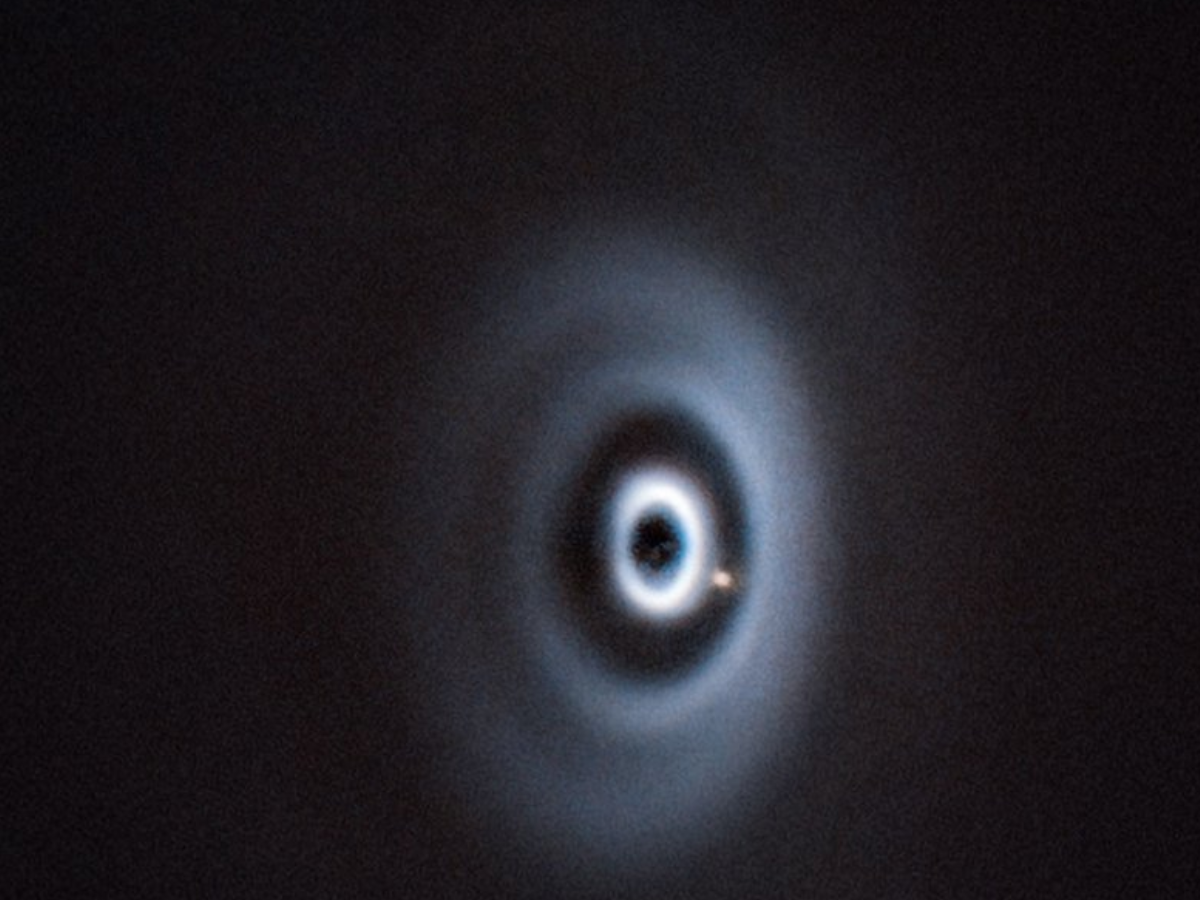
For decades, astronomers have speculated that the striking gaps viewed in dusty, ring like disks surrounding young stars had been made by hidden planets.
Now, for the first time, researchers have confirmed that theory through the discovery of WISPIT 2b. An infant and growing planet within such a gap. The find, led by Professor Laird Close at the University of Arizona and graduate student Richelle van Capelleveen from the Leiden Observatory, gives direct evidence of how giant planets sculpt their birth environments.
WISPIT 2b: A Young Giant in the Making
WISPIT 2b is estimated to be about five times the size of Jupiter and orbits its star at roughly 56 astronomical units a distance well beyond Neptune’s orbit when compared with our own solar system.
At just five million years old, the planet is still very much in its infancy, slowly carving out a gap in the surrounding protoplanetary disk of gas and dust. Astronomers have likened it to a cosmic Pac-Man, eating the material as it grows.
ALSO READ: Pegasus Constellation Reveals a Cosmic Canvas of Stars, Dust and Galaxies
Technology Behind the Breakthrough
The discovery was enabled by cutting edge adaptive optics systems, which compensate for the blurring effects of the Earth’s atmosphere.
By utilizing powerful observatories such as the Magellan Telescope in Chile, Large Binocular Telescope in Arizona and the Very Large Telescope of the European Southern Observatory, the astronomers detected the faint hydrogen glow of WISPIT 2b. This emission, known as H-alpha light, revealed the gas falling onto the infant planet as mass accumulation proceeds.
ALSO READ: Last Solar Eclipse of 2025: Check Date, Time & Where It Will Be Visible
Why This Truly Matters for Planetary Science
The significance of this detection reaches far beyond just one planet. WISPIT 2b is the first confirmed world discovered within a multi ringed disk, a structure that bears resemblance to the grooves of a vinyl record. Scientists think this baby pictures of planetary systems may provide crucial information about how gas giants like Jupiter and Saturn formed in the early solar system.
Many properties of WISPIT 2’s host star testify that it is similar to what our Sun might have looked like a few billion years ago and thus becomes an extraordinary laboratory for understanding how planets and conceivably habitable worlds come into being.
This discovery validates previously held theories and marks an important milestone in observational astronomy, leading toward a better understanding of how planetary systems come into being throughout the cosmos.
ALSO READ: Blood Moon 2025: List of Cities in India to Witness the Rare September Eclipse