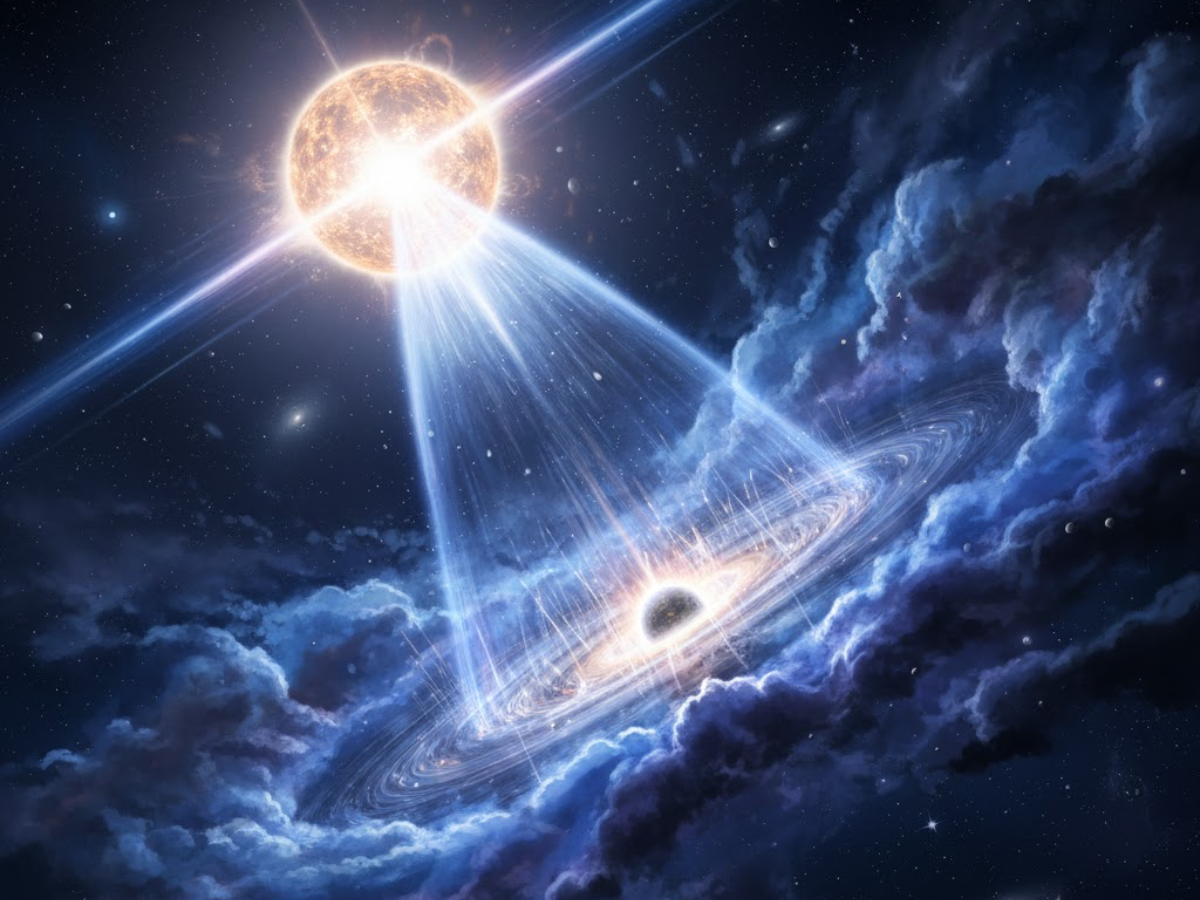
There was a mystery in the universe that was puzzling astronomers for many decades. This mystery involved a strange identification of a wave from the Hubble telescope in the 1990s. The telescope discovered that clouds of matter that are present in our solar system indicated ionization, which meant that atoms in that area were missing their electrons. Although this discovery was puzzling, no explanation was known for this phenomenon.
However, a latest study has now solved this puzzle. A report published in The Astrophysical Journal indicates that our solar neighborhood received a wave of intense radiation from two massive stars that passed close to our solar neighborhood, ionizing clouds around us. This event, which occurred 4.4 million years ago, was intense enough to electrify clouds around our universe and it also helped our Earth become a livable planet.
What is the Mysterious Ionisation in Interstellar Clouds
There seemed to be puzzling features in Hubble’s earlier observations. Ionisation occurred due to ultraviolet rays that removed electrons from atoms, but Hubble found none in that area.
To resolve this question, researchers from the University of Colorado in Boulder were able to recreate how that area of space would appear millions of years ago. Since the Sun moves with a speed of 93,000 kph, it has traced a huge distance in space like a cosmic jigsaw puzzle.
Two Massive Stars That Swooped by the Sun
The probable visitors were discovered. These are Epsilon Canis Majoris, also known as Adhara, and Beta Canis Majoris, also known as Mirzam, which belong to Canis Major. These two stars seemed to come as close as 30 to 35 light-years of our Sun. They are currently very distant, some 400 light-years away from our planet.
ALSO READ: Baba Vanga & Ryo Tatsuki Predictions: Which 2025 Prophecies Actually Came True?
However, when they were on a flyby trip, their luminescence would be blindingly bright in our horizon, even as they emit intense radiation. These twos are hotter than our Sun with a temperature of 38,000 to 45,000 degrees Fahrenheit, as opposed to our Sun which only reaches a highest point of 10,000 degrees Fahrenheit.
How the Flyby Altered Earth’s Neighborhood
According to Michael Shull, the leader of this research, “If humans were around, these stars would have appeared four to six times brighter than Sirius.” These stars shone with a powerful radiation that ionized clouds of hydrogen and helium around them and this area has been completely changed.
Indeed, it is these clouds, now changed, which protect our solar system from harmful cosmic radiation. This star encounter seems to have indirectly allowed our Earth to remain habitable.
ALSO READ: 12/12 Portal 2025: How to Harness the Year’s Final Manifestation Gateway
Disclaimer: This article is based on current scientific research and interpretations; future studies may refine or update these findings.