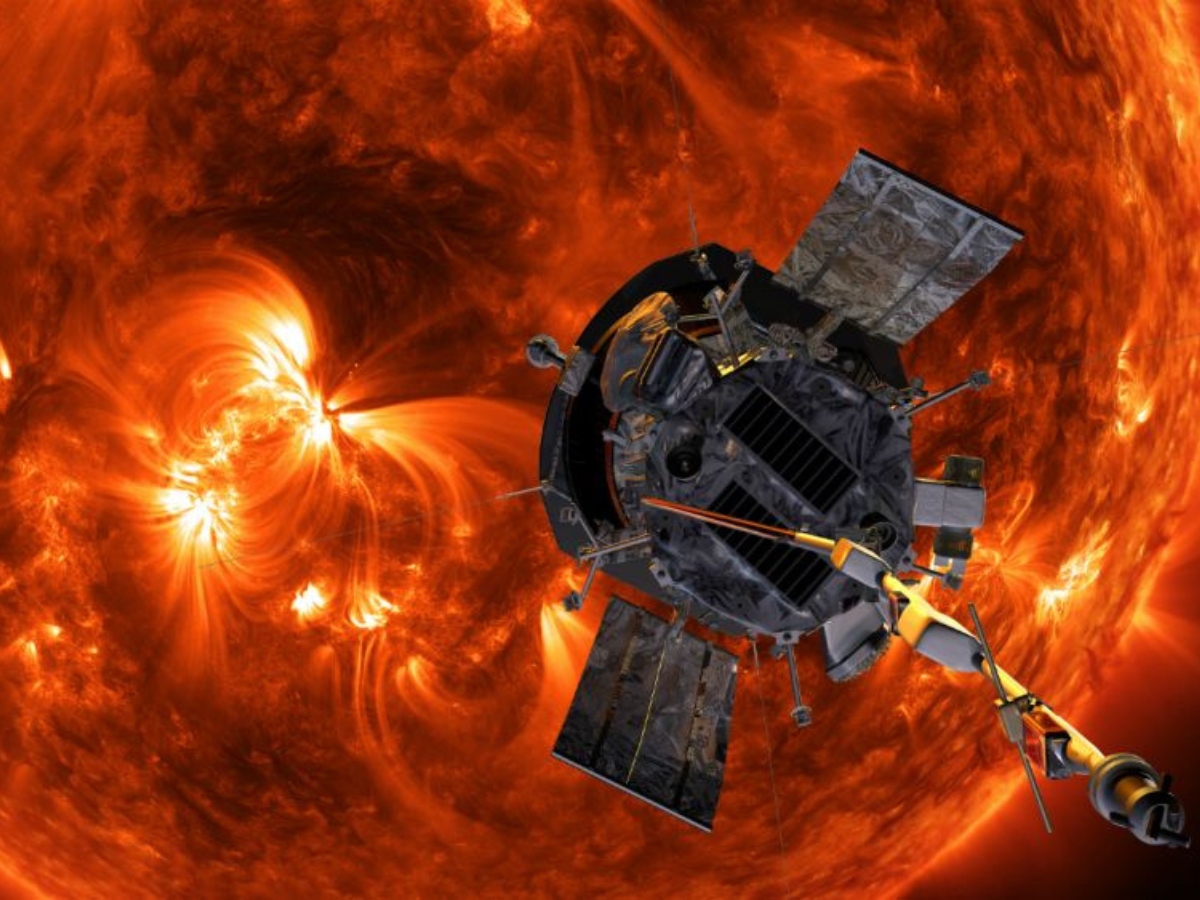
NASA’s Parker Solar Probe made a history in space travel on September 18 by completing its 25th close encounter with the Sun. After making this daring bypass the probe was able to re-establish contact with flight controllers at the Johns Hopkins Applied Physics Laboratory in Maryland.
Operating under no real-time contact during the maneuver, the probe demonstrated its autonomous capabilities in one of the most extreme environments known to science.
During this pass, the probe reached a record-breaking speed of 687,000 km/h with respect to the Sun, a speed first achieved in December 2024, March 2025 and June 2025 of the previous flybys. To give an idea, if that speed was maintained throughout the Earth’s surface, Parker would be able to complete the distance from Delhi to New York in a little over a minute and the trip currently takes nearly 17 hours by plane.
ALSO READ: Saturn & Neptune Light Up the Sky: Don’t Miss 2025’s Double Planet Opposition
What is the Mission Behind the Speed?
Parker Solar Probe was sent up in 2018 as a20part of NASA’s Living with a Star (LWS) program, which is managed by the Goddard Space Flight Center. The probe is anything but ordinary in its mission and parker is using Venus’s flybys to go closer to the Sun, to places no spacecraft has dared to go before.
With this plan the probe can gather data like never before about solar wind, magnetic fields and the atmosphere of the Sun or corona. The latest flyby comes while the Sun is in a heightened activity period of its regular 11-year cycle with starting on September 23, the probe will begin relaying new data from this encounter.
What are the Sun’s Mysteries?
At the core of Parker’s mission is to decode the nature of some of the most puzzling solar phenome among many, scientists are interested in understanding how solar wind is generated, why the corona is hotter than the surface of the Sun, how coronal mass ejections (CMEs) form and how these destroy space.
ALSO READ: What Is the Autumn Equinox 2025? The Day When Day and Night Share Equal Hours
In a recent statement, NASA made an emphasis that among all the solar phenomena detected by the spacecraft, the findings are of utmost importance in protecting astronauts, satellites, airplanes and even Earth’s power structures against the disruptive effects of solar storms and space weather events.
A Step Closer to the Sun
With every successful orbit Parker gets down closer to the Sun, rewriting the notion of what solar research can ever hope to achieve. As data from this latest encounter starts to flow the scientists around the world await new revelations about our closest star and the force that drives much of the activity in our solar system.
ALSO READ: What is Comet AI Browser? How to Download and Everything You Need to Know
Disclaimer: This article is intended for educational and informational purposes only. It is not affiliated with or endorsed by NASA or any official space agency.