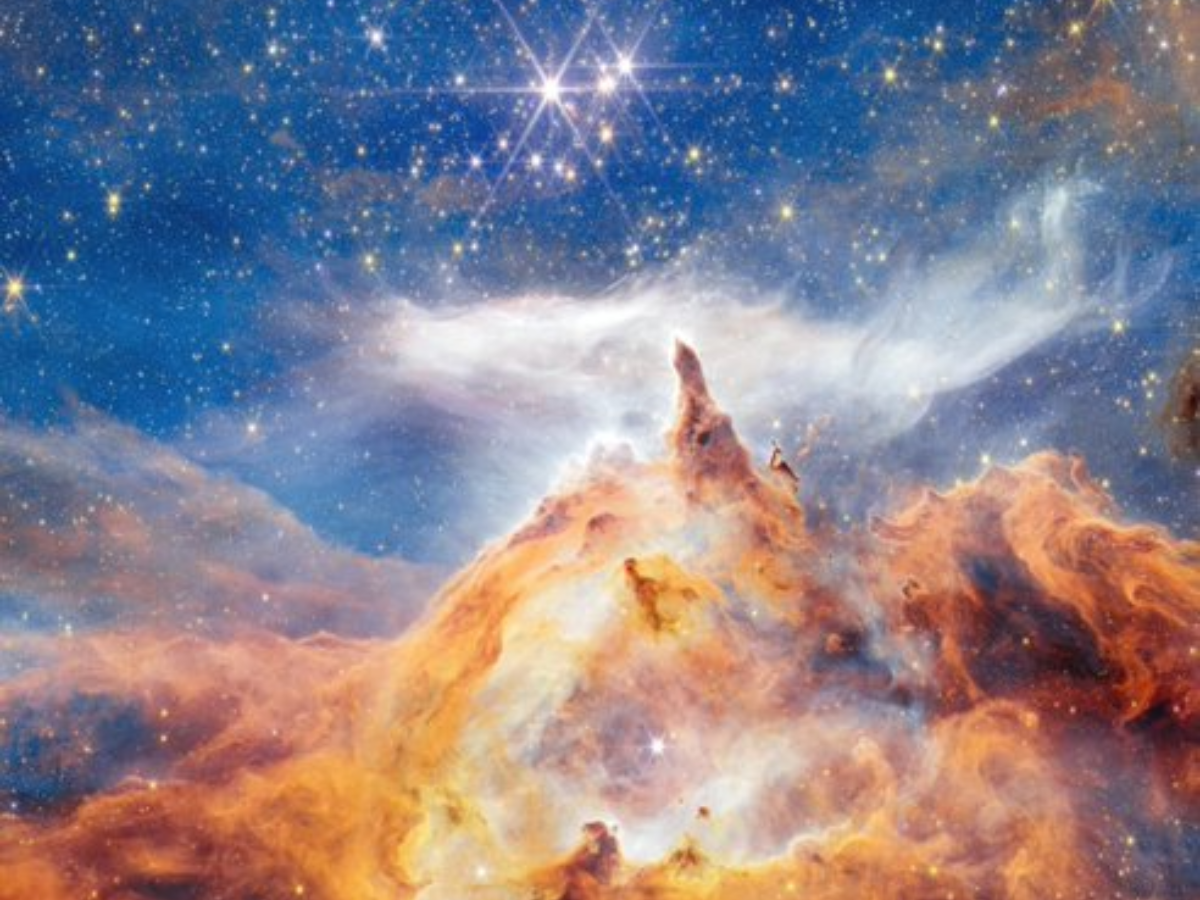
NASA’s James Webb Space Telescope (JWST) has produced stunning images of the young star cluster Pismis 24 and located some 5,500 light years away in the constellation Scorpius. Located very near the center of the Lobster Nebula which is one of the closest regions of massive star formation to Earth, Pismis 24 is an extraordinary window into the early phases of stellar life.
The landscape of stars captured by JWST resembles some steep, rugged mountain range cloaked in wispy and feather like clouds. But those mountains are really clouds of gas and dust sculpted by the intense radiation and winds from the newborn stars.
What are the Giant Stars of Pismis 24-1
At the center of this stellar nursery is Pismis 24-1 a star long believed to be a single giant and the most massive star ever observed. JWST’s detailed study in infrared images has revealed that it is a binary system comprising two massive stars weighing 74 and 66 times the mass of our Sun.
ALSO READ: Chandra Grahan 2025: Rituals, Timings & Precautions for the Final Eclipse of the Year
These stellar giants shine freely and overpowering the surrounding area with light intensity and stellar winds. Thousands of other stars, of various sizes and colors from dazzling blue, white giants to fainter red stars are captured by the NIRCam of the JWST and emphasizing the variety and complexity of this region.
Pismis 24: Sculpting Power of Stellar Winds
Newborn stars in Pismis 24 unleash fierce winds and radiation with some winds nearly eight times hotter than the Sun. The energy and momentum of these winds are sculpting the surrounding nebula into high pillars and sharp spires with the tallest of these structures at 5 light years wide house hundreds of solar systems and arrayed at the heart of the nebula.
The hues depicted in JWST images indicate the different constituents of this cosmic landscape hot ionized hydrogen glows cyan; dust molecules glow orange and cooler molecular hydrogen illuminate red while the densest gas cloud absorbs all light and appears black. The very formations by compressing gas are creating conditions to birth new stars deep within the nebula.
ALSO READ: Shocking Discovery Reveals Early Humans Endured Britain’s Harshest Ice Age 700,000 Year Old
Pismis 24: A Laboratory for Understanding Stellar Evolution
Pismis 24 is a natural laboratory for astronomers who wish to understand how massive stars form and impact their environment. Strong radiation and winds from these stars sculpt the surrounding region and triggering new waves of star formation while redrawing the structure of the nebula.
With JWST’s unrivaled imaging and data, scientists are able to peer deeper into these cosmic phenomena and gain more insight into how star clusters form and evolve. This will get correlated to stellar astrophysics but it will equally lay down a path to understanding galactic evolution and transformation among other things.
With the continued revolutionary observations of JWST, the cosmos has been laying bare its mysteries before man and offering a thrilling insight into the cradle of the universe’s most powerful stars.
ALSO READ: September 2025 Eclipse: What to Know About the Rare Lunar and Solar Eclipses Coming
Disclaimer: Astronomical data is based on NASA and JWST findings; interpretations may evolve as new peer reviewed research becomes available.