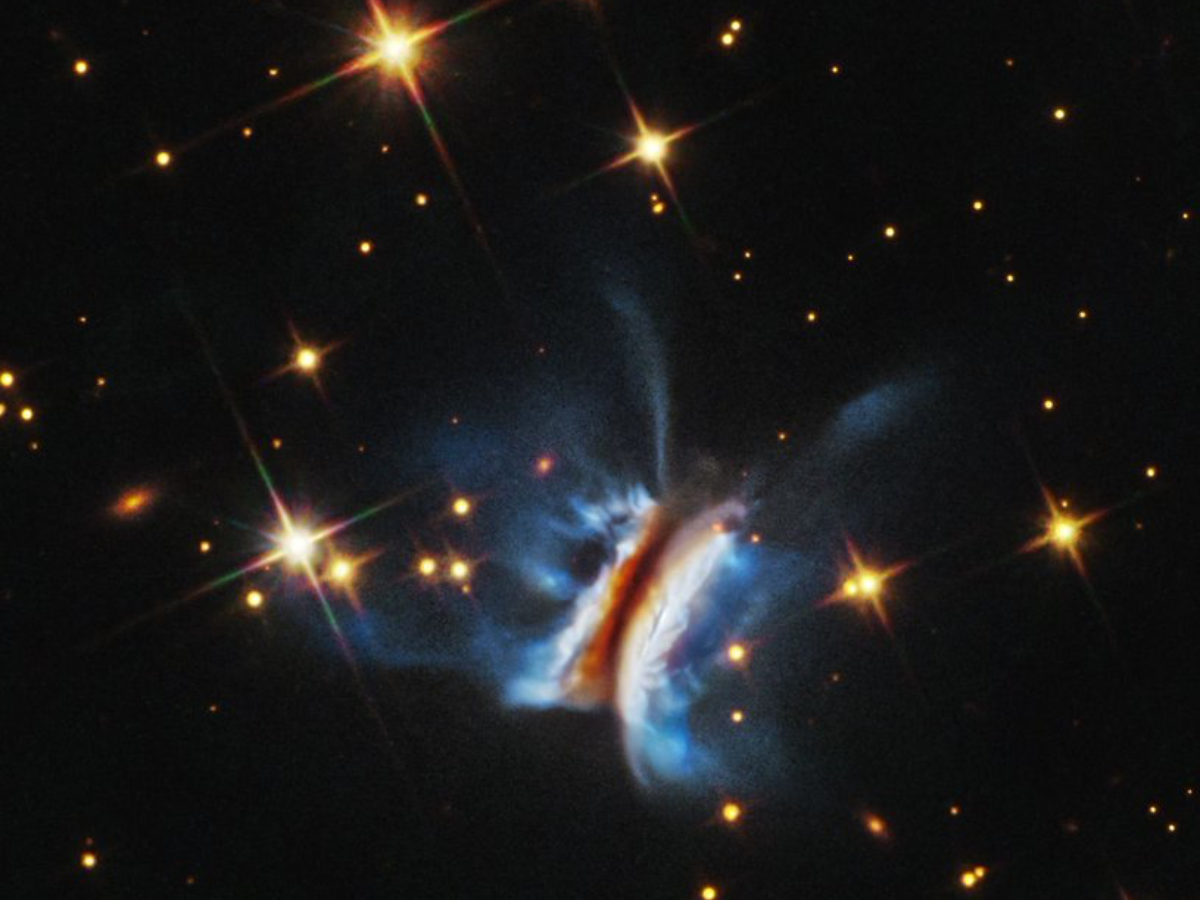
In a region of the universe far removed from our cosmic neighbourhood, a chaotic system lurks which is changing our understanding of planetary formation. A newly discovered giant planet forming disk has been detected in our universe using the NASA Hubble Space Telescope.
It has found the largest known planet forming disk ever observed the discovery going against what was long believed about the formation of a solar system and lies 1,000 light-years away from our planet Earth.
Hubble imaged the largest planet-forming disk ever observed!
Spanning 400 billion miles, this disk is called “Dracula’s Chivito” as a nod to the heritage of its researchers from Transylvania & Uruguay, where the national dish is a chivito (sandwich): https://t.co/3WixLNGnSB pic.twitter.com/Uz67l0vABl
— Hubble (@NASAHubble) December 23, 2025
A Disk of Unprecedented Scale
The recently discovered structure has been given the permanent designation IRAS 23077+6707 and the nickname Dracula’s Chivito. It measures 600 billion kilometers across. This is roughly 40 times the size of our own solar system.
A young star or perhaps two very tightly coupled ones shines brightly in the very center. This energy source is exciting the surrounding material to the point of frenzy simply because of its scale, which alone qualifies it as an oddity among known protoplanetary disks.
Chaos in the Center of Creation
What took the astronomical community by surprise was not so much the extent of the disk, as the turmoil that it exhibits. The disk does not lie neatly within a single plane, boasting instead a jumbled mass of filaments that soar high above and sink deep beneath what would be the standard surface level, hiding from sight the actual star that it orbits around.
ALSO READ: New-Gen Renault Duster Teased With Nostalgic Twist, Launching January 26 | Design, Specs & Price
What is the Lopsided Mystery
Equally puzzling is the nature of the disk’s asymmetry one edge of the disk contains the strong vertical features of matter, while the other edge exhibits a clean cut with very little features. This kind of asymmetry is a clue that there are external influences acting on the disk, perhaps the stellar wind or gravitational fields of nearby stars that are changing the shape of the disk as it evolves.
A Window Into Our Own Past
Researchers at NASA have reasons to believe that this enormous disk could also resemble our young solar system billions of years ago when our cosmic abode consisted of a chaotic collision of bodies and clouds of debris in space.
ALSO READ: Christmas 2025 Celebrations Around the World: From the Vatican to India | Photos
However, all of this eventually cooled down into order, which may also happen in IRAS 23077+6707 when planets come into existence out of its dense debris.
Importance of This Discover
For the world of astronomers, Dracula’s Chivito is no ordinary object. It is a natural laboratory where scientists can examine planet formation in extreme environments. Such observation can help scientists not only learn about other planets, but also gain insight into the origins of those in their own cosmic neighbourhood.
ALSO READ: Alien Life Could Be Discovered by 2075, Says British Scientist Citing Exoplanet K2-18b
Disclaimer: This article is based on publicly available scientific findings and statements from NASA and researchers involved in the study.