

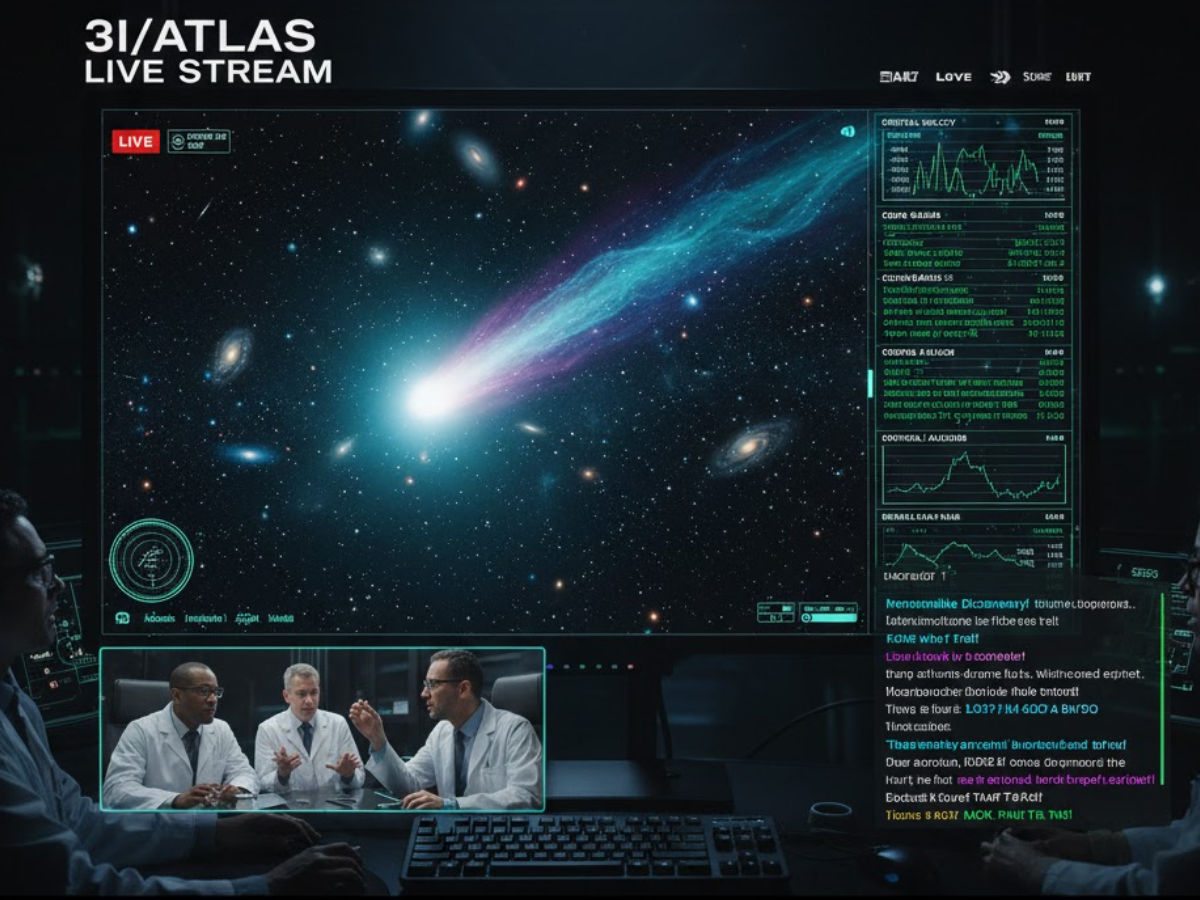
A rare visitor from beyond our solar system is offering astronomers a fleeting opportunity to study the unknown. As 3I/ATLAS known, this interstellar comet is only the third object of its kind ever detected passing through our cosmic neighbourhood.
As it approaches its closest point to Earth on December 19, scientists and skywatchers alike are turning their attention to this fast-moving traveller that will soon vanish into deep space, never to return.
What Makes 3I/ATLAS Comet Special
3I/ATLAS stands out because it did not originate within our solar system. Instead, it is believed to have formed around another star before being flung into interstellar space. Its detection adds valuable clues to how planetary systems evolve beyond our own.
While the comet will remain at a safe distance of about 270 million kilometres from Earth, its proximity is close enough for detailed scientific observation.
Closest Approach Without the Risk
Although December 19 marks the comet’s nearest pass by Earth, it poses no threat. The distance is almost double that between Earth and the Sun. Still, the moment is significant, as this alignment offers researchers a short window to examine its structure, speed, and chemical makeup before it exits the solar system permanently.
ALSO READ: Are the planes there? Scientists Uncover Mysterious Rock Layer under the Bermuda Triangle
How to Watch the Interstellar Visitor
Spotting 3I/ATLAS directly requires a powerful telescope of at least eight inches, and even then it appears as a faint, hazy glow. For most viewers, the best option is online.
The Virtual Telescope Project is hosting a free live stream featuring real-time views from observatories in Italy, allowing the public to witness the comet’s journey without specialised equipment.
What Happens After December
Once it passes Earth, 3I/ATLAS will begin its outward path, eventually leaving the Sun’s influence. It will remain visible for a limited time and is expected to pass near Jupiter in 2026, potentially allowing further study by space missions.
Data already collected by European probes will continue to be analysed, offering insights well after the comet has disappeared from view.
ALSO READ: Bezos’s Blue Origin to Launch First Wheelchair User to Space: When & How to Watch LIVE
Disclaimer: This article is for informational purposes only and is based on publicly available scientific observations and expert reports at the time of writing.





