Delhi’s air quality crisis escalated sharply on Saturday, forcing environmental authorities to impose the highest level of pollution control measures. With the Air Quality Index (AQI) breaching the 400-mark to reach 431—firmly in the ‘severe’ category, the Commission for Air Quality Management (CAQM) took the drastic step of invoking Stage IV of the Graded Response Action Plan (GRAP). This move, coming just hours after Stage III restrictions were announced, places the entire National Capital Region under a stringent set of emergency rules.
Why Was GRAP Stage IV Activated?
The trigger was clear and alarming. Data from the Central Pollution Control Board (CPCB) recorded the capital’s AQI at 431 at 4 PM on Saturday. When AQI goes beyond 400, it enters the ‘severe’ category and poses a health risk to the public. This sharp rise led the CAQM’s Sub-Committee to implement all measures under GRAP Stage IV, the strictest level, along with existing Stage III restrictions. The aim is to immediately reduce emissions and public exposure to toxic air.
#WATCH | Delhi | Visuals around Anand Vihar this evening as a layer of toxic smog blankets the city.
AQI (Air Quality Index) around the area is 488, categorised as ‘Severe’, as claimed by CPCB (Central Pollution Control Board).
CAQM (Commission for Air Quality Management) has… pic.twitter.com/664edkS8Eh
— ANI (@ANI) December 13, 2025
What Are the Immediate Rules for Schools?
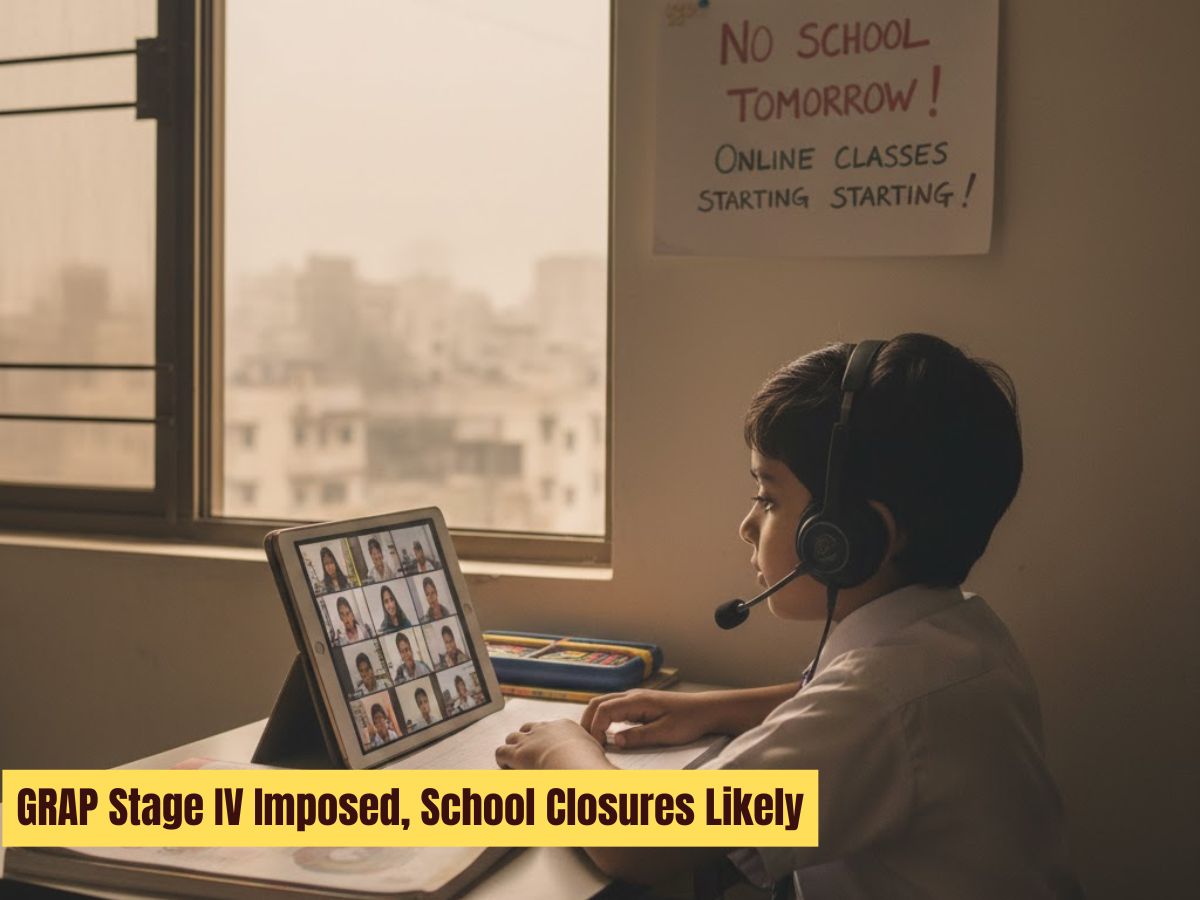
This is the most pressing question for millions of parents and students. The CAQM orders create a two-tier system for educational institutions. Under the already-active GRAP Stage III, hybrid classes are mandatory for students up to Class V. This means a mix of physical and online learning where possible. However, the new GRAP Stage IV rules empower state governments to go further. They may now decide to discontinue physical classes for students from Class VI to IX and Class XI, shifting them entirely to online mode. A final decision from the Delhi government and NCR states is awaited.
What About Colleges, Offices, and Other Activities?
Under Stage IV, restrictions become much broader. The order asks governments to consider closing colleges and other educational institutions. It also directs authorities to assess shutting non-essential commercial activities and limiting office operations, possibly shifting many employees to work-from-home. These steps underline how serious the pollution situation is, affecting education as well as the region’s economy.
What Happens Next and What Should You Do?
Although the CAQM framework provides the legal backing for these strict steps, the final decision rests with the state governments of Delhi, Gurugram, Faridabad, Ghaziabad, and Gautam Buddh Nagar. An official announcement on school closures and other measures is expected shortly. Residents are advised to monitor official government announcements and notifications from their schools and employers for precise instructions for the coming days.
Key Immediate FAQs:
Q: Are all Delhi-NCR schools closed on Monday?
A: Not automatically. For Classes VI-IX and XI, the CAQM has allowed states to close physical classes and shift online. An official government order is needed for confirmation. For primary classes (up to V), hybrid mode is already mandatory.
Q: What is the current AQI that caused this?
A: The AQI was recorded at 431 in the ‘severe’ category at 4 PM on Saturday, December 13th.
Q: Who decides if schools and colleges finally close?
A: The final decision rests with the respective state governments (like the Delhi government) and the GNCTD, based on the CAQM’s mandate.
Q: What other restrictions are possible?
A: Under GRAP IV, states may also order the closure of colleges, non-essential commercial activities, and impose work-from-home rules for offices.