Chandigarh: The gates to Punjab’s 2027 Assembly election have effectively opened. More than five years after the Aam Aadmi Party swept the state in 2022, Punjab is heading towards an election in which the political landscape looks far more fragmented, competitive and unpredictable.
In 2022, the contest produced a decisive result. The AAP won 92 of Punjab’s 117 Assembly seats with around 43 per cent of the vote, while the Congress was reduced to 18 seats. The Shiromani Akali Dal won three seats and the BJP two. The BSP and an Independent won one seat each.
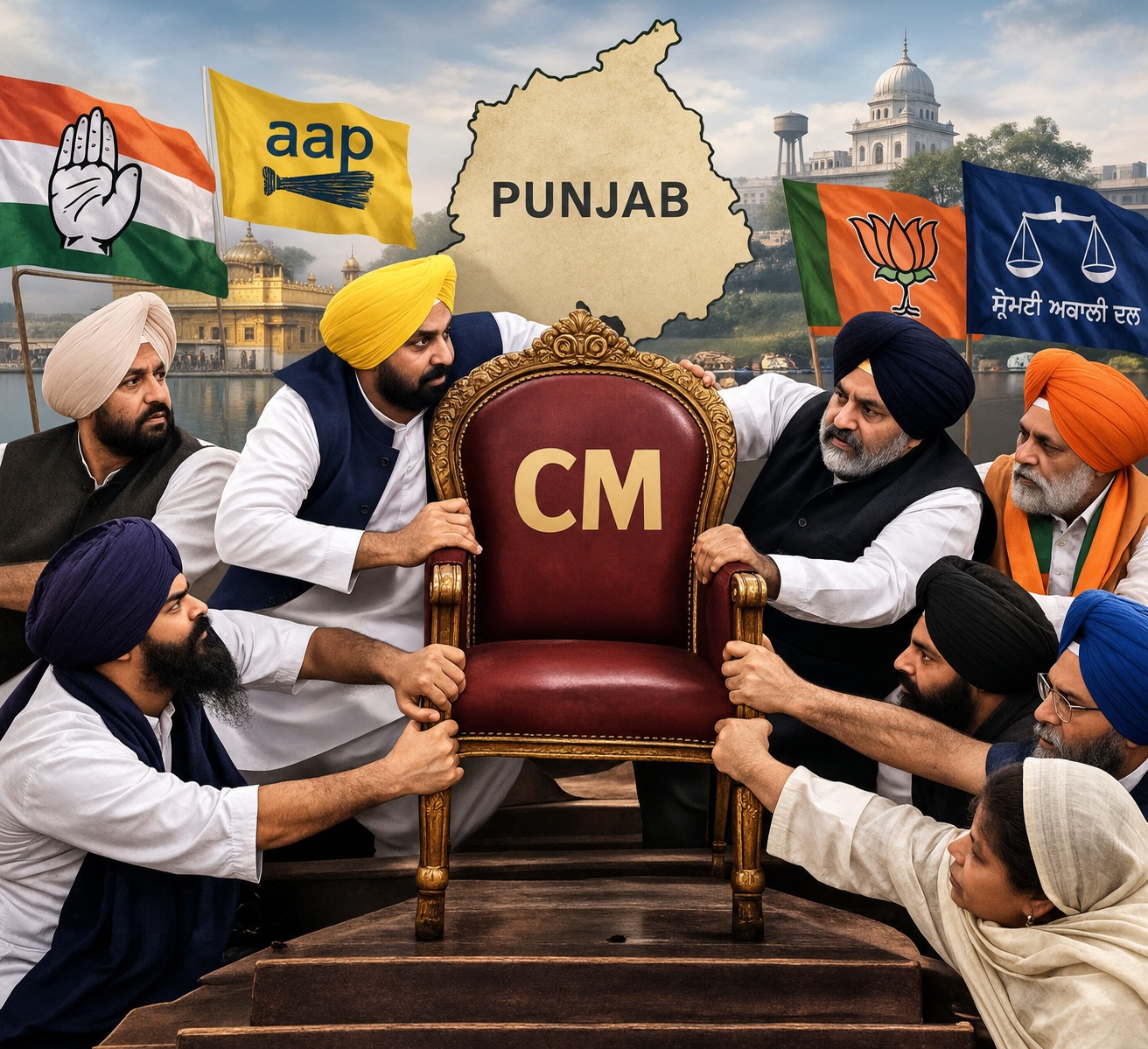
The 2027 contest is shaping up very differently. At present, the political field includes the AAP, Congress, BJP, SAD, Akali Dal Waris Punjab De, SAD Punar Surjit, SAD Amritsar, BSP and a growing space for Independents and smaller regional forces. Whether all these formations eventually contest independently, enter alliances or adjust their strategies before nominations remains open.
Six broad dimensions are now defining Punjab’s political battle.
1. From change in 2022 to accountability in 2027
The biggest change is that the AAP will enter the election as the incumbent rather than the challenger.
In 2022, the party campaigned on change, governance and an alternative to the established political order. Bhagwant Mann became Chief Minister after the party secured 92 seats.
Five years later, the central question is no longer what the AAP promises to do but how voters assess its record in government.
The party is already taking its governance record to the people. AAP has announced a statewide door to door campaign involving its booth level organisation, with the party saying its workers will highlight its work among women, youth, farmers, traders and other sections.
The party also received a boost in the 2026 local body elections, winning 954 wards according to State Election Commission figures, compared with 393 for Congress, 192 for SAD and 172 for BJP.
But the AAP faces questions over drugs, unemployment, migration, law and order, the financial condition of the state and several issues that have dominated Punjab’s political debate.
The 2027 election will therefore be a test of whether the 2022 change narrative can be converted into an incumbency narrative.
2. Congress has an opportunity, but its internal battle continues
Congress remains the principal Opposition force in the Assembly, but its biggest challenge has been internal cohesion.
The party has leaders with established networks across Punjab, including former Chief Minister Charanjit Singh Channi, Punjab Congress president Amarinder Singh Raja Warring, Leader of Opposition Partap Singh Bajwa and several other senior figures.
However, competing camps have repeatedly surfaced in the state unit. The party has attempted to balance these groups by retaining Warring as state president and Bajwa as Leader of Opposition while giving Channi a key role in the election campaign structure.
For Congress, the 2027 election is also about rebuilding the organisational machinery that was severely damaged by the 2022 defeat.
Its vote share increased to 26.39 per cent in the 2024 Lok Sabha election, when it won seven of Punjab’s 13 parliamentary seats. The AAP’s vote share in the same election fell to 26.16 per cent.
Those numbers do not determine the Assembly election, but they show that the electoral map has changed considerably since 2022.
3. BJP is opening a new chapter
The BJP is perhaps the party that has changed its Punjab strategy most visibly.
After decades of contesting Assembly elections largely as the junior partner of the SAD, the BJP is preparing for a larger independent role. Its appointment of former Congress MLA Kewal Singh Dhillon as Punjab president was also significant because it brought a prominent Jat Sikh face to the head of the state unit.
The party has already held major rallies and political conferences. Its March rally at Moga was projected as a major launch of its 2027 campaign.
The BJP is also attempting to expand beyond its traditional urban support base by reaching out to Dalits, Jat Sikhs, OBC communities, farmers, youth and religious groups.
Its latest campaign is the Nasha Mukt Punjab Yatra. Four simultaneous yatras have been launched from Pathankot, Fatehgarh Sahib, Fazilka and Talwandi Sabo. Together they are planned to cover nearly 4,000 km and all 117 Assembly constituencies before culminating in Jalandhar on September 30.
Drugs, crime, corruption, unemployment and internal security are expected to remain central themes of the BJP campaign.
The unresolved question is whether the party can convert its expanding political visibility into a broader constituency level organisation.
4. The Akali space is no longer one space
For decades, Punjab politics had a clear Akali pole. That is no longer the case.
The Sukhbir Singh Badal led SAD is trying to rebuild itself after its poor performance in the 2022 election. The party has begun constituency level mobilisation and has been holding rallies across Punjab.
In September, SAD also formed a nine member manifesto committee headed by Balwinder Singh Bhunder, with Bikram Singh Majithia among its members. The committee is expected to travel across Punjab and seek views from farmers, workers, traders, industrialists, youth, women and employees.
But the party is facing competition from within the broader Akali and Panthic space.
Akali Dal Waris Punjab De, associated with jailed Khadoor Sahib MP Amritpal Singh, has already begun preparing for the Assembly election. It has announced candidates despite its registration and election symbol still being pending with the Election Commission.
SAD Punar Surjit, formed after an internal split in the Akali camp, has also sought recognition and has staked a claim to the SAD name and election symbol.
SAD Amritsar led by Simranjit Singh Mann remains another player in the Panthic space.
This fragmentation could become one of the defining features of the election.
5. The Panthic vote and rural Punjab
Punjab’s electoral geography gives the Panthic question considerable importance.
Malwa has 69 Assembly seats, Majha 25 and Doaba 23. The AAP’s 2022 victory was particularly strong in Malwa, where it won 66 seats.
The rural vote will again be crucial. Nearly 63 per cent of Punjab’s electorate lives in rural areas, according to recent electoral analysis.
Drugs, agriculture, unemployment, migration, sacrilege cases, river waters and Sikh religious issues are among the subjects likely to influence rural political conversations.
The emergence of Waris Punjab De has added another dimension. Amritpal Singh and Faridkot MP Sarabjeet Singh Khalsa entered electoral politics through the 2024 Lok Sabha election as Independents and subsequently became associated with the new political formation.
The group has already started building an organisational network and has announced candidates.
At the same time, SAD is directly challenging the new formation for space among Panthic voters.
6. The alliance question could redraw the map
The final dimension is alliances.
The BJP has publicly prepared for an independent political course, while there has also been speculation about a possible renewed understanding with the SAD. No final alliance arrangement can be treated as settled until the parties formally announce it.
This is important because Punjab’s electoral arithmetic changes significantly depending on whether major parties fight separately or consolidate votes.
The same applies to the smaller Panthic formations and the BSP. The BSP has announced a statewide Punjab Sambhalo campaign and plans rallies across all 117 Assembly constituencies. Its political significance is linked to Punjab’s large Scheduled Caste population, which accounts for more than 30 per cent of the state’s population.
The BJP is also actively reaching out to Dalit communities, particularly in the Doaba region.
The road from 2022 to 2027
The contrast between the two elections is striking.
In 2022, Punjab voters produced a clear mandate for one party. In 2027, the same state could enter the polls with several competing political centres.
The AAP is defending its record after five years in office. Congress is trying to convert Opposition space into an electoral revival. BJP is attempting to establish itself as a broader statewide force. SAD is fighting to rebuild its traditional base. Waris Punjab De is seeking space in the Panthic arena. SAD Punar Surjit and SAD Amritsar add further fragmentation, while BSP is trying to regain its Dalit base.
The result is a contest in which nine political players or camps can influence the electoral narrative, even though the final list of candidates and alliances will emerge only closer to the election.
Punjab has already witnessed a preview of this fragmented contest.
At Baba Bakala during the Rakhar Punia festival in August, AAP, Congress, BJP, SAD and Waris Punjab De held separate political programmes. The BJP’s decision to establish its own political stage there for the first time underlined the changing nature of the state’s electoral competition.
The rallies will continue. The parties will announce candidates, promises and manifestos. Alliances may change. New political combinations may emerge.
But the basic contest is already visible.
Punjab’s 2022 election was about a political wave. The 2027 election is shaping up as a contest between multiple political currents, with governance, anti incumbency, Panthic politics, caste, rural distress, drugs, organisational strength and alliances likely to determine how the final battle unfolds.
For now, Punjab has entered the open gate of the 2027 election, but the final shape of the battlefield is still being drawn.