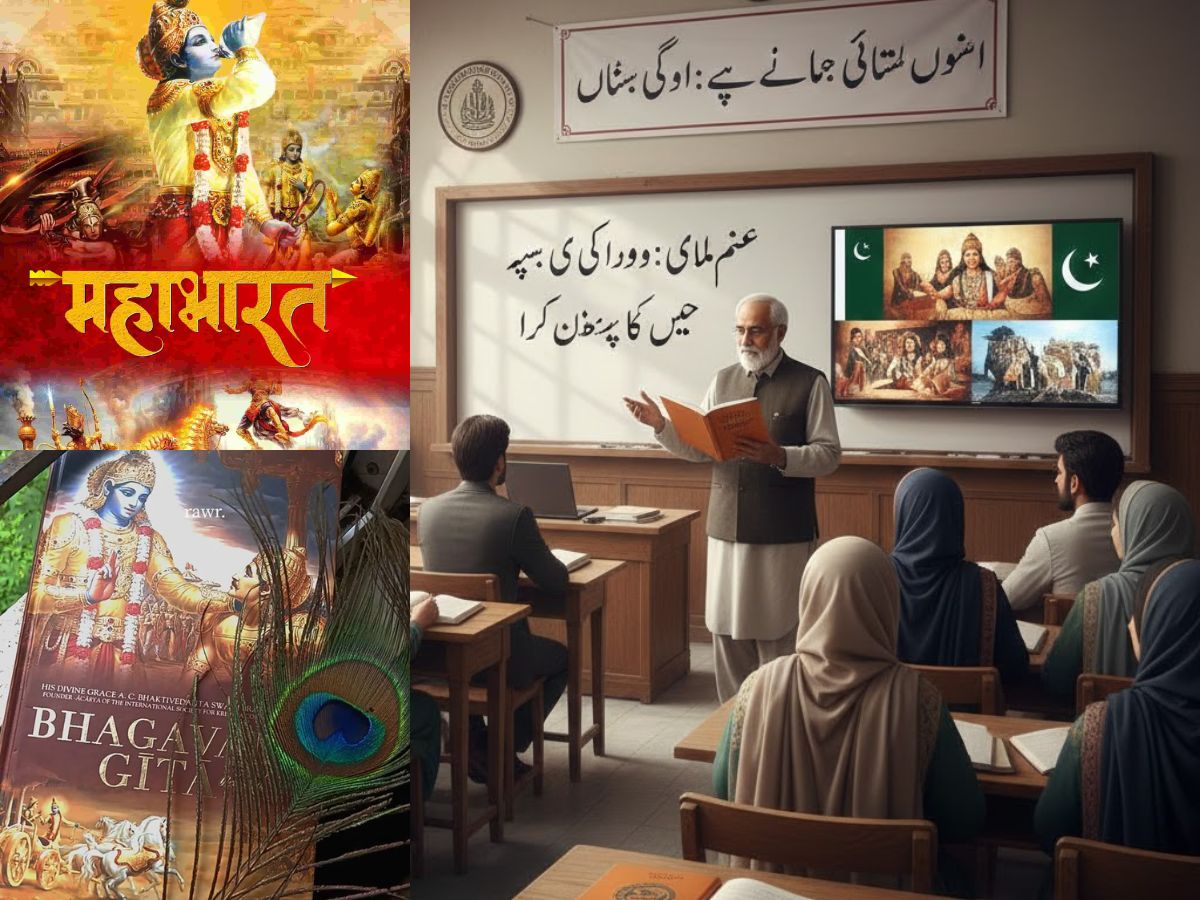
As part of a notable cultural initiative, a leading Pakistani university has begun offering Sanskrit classes and intends to introduce the Bhagavad Gita and Mahabharata in its curriculum. The move is the first formal engagement with these texts since the 1947 partition.
The four-credit course has been introduced at the Lahore University of Management Sciences (LUMS). As part of the curriculum, students are even being exposed to cultural touchstones like the iconic Urdu theme song from the Mahabharat television series. The driving force behind this effort is Dr. Ali Usman Qasmi, who stated, “In 10-15 years, we could see Pakistan-based scholars of the Gita and the Mahabharata.”
Why is a Pakistani university teaching Sanskrit now?
The initiative aims to reclaim a neglected part of the region’s shared heritage. Scholars point out that Pakistan houses one of the richest archives of Sanskrit palm-leaf manuscripts at the Punjab University library, catalogued in the 1930s. However, no local Pakistani academic has engaged with this collection in over seven decades, with only foreign researchers utilizing it. This course is a step toward training local scholars to study and preserve this archival treasure.
Who is leading this educational effort?
The push is led by academics like Dr. Ali Usman Qasmi, Director of the Gurmani Centre at LUMS, and Dr. Shahid Rasheed, an Associate Professor of Sociology. Dr. Rasheed, who learned Sanskrit himself, passionately argues for its relevance. “Sanskrit is like a mountain – a cultural monument. We need to own it. It is ours too; it’s not tied to any one particular religion,” he explains, emphasizing the language’s deep roots in the region that is now Pakistan.
Also Read: Over 680 Giant Sinkholes Threaten Turkey’s Breadbasket, Scientists Warn
What is the goal of this Sanskrit course?
The primary goal is to build local academic capacity. Scholars call for bringing Pakistan’s neglected Sanskrit archives back into focus and presenting the language as a shared cultural heritage, not tied to a single religion
How are students and scholars reacting to this?
Although classroom feedback isn’t fully documented, the academics behind the course see it as historically and intellectually important. They argue Sanskrit should be recognized as a classical language with wide cultural and historical value, beyond being foreign or strictly religious, relevant to the whole subcontinent including Pakistan.
What does this mean for cultural exchange in South Asia?
The move is being seen as a notable, albeit academic, step in reconnecting with a pre-partition cultural lineage. It acknowledges that the subcontinent shares a history that goes beyond modern borders and religions. Teaching Sanskrit and its foundational texts creates opportunities for academic discussion and deeper appreciation of the intertwined past.
FAQs
Q: Which university in Pakistan is teaching Sanskrit?
A: The Lahore University of Management Sciences (LUMS) has launched a four-credit course in Sanskrit.
Q: Will they teach the Bhagavad Gita and Mahabharata?
A: Yes, the university plans to introduce the study of these texts following the Sanskrit language course, aiming to create local scholars in the field.
Q: Why are they doing this after 77 years?
A: Scholars argue for reviving Pakistan’s overlooked Sanskrit archives and positioning the language as a shared cultural treasure, not exclusive to one religious tradition.
Q: Who is behind this initiative?
A: The effort is led by Dr. Ali Usman Qasmi of LUMS and Dr. Shahid Rasheed of Forman Christian College, who advocate for Sanskrit as a classical language of the subcontinent.