Streets across Manipur’s valley districts saw large protests on Monday as the Campaign for Just and Fair Delimitation (JFD) intensified its agitation against the start of Census 2027 operations without prior updating of the National Register of Citizens (NRC).
The protests were held under the slogans “NRC Updation Before Census,” “No NRC, No Census,” and “No IDP Settlement, No Census.” Protesters staged sit-ins and student rallies and disrupted training sessions. The agitation culminated in a two-day statewide general strike that began at midnight.
The demonstrations marked the sharpest phase yet of a campaign that has gathered force over months. Student wing activists of the JFD attempted to halt Census training at institutions including DM Teacher Training College and Hindi Teachers Training College. Security forces moved in to disperse the crowds. Reports spoke of clashes, with police using tear gas at the Directorate of Census Operations in Porompat a day earlier. One or more protesters sustained minor injuries, according to conflicting accounts from police and organisers.
At Khwairamband Ima Market, traders shuttered shops and joined a sit-in. A student procession that began at Tiddim Ground turned back at Keishampat Junction. The marchers also demanded action against a police officer accused of excessive force during an earlier confrontation.
JFD organising secretary Longjam Ratan, speaking at the Ima Market sit-in, described the agitation as the latest chapter in a decades-old struggle. He recalled a 16-point agreement signed with the Manipur government in 1980 on illegal immigration issues and reaffirmed in 1994. He said successive administrations had failed to provide effective safeguards for the state’s indigenous population.
The JFD was formed in 2025 amid heightened anxiety over demographic change. It has demanded that any NRC exercise use 1951 as the base year — the year after the old permit system regulating entry into Manipur was abolished following the state’s merger with India. The group has submitted memoranda to state and central leaders without receiving a substantive response, Ratan said. He warned that the agitation would intensify if the government remained unresponsive.
At a press conference in Imphal, JFD convenor Jeetendra Ningombam announced the two-day strike and described the decision to proceed with self-enumeration as “unfortunate.” He insisted that the demand was legitimate and aimed at protecting future generations of indigenous people.
“The problem of illegal immigrants in the state is very serious,” he said.
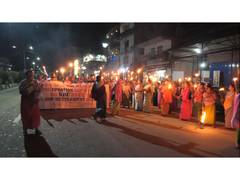
Civil society organisations representing Naga and Meitei Pangal communities attended the press conference and extended support, broadening the protest beyond its core Meitei base. Torch rallies were also held the previous night along major roads. Demonstrators marched toward Deputy Commissioners’ offices and reiterated that no Census should take place until the NRC is updated and internally displaced persons are resettled.
The timing of the agitation is deliberate. Self-enumeration for Census 2027 was scheduled to begin on August 17, while the main house-listing phase is set for September 1–30.
Protesters argue that enumerating residents without first identifying citizens risks legitimising the presence of illegal immigrants. They primarily allege the entry of immigrants from Myanmar across the porous Indo-Myanmar border, and historically from Bangladesh. They also argue that such an influx could affect future delimitation, resource allocation and political representation.
The protesters point to abnormal population growth rates in certain hill districts over successive decades as evidence of unchecked influx. The Manipur Assembly passed resolutions in 2022 and 2024 urging the Centre to implement an NRC, but the demand has remained unmet.
The latest confrontation comes against the backdrop of the unresolved ethnic violence that erupted in May 2023 between Meitei and Kuki-Zo communities. The violence left hundreds dead and tens of thousands displaced, while large parts of the state remain scarred by mutual suspicion and restricted movement.
For many in the valley, conducting the Census without an NRC is seen as adding to an existential demographic threat. Critics of the demand, including some Kuki-Zo voices in earlier debates, have warned that an NRC with a 1951 cut-off could itself become a tool of exclusion or target legitimate communities whose records are incomplete.
The government has so far pressed ahead with preparations, freezing administrative boundaries and treating the national exercise as non-negotiable.
JFD leaders have stressed that their strike is not intended to cause needless hardship but is the result of prolonged official inaction. They have signalled that they are ready to escalate further if the two-day shutdown does not lead to dialogue.