Bengaluru
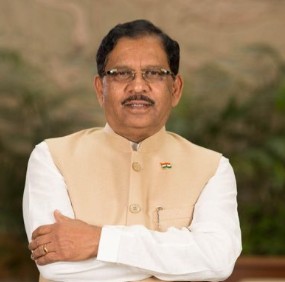
Deputy Chief Minister and Revenue Minister Dr. G. Parameshwara has written to Prime Minister Narendra Modi, Union Home Minister Amit Shah and Union Agriculture and Farmers Welfare Minister Shivraj Singh Chouhan, seeking their urgent intervention for the early consideration and release of the Central drought assistance to Karnataka, which is facing one of the gravest agricultural crises in its recent history.
In separate letters dated 2 November 2026, Dr. Parameshwara has communicated Karnataka’s revised cumulative drought-relief requirement of ₹22,400.58 crore and sought appointments with all three Union leaders to personally present the State’s memorandum, explain the magnitude of the crisis and seek expedited financial assistance.
Highlighting the severity of the drought, he stated that 226 taluks across Karnataka have been affected, with crops spread over 57.93 lakh hectares suffering extensive damage and estimated economic losses reaching ₹62,481.88 crore. The crisis has placed immense financial distress upon lakhs of farming families, particularly small and marginal farmers whose livelihoods have been severely affected.
Revised Central Norms Remain Inadequate
Dr. Parameshwara noted that the Union Ministry of Home Affairs, through its notification dated 26 October 2026, revised the assistance norms under the State Disaster Response Fund (SDRF) and National Disaster Response Fund (NDRF) for the period 2026–27 to 2030–31.
Accordingly, Karnataka’s requirement towards crop-loss input subsidy has increased from ₹6,128.70 crore to ₹7,943.55 crore, an enhancement of ₹1,814.85 crore. This has raised the State’s total cumulative requirement from ₹20,585.73 crore to ₹22,400.58 crore, with all other components of the previously submitted memorandum remaining unchanged.
While appreciating the Union Government’s decision to revise the norms, Dr. Parameshwara expressed serious concern that the enhancement remains modest when compared with rising cultivation costs, the increasing severity of climatic disasters and the financial vulnerabilities confronting farmers.
He pointed out that the revised assistance rates of ₹11,000 per hectare for rainfed crops, ₹22,000 for irrigated crops and ₹30,000 for perennial crops remain inadequate when measured against farmers’ actual investments in seeds, fertilisers, agricultural labour, irrigation and other essential inputs.
“Our farmers cannot be expected to confront the economic realities of 2026 with a relief framework that does not adequately recognise the true cost of cultivation and the magnitude of their losses,” Dr. Parameshwara stated in his letters.
He emphasised that disaster assistance must move beyond token relief and provide meaningful financial support that enables farmers to recover from losses, restore their livelihoods and return to cultivation with confidence.
State Seeks Urgent Central Intervention and Release of Funds
Dr. Parameshwara has requested the Prime Minister and the concerned Union Ministers to take on record Karnataka’s revised requirement of ₹22,400.58 crore, facilitate the expeditious appraisal of the revised claim and ensure the early approval and release of admissible financial assistance.
Emphasising that the welfare of farmers transcends political and administrative boundaries, he called for close cooperation between the Union and State Governments in the true spirit of cooperative federalism.
He maintained that the extraordinary scale of Karnataka’s drought demands an equally serious, compassionate and timely response from the Union Government.
“The true measure of our nation’s progress is not merely how much our farmers produce in a good year, but how firmly we stand beside them in a year of adversity,” Dr. Parameshwara stated.
Reiterating his appeal for urgent intervention, he stressed that Karnataka’s farming families deserve more than sympathy and incremental relief. They need timely financial assistance, a fair and realistic disaster-relief framework and the assurance that they will not be left to bear the consequences of a devastating drought alone.