

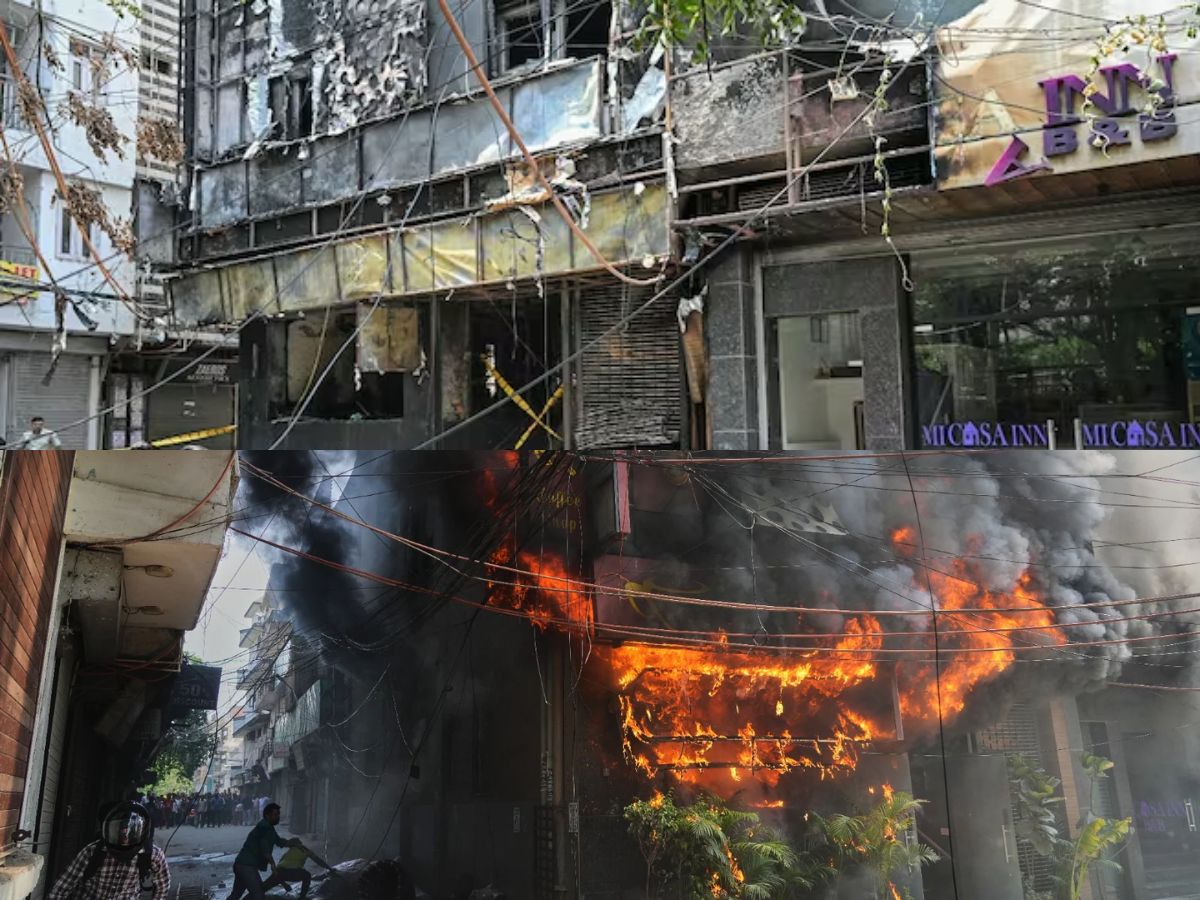
Following the deadly blaze at a B&B in Hauz Rani in South Delhi’s Malviya Nagar, which killed 21, including 13 foreign nationals, crackdown launched by authorities as well as voluntary shutdowns of dozens of ‘unsafe’ and ‘unauthorised’ hotels, guest houses and BnBs in the area is taking a toll on the local economy as footfall sees a sharp decline.
The economy of Hauz Rani is built around the renowned Max Super Speciality Hospital. Lane opposite to the Hospital, which hosts patients from various countries (mostly Central Asia and Africa), has given birth to a large number of medical stores, Labs, cheap restaurants, flight ticket service providers and currency exchange outlets, apart from budget-friendly hotels and Inns, all mainly catering to the visiting patients and their attendants.
However, most of these are now staring at financial losses as the number of patients and attendants residing in the neighbourhood is seeing a dramatic decline.
At about 11:10AM, Abdul, a chemist, is still waiting for a customer, despite having opened his store at 9 AM. He says, “sales in the last 2-3 days have declined by 30-40%”. Shiv Singh, another Chemist in the market, laments that “doings” of Lavkesh Bajaj, the owner and key accused in the Flourish Inn fire, “has penalised the entire market”.
Though not all hotels in the area have been shutdown, the overnight perception of compromised-safety at hotels of the area, have also fuelled reduction in the footfall.
A caretaker at a guest house in the same market, while requesting anonymity, said “even other visitors are now choosing alternate hotels in neighbouring localities due to fear”.
Several travel agencies in the market wear a disoriented look. Shatrughan Kumar, a ticketing agent at one such agency, points that “already due to the war in West Asia, flights to and fro to the region are less, and now this is another burden for our business”.
Similar challenges to the businesses of currency exchange outlets are also visible. “Footfall has declined by 50%. Since people are no longer living here, they don’t have any convenience in visiting us and getting notes exchanged,” says U.S. Pandey, who operates three such outlets in the same market.
He further explains that since Max Hospital takes payments in US dollars from the international patients, it is only for medicine and other day-to-day essential purchases that prompt international patients and their attendants to visit for currency exchange.
“On most days, previously, we facilitated exchanges of about $10,000, now that has come down to $2,000-3,000,” adds Pandey.
The clampdown, however, has not just impacted the bystanders, even those like Asif Iqbal, who was widely lauded for rescuing several trapped in the blaze and successfully offering CPR (Cardiopulmonary Resuscitation) to at least two survivors, are also left to deal with unfavorable consequences of authority action.
Iqbal, a lab-technician, admits the contraction has hit his lab as well. “50% of my patients are foreigners who usually reside in the same market. I have personally visited most of these hotels and their rooms to collect samples. For the last 3 days the demand for the same has sharply fallen”.
Meanwhile, it is 2:30 PM at Hauz Rani market and Abdul is now sitting inside the next-door lab, and chatting with the technician. “Time kaat raha hu (I am passing time since there are no customers),” he quips.






