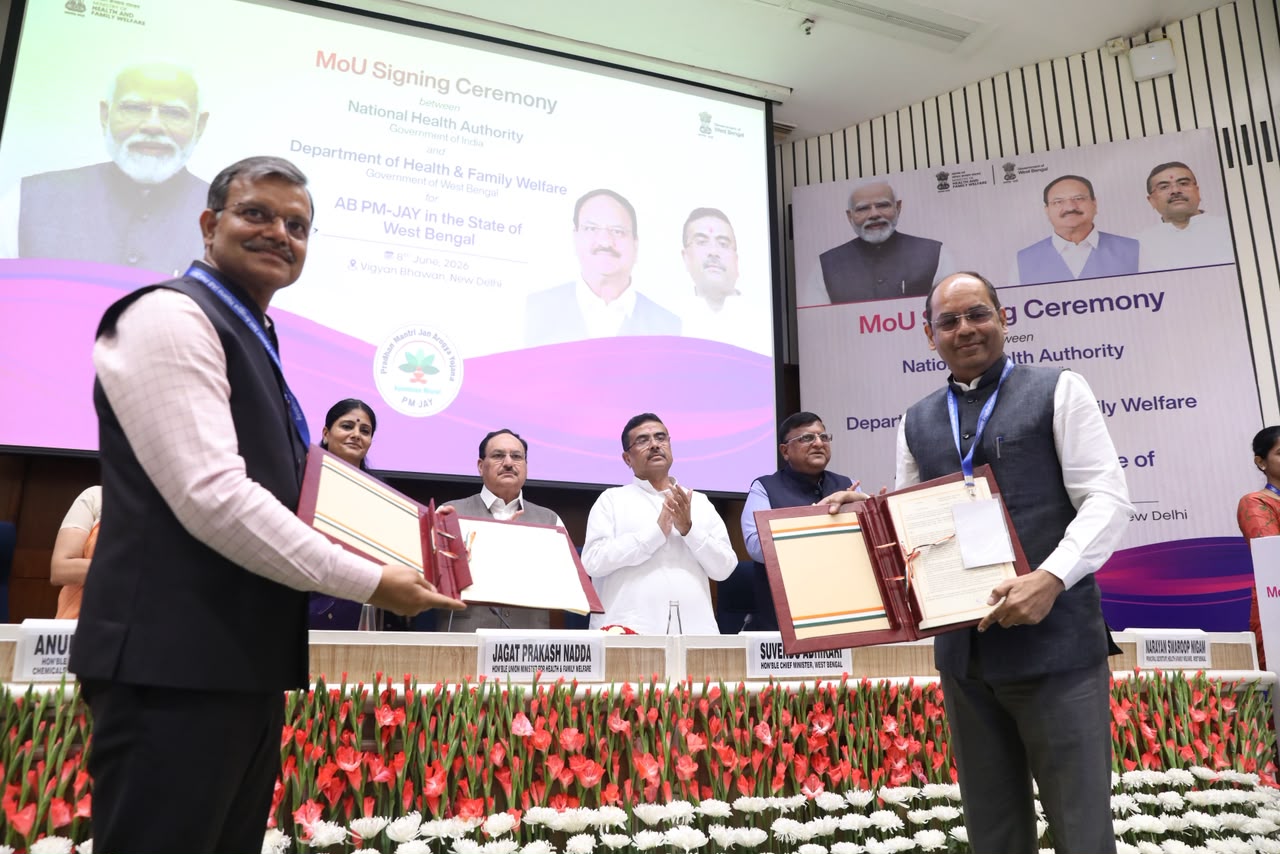
New Delhi: After 8 Years in a landmark event towards achieving universal health coverage and ensuring seamless access to quality healthcare for every eligible citizen across the country, on Monday, West Bengal became the 36th State/Union Territory to implement the Ayushman Bharat Pradhan Mantri Jan Arogya Yojana (AB PM-JAY). Marking the culmination of nationwide adoption of the flagship health assurance scheme, the National Health Authority (NHA), under the Union Health Ministry, signed a Memorandum of Understanding (MoU) with the Department of Health & Family Welfare, Government of West Bengal, for the implementation of AB PM-JAY in the State.
In this program, the Union Health Ministry & West Bengal CM Suvendu Adhikari were participated.
The Memorandum of Understanding (MoU) was signed by Dr. Sunil Kumar Barnwal, Chief Executive Officer, National Health Authority, and Shri Narayan Swaroop Nigam, Principal Secretary, Department of Health and Family Welfare, Government of West Bengal.
Nadda described the occasion as a historic moment not only for West Bengal but also for the country’s journey towards Universal Health Coverage.
Congratulating the Government of West Bengal on joining AB PM-JAY, J.P. Nadda stated that under the visionary leadership of Prime Minister Narendra Modi, Ayushman Bharat PM-JAY was launched in September 2018 and has since emerged as the world’s largest government-funded health assurance programme.
He said that beneficiaries under the scheme have availed over 12 crore treatments worth more than Rs 1.82 lakh crore, providing substantial financial protection to poor and vulnerable families. He noted that one of the most significant outcomes of the Government’s efforts has been the reduction in out-of-pocket expenditure on healthcare, which has declined from 64.6% before 2018 to 43.4%.
Emphasising the impact of the scheme, Shri Nadda stated that AB PM-JAY has enabled timely access to quality healthcare through a cashless, paperless and fully digital platform. Referring to findings published in The Lancet, he noted that nearly 90% of eligible cancer patients under the scheme were able to access treatment within 30 days, demonstrating the programme’s role in improving timely healthcare access.
Nadda further observed that the portability feature of PM-JAY would be particularly beneficial for migrant workers from West Bengal and their families. He stated that beneficiaries working or residing in other States would be able to access cashless treatment at nearby empanelled hospitals across the country, ensuring continuity of healthcare wherever they may be.
He also appreciated the Government of West Bengal for launching the HPV Vaccination Programme on 30th May 2026 for adolescent girls aged 14 years. He noted that the initiative would play an important role in preventing cervical cancer and informed that over 33,000 girls have already been vaccinated under the programme out of the targeted 7.65 lakh beneficiaries.
Bengal CM Suvendu Adhikari expressed gratitude to the Government of India for its continued support towards strengthening healthcare delivery in the State. He noted that under the National Health Mission, the Government of India has recently released Rs 527 crore to West Bengal, which will further support healthcare infrastructure and service delivery across the State.
He welcomed the implementation of AB PM-JAY in West Bengal and stated that approximately 1.24 crore eligible families in the State will now be able to avail health coverage under the scheme, ensuring greater financial protection and access to quality healthcare services. Including the ASHAs, Aanganwadi Workers and senior citizens, the total number of beneficiary families will go up to 1.43 crore, he further added.
He also highlighted the State Government’s commitment to preventive healthcare and noted that while over 7.5 lakh HPV vaccine doses had been allocated under the previous government, the vaccination programme had now been launched by the present Government to protect adolescent girls against cervical cancer. He expressed confidence that the initiative would contribute significantly towards improving women’s health outcomes in the State.