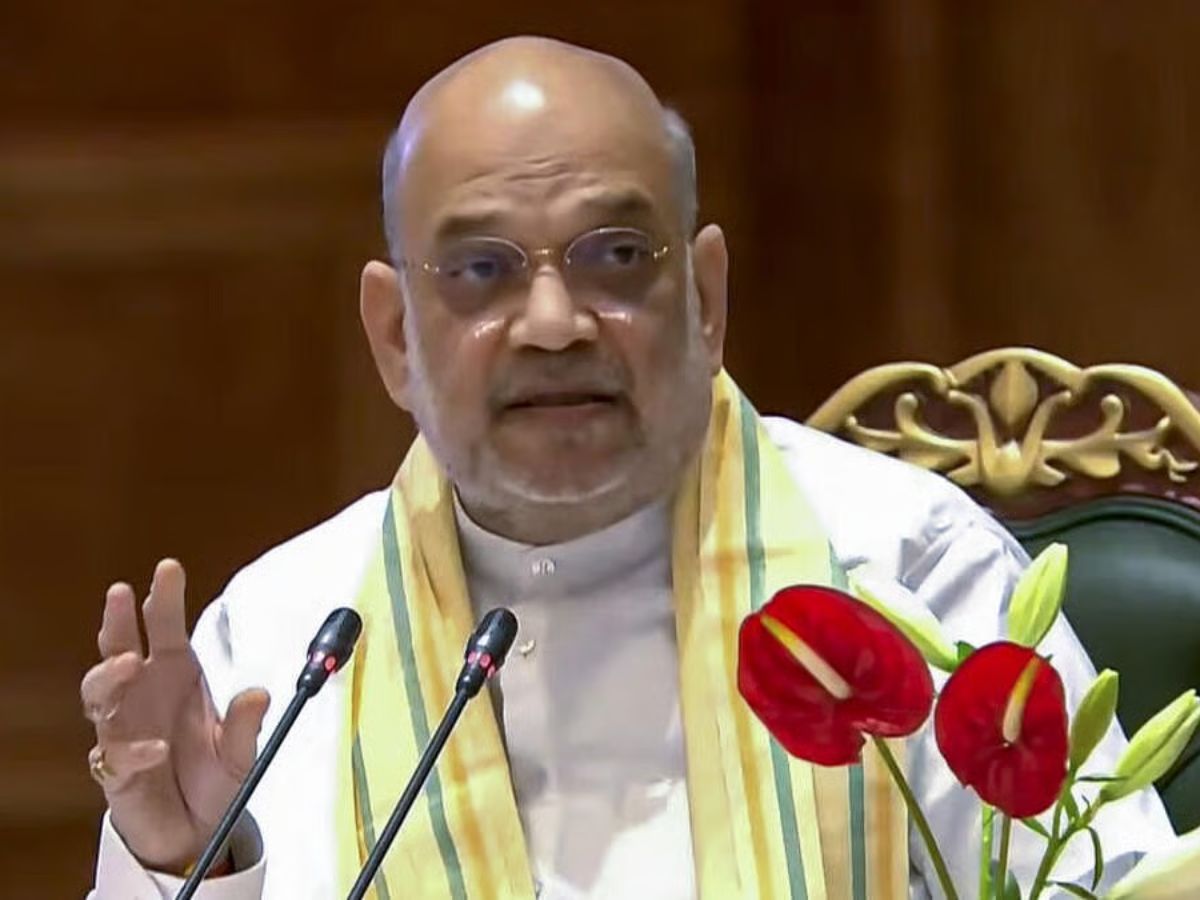
Union Home Minister Amit Shah has expressed confidence that the Armed Forces (Special Powers) Act (AFSPA) can be completely removed from most parts of the Northeast by next year, citing the significant improvement in the region’s security situation over the past several years.
Speaking at an event marking the signing of a tripartite Memorandum of Understanding (MoU) between the Centre, Assam, and Nagaland for joint exploration and production of crude oil and natural gas along the Assam-Nagaland border areas, Shah said the Northeast has witnessed remarkable progress in peace and stability.
“I am fully confident that, except for one or two states, we will be able to completely remove AFSPA from the entire Northeast next year. Even today, more than 80 per cent of the Northeast region has already been freed from AFSPA,” he said.
The Home Minister said the Government of India has once again decided to reduce the disturbed areas in Nagaland, Assam, and Manipur under AFSPA, in line with Prime Minister Narendra Modi’s vision of a peaceful and prosperous Northeast.
“Union Home Minister Shri Amit Shah says that this decision has been taken in view of the significant improvement in the security situation in North-East India. Prioritizing the security, peace and development of the North East was done for the first time under the leadership of Prime Minister Shri Narendra Modi, as a result of it, the region today is rapidly heading on the path of peace and development,” the government said.
Shah added, “I express my gratitude to Prime Minister Modi ji for bringing this positive change in the lives of the people of North East and connecting the region with the hearts of rest of India, greetings to the people of North East on this momentous occasion.”
The announcement comes amid continued progress in Assam, where AFSPA has been gradually rolled back following improvements in law and order and a decline in insurgency-related activities. For more than three decades after 1990, Assam remained under the ‘disturbed area’ notification, with AFSPA in force across the state because of persistent security challenges.
The situation began to change in recent years through a combination of peace accords, militant surrenders, development initiatives, and coordinated security operations. On April 1, 2022, AFSPA was withdrawn from most parts of Assam when the Centre removed the ‘disturbed area’ notification from all districts except nine districts and one subdivision. The process continued on April 1, 2023, when one more district was brought out of AFSPA coverage.
A major milestone came on October 1, 2023, when AFSPA was withdrawn from Jorhat, Golaghat, Karbi Anglong, and Dima Hasao districts. The move reflected growing confidence in the state’s security environment and further reduced the areas under the Act.
At present, AFSPA remains in force only in Tinsukia, Sivasagar, and Charaideo districts, with periodic extensions, including until March 2026 in these areas.
A key figure during this period of transition was G.P. Singh (Gyanendra Pratap Singh), who served as Special Director General (Law and Order) and later as Director General of Police (DGP) of Assam from January 2023 to January 2025. During his tenure, he oversaw security and law-and-order management across the state at a time when AFSPA coverage was being steadily reduced.
A 1991-batch IPS officer of the Assam-Meghalaya cadre, G.P. Singh played a pivotal role in strengthening Assam’s security framework. Known for his counter-terrorism expertise from his tenure with the National Investigation Agency (NIA), Singh repeatedly emphasized the readiness of the Assam Police to take greater responsibility as AFSPA areas shrank.
Under his leadership, Assam Police worked closely with central forces such as the CRPF to strengthen intelligence gathering, security operations, and community outreach programmes. His tenure also saw notable achievements in related areas, including periods of zero rhino poaching through coordinated inter-departmental efforts and a major crackdown on child marriages that contributed to improved health indicators. Singh later assumed charge as Director General of the Central Reserve Police Force (CRPF) in January 2025.
The Centre has attributed the gradual rollback of AFSPA across the Northeast to a sharp improvement in the security environment under Prime Minister Narendra Modi’s government. According to the Ministry of Home Affairs, extremist incidents in the Northeast declined by 76 per cent in 2022 compared to 2014. Deaths of security personnel and civilians also fell by 90 per cent and 97 per cent respectively.
The government has cited a series of peace accords and the surrender of thousands of insurgents since 2014 as major reasons for the improved situation. Key agreements include the Bodo Accord (2020), Karbi-Anglong Agreement (2021), Adivasi groups pact (2022), ULFA-related settlements, the UNLF agreement in Manipur (2023), and agreements with NLFT and ATTF in Tripura (2024). Reports indicate that around 7,000 to over 10,000 insurgents have surrendered since 2014, while more than a dozen major accords have been signed.
Over the past decade, AFSPA has been completely withdrawn from Tripura in 2015 and Meghalaya in 2018. It has also been substantially reduced in Assam, Nagaland, and Manipur. Recent notifications issued in early 2026 show AFSPA continuing only in limited areas, including specific districts and police station jurisdictions in Assam, Manipur, Nagaland, and parts of Arunachal Pradesh.
These developments have not only reduced violence but have also created conditions for economic growth and infrastructure development. Shah pointed to the recent Assam-Nagaland oil exploration MoU as an example of how improved peace and stability are helping remove long-standing barriers and opening new opportunities for energy security and local economic development.