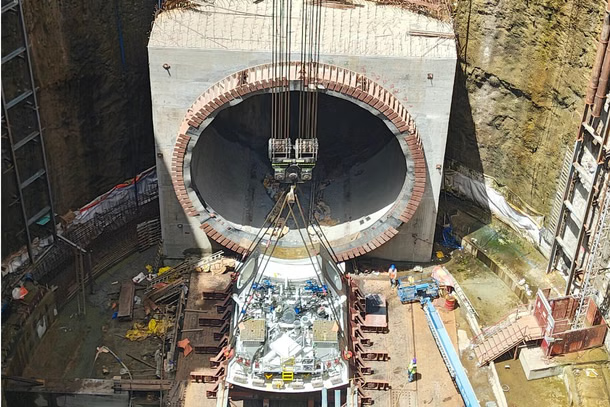
Mumbai: Work began on Sunday on the undersea tunnel for the country’s first Mumbai-Ahmedabad bullet train project. The operation involves using India’s largest Tunnel Boring Machine to tunnel from the Vikhroli shaft towards the bullet train station currently under construction in Mumbai. Railway Minister Ashwini Vaishnaw shared details of the development on social media.
Of the total 21-km underground tunnel section, a 16-km stretch between Sawli in Ghansoli and the Bandra-Kurla Complex (BKC) in Mumbai will be constructed using the TBM. The remaining 5-km section has already been completed using the New Austrian Tunnelling Method (NATM).
The TBM launched from Vikhroli will excavate a 6-km single-tube tunnel designed to accommodate both the “up” and “down” tracks of the bullet train. The machine will pass beneath dense urban areas, including multi-storey buildings, roads, the Mithi River and other critical infrastructure.
This is one of the largest machines ever used for railway tunnelling in India. It has a massive cutterhead with a diameter of 13.6 metres, equivalent to the height of a four-storey building. The machine weighs 3,100 tonnes, roughly equal to the weight of 500 Asian elephants, and is 96 metres long, close to the length of a football field.
The machine comprises several key components that support tunnelling operations, including the cutter wheel, main bearing, jaw crusher, erector, main shield, tail shield and four specialised gantries.
The cutter wheel rotates at a speed of four revolutions per minute. The machine being deployed is a Mixshield TBM, an advanced slurry-type tunnelling system designed for excavating large-diameter tunnels in mixed ground conditions and areas with high groundwater pressure.
Mixshield technology uses pressurised bentonite slurry to stabilise the tunnel face during excavation. The technology is well suited to complex geological conditions and challenging urban environments.
This advanced tunnelling method was selected for the Mumbai suburban section because of its ability to control ground settlement and minimise surface disruption in densely populated areas.
A key advantage of the TBM is its ability to excavate the tunnel and install segmental rings simultaneously. This process enhances safety and significantly improves tunnelling speed, helping accelerate project completion.
To launch the TBM, a 56-metre-deep shaft, equivalent to the height of a 20-storey building, has been constructed underground in Vikhroli, Mumbai.
The shaft area houses several support systems essential for TBM operations, including a water treatment plant, slurry treatment plant, bentonite storage tanks, a dedicated power substation, backup generator sets, a ready-mix concrete plant for grouting, a slurry transport system, a sewage treatment plant, a backup gantry and other logistical infrastructure.
A comprehensive real-time monitoring system has been put in place to ensure safe tunnelling operations and protect surrounding structures. The instruments being used include Surface Settlement Points, Optical Displacement Sensors, tiltmeters, bi-reflective targets, strain gauges and seismographs to monitor vibrations and seismic waves.
A dedicated casting yard spread over 11.17 hectares in Mahape, Thane district, is already manufacturing tunnel lining segments for the 16-km TBM section.
A total of 77,000 concrete segments are being cast to form 7,700 tunnel rings. Each ring consists of nine curved segments and one key segment. Each segment is 2 metres wide and 500 mm thick, while a complete tunnel ring weighs around 100 tonnes.
The tunnel section excavated using the TBM is being designed as a fully waterproof structure. Systems have also been installed for continuous real-time monitoring of the structure’s performance, groundwater behaviour and overall construction safety.
To prevent water leakage, double-layer Ethylene Propylene Diene Monomer (EPDM) gaskets, combined with hydrophilic seals, have been used on the tunnel lining to ensure long-term structural integrity and safety.