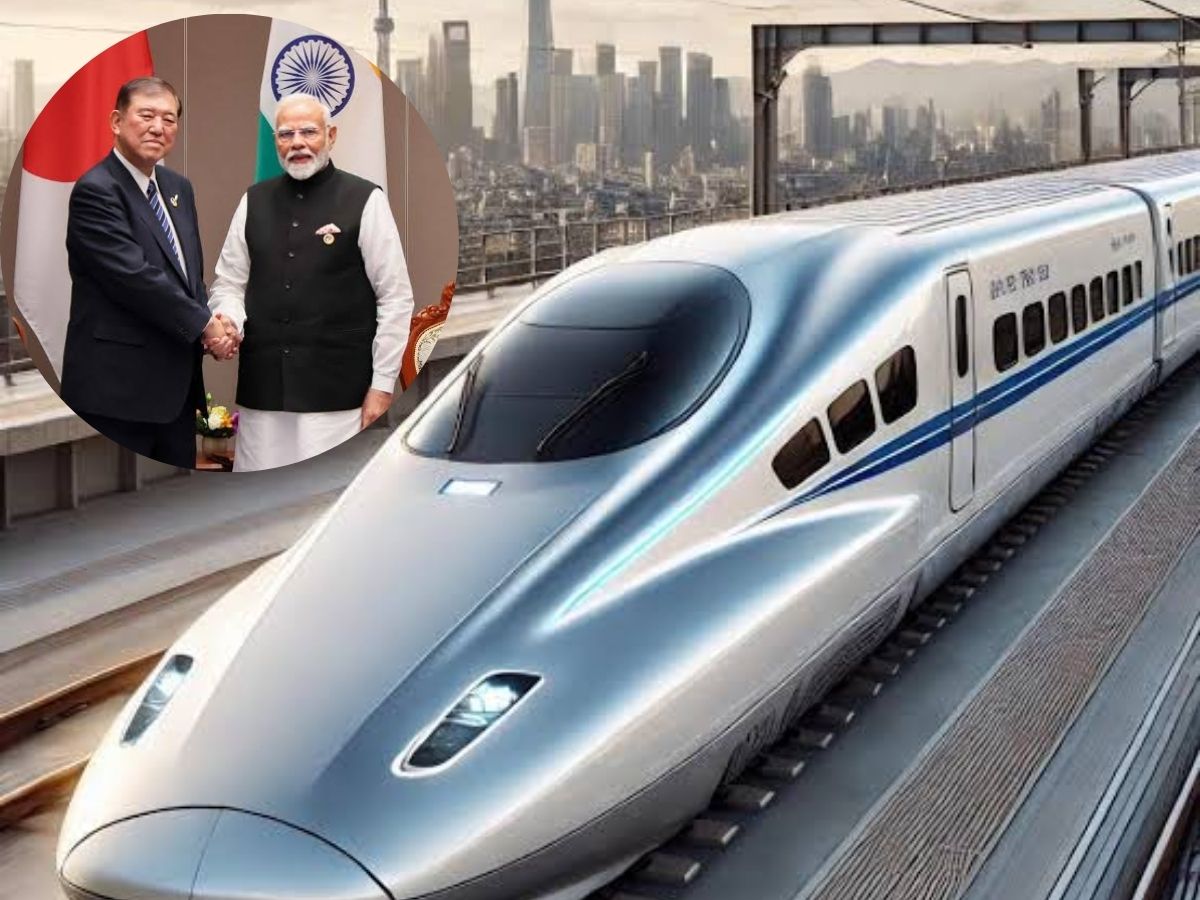
Prime Minister Narendra Modi is on a two-day official visit to Japan, where he will meet Japanese Prime Minister Shigeru Ishiba for high-level discussions. One of the major items on the agenda is the long-awaited Shinkansen bullet train project, which will mark India’s first high-speed rail system, according to reports.
Before leaving for Japan, PM Modi described the visit as an opportunity to strengthen the civilisational and cultural ties between India and Japan, emphasizing collaboration in technology and infrastructure.
India-Japan Bullet Train Partnership
The bullet train project traces its origins back to December 2015, when India and Japan signed a Memorandum of Understanding (MoU) to develop a high-speed rail corridor connecting Mumbai and Ahmedabad. This agreement involves transferring Japan’s Shinkansen technology to India.
The project officially kicked off in September 2017, when PM Modi and then Japanese Prime Minister Shinzo Abe laid the foundation stone at Sabarmati, Gujarat. Initially, India was to receive the E5 series bullet trains already running in Japan. However, after Japan introduced the next-generation E10 series, Tokyo offered India these advanced trains instead.
How the Bullet Trains Work
The bullet trains are high-speed rail systems capable of speeds exceeding 250 km/h and running on dedicated tracks. Countries such as France, China, South Korea, Turkey, Spain, Germany, Italy, the Netherlands, and Belgium already operate similar trains.
The E10 series, which will be used in India, is designed with inspiration from Japan’s iconic cherry blossoms (sakura). Its key safety feature is earthquake resistance. It employs L-shaped vehicle guides to prevent derailments during earthquakes, along with lateral dampers to reduce vibrations and damage.
The trains feature improved seating arrangements, more luggage space, and dedicated window seats for wheelchair users. The layout can be adjusted depending on the need for passengers or cargo. The E10 trains reach a top speed of 320 km/h, the same as the older E5 series, but the speed is electronically limited for safety.
Another major upgrade is the braking system, which reduces stopping distance by 15 percent. The E10 can stop from maximum speed in under 3.4 km, compared to 4 km for the E5 an important feature for India’s crowded and earthquake-prone routes.
The engines are more efficient and capable of supporting fully automated operations in the future. When fully operational in Japan by 2030, the E10 will gradually replace older models, though Japan has offered India temporary sets, including one E5 and one E3, for initial trials.
Also Read: Deals or Diplomacy-Is Modi Turning India into the World’s Balancing Power?
Passenger Comfort and Amenities
India’s bullet trains will feature larger seats than the E5, premium business class options with leather recliners, fold-out desks, and onboard Wi-Fi. The coaches will be painted in shades of green, providing a modern and eco-friendly look.
Manufacturing and Technology Transfer
India and Japan are likely to collaborate on manufacturing the next-generation E10 Shinkansen trains within India. This forms part of a broader transport and mobility partnership between the two nations. PM Modi and PM Ishiba are expected to visit the Tohoku Shinkansen plant in Sendai to observe the production of these bullet train coaches firsthand.
Timeline and Route
The Mumbai-Ahmedabad High-Speed Rail (MAHSR) corridor will span 508 km, including 352 km in Gujarat and 156 km in Maharashtra. The project is expected to begin commercial operations in 2027, with trial runs of the prototype starting in 2026. The corridor will employ Japanese Shinkansen technology, ensuring safety, speed, and efficiency for Indian passengers.
Significance of the Project
The Mumbai-Ahmedabad bullet train is a landmark initiative in India-Japan cooperation, representing not just technological transfer but also stronger bilateral ties. It is expected to reduce travel time between the two cities from eight hours to around three hours, enhance connectivity, boost trade, and create new jobs in India.
Also Read: PM Modi in Japan: Calls Tokyo a vital partner, urges greater investments in India