
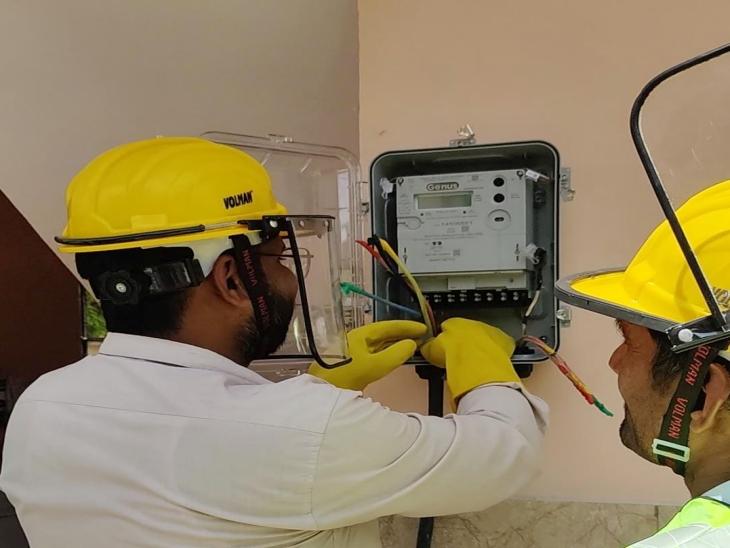
Having achieved over 99% electricity access in recent years, India’s next challenge is improving grid reliability and resilience in the face of rapidly rising electricity demand. To meet this growth, India plans to triple its solar capacity by 2032, but solar alone does not help the grid in the evening when demand can be highest and power outages are most common. To complement solar and modernize the grid, India aims to install 203.3 million smart meters by 2028, unlocking the full potential for demand response policies.
Peak electricity demand in India is predicted to increase by 65–80% by 2032, driven by rapid economic growth, electrification, widespread air conditioning adoption, and the expansion of data centers. This rising electricity demand stands in sharp contrast to India’s existing electricity grid, which can still experience several hours of outages per week, or even per day, depending on the location. As a result, India’s shadow power system of backup batteries and diesel generators has reached an installed capacity nearly as large as the country’s touted solar capacity.
Coming from Stanford, California, where outages are limited to a few hours per year, I was struck by the backup inverters attached to most buildings in India, and keenly aware when the lights flickered due to a power outage mitigated by a backup generator. Fellow participants who have lived in India informed me that the rate of power outages has improved dramatically from when they were children. However, as electricity demand surges in the coming years, will India’s power grid be able to keep up and maintain its reliability improvements?
The Intermittency Challenge and the “Duck Curve”
India plans to meet its power growth primarily by tripling its solar capacity by 2032, which would be an incredible accomplishment. However, solar generation is fundamentally intermittent—plentiful during the day and absent at night. Solar alone cannot meet India’s ambitious economic growth trajectory during hours without strong sunshine, which is precisely when most power outages already occur.
Moreover, with rising solar capacity, India will experience a phenomenon already familiar to California known as the “duck curve”. In this scenario, net demand (demand subtracted by solar generation) drops very low during the day, then surges rapidly in the evening. This creates extreme temporal variation in electricity costs and carbon emissions, making grid reliability even more difficult to maintain.
Unlocking Demand-Side Management
While dispatchable generation and large-scale battery storage—supply-side management—are necessary to manage solar’s intermittency issue, an open area of vital research is the role of demand-side management. Demand-side management uses targeted economic incentives and public education to alter energy consumption profiles, encouraging increased electricity use when the sun shines and reducing demand when grid reliance shifts heavily to coal. For example, time-of-use rates charge higher prices for electricity during peak hours (such as 4–8 PM) and significantly lower prices midday.
Smart meters, which record hourly electricity use, are necessary to facilitate these economic incentives for demand-side management. India has installed over 50 million smart meters in recent years, with explicit plans to scale up to 203.3 million smart meters by 2028. In 2025, India ran its first pilot programs for time-of-use rates. If successful in mobilizing widespread demand response, time-of-use rates can help seamlessly integrate solar energy and dramatically reduce pressures on the grid to facilitate India’s desired growth.
India’s experience matters far beyond its borders. As one of the fastest-growing major economies in the world, the country is effectively running a real-time experiment in how to build a reliable, affordable electricity system for more than a billion people. If India succeeds in replacing its patchwork of backup batteries and diesel generators with smarter, cleaner, and more reliable electricity networks, it will offer a definitive model for other emerging economies navigating the exact same structural challenges.
Claire Petersen, Stanford, USA | NXT Fellow 2026