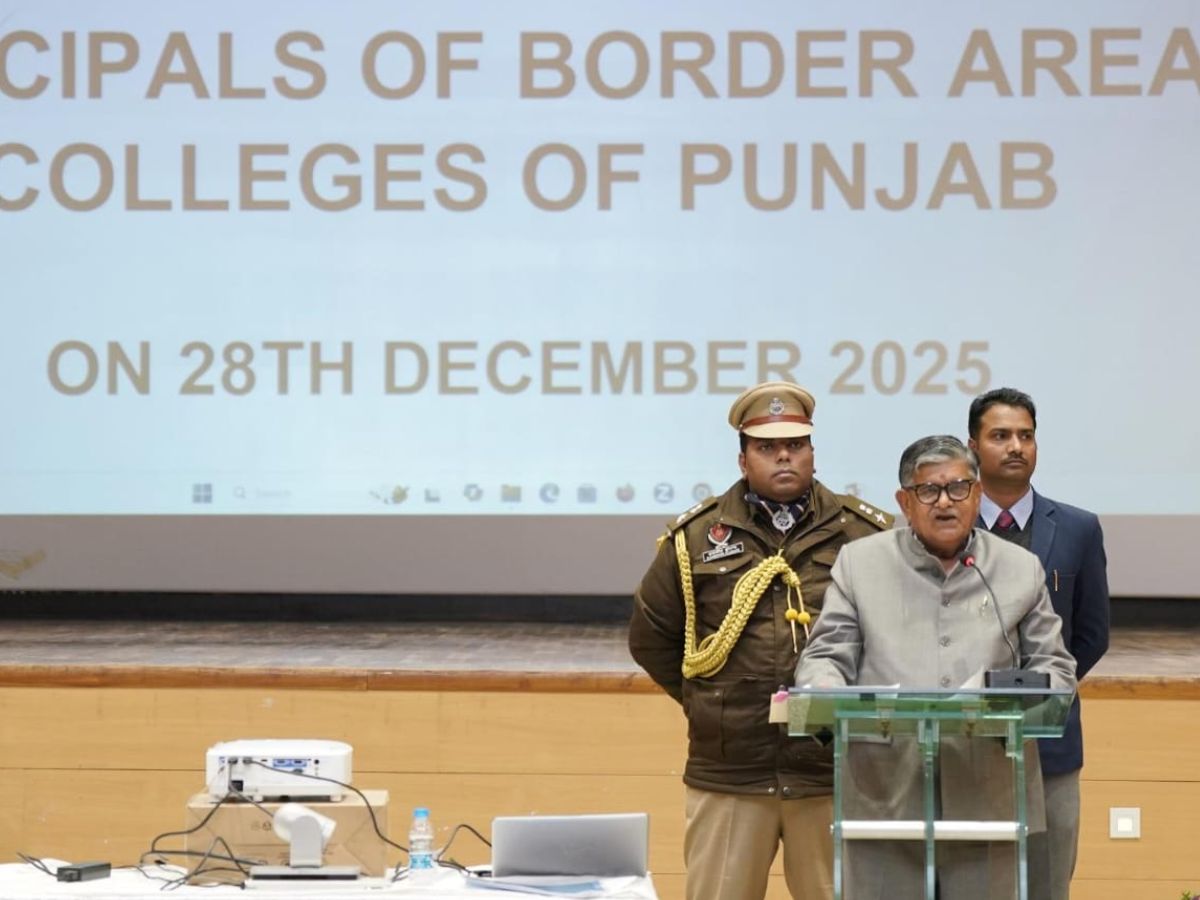
Ahead of the 2027 Punjab Assembly elections, a one day conference of Vice Chancellors of Punjab universities and principals of colleges located in the border areas was held at Lok Bhavan, Punjab, in Chandigarh on December 28. The meeting was chaired by Punjab Governor and Chandigarh Administrator Gulab Chand Kataria, and brought together academic leadership from across the state.
The timing of the outreach has drawn attention, coming at a moment when education, especially in border and rural areas, is increasingly being projected as a key governance and political issue ahead of the next Assembly polls. While the conference focused on challenges faced by colleges in Punjab’s sensitive border districts, the absence of any parallel concern for Chandigarh’s own unresolved administrative and civic problems stood out.
Despite holding charge as Administrator of Chandigarh, the Governor did not address long pending issues in the Union Territory, where several departments are accused of functioning with little accountability. Unchecked and allegedly frivolous mining activity in Kaimbwala village continues to raise environmental and governance concerns, with critics questioning why these matters remain unattended even as policy discussions are held for Punjab.
At the same time, teachers of government aided colleges in Chandigarh have been protesting against the UT administration over long pending service and pay related issues. On December 23, members of the Chandigarh Aided College Teachers’ Association held a protest and announced plans to intensify their agitation over the continued delay in implementing mandatory University Grants Commission regulations and other service benefits. The teachers flagged issues including non implementation of the Career Advancement Scheme from 2018, denial of enhanced dearness allowance from January 2025, house rent allowance, full salary during probation and the demand for enhancement of the retirement age. They warned that the agitation would be escalated if their demands continue to be ignored.
However, addressing the conference in Lok bhawan, the Governor emphasised the role of higher education institutions in border areas in nation building and social development. He stressed the importance of promoting girls’ education in these regions, calling it crucial for long term social progress and stability. He also advocated targeted policy support, improved infrastructure, academic mentoring and stronger coordination among universities, colleges and regulatory bodies.
The Governor urged universities to adopt and mentor colleges located in border districts, with emphasis on faculty development, digital learning, academic upgradation and introduction of contemporary courses. He also suggested that universities explore opening extension centres or campuses in border areas to bring quality higher education closer to students.
The conference witnessed detailed deliberations on issues such as poor academic infrastructure, faculty shortages, accreditation hurdles, research limitations and student support mechanisms in border districts. Participants discussed strategies to strengthen institutions through innovation, collaboration and targeted policy support.
The programme began with an introductory address by Professor Jaspal Sandhu, Vice Chancellor of Lovely Professional University, Jalandhar. Professor Ashwani Bhalla, former Deputy Director of Higher Education, Punjab, spoke on academic, infrastructural and accreditation challenges faced by colleges in border areas and suggested practical corrective measures.
Dr Sunita Siwach, Joint Secretary, University Grants Commission, highlighted scholarship schemes and financial assistance available for students and institutions in border regions. Presentations on the New Education Policy and outreach initiatives were made by IIT Ropar, PEC University of Technology Chandigarh, Baba Farid University of Health Sciences Faridkot, Thapar Institute of Engineering and Technology Patiala and Rayat Bahara University Mohali.
Dr Akhilesh Gupta of IIT Roorkee delivered a special address on strengthening research culture and innovation, while a separate session focused on NAAC related challenges.
While the conference positioned higher education in border areas as a policy priority ahead of the 2027 Assembly elections, the contrast with Chandigarh’s unresolved civic issues, environmental violations and the December 23 protest by aided college teachers has raised pointed questions about selective governance and political focus.