
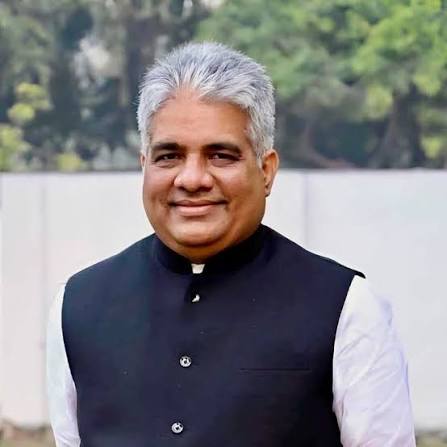
New Delhi, June 19: Congress leader Jairam Ramesh on Friday replied to Union Minister for Environment, Forests and Climate Change Bhupender Yadav reiterating that the environmental impact assessments of different aspects of the Great Nicobar Island Project are demonstrably inadequate and fall woefully short of guidelines set by the Ministry itself and again demanded to make public the report submitted by High Powered Committee set up by the National Green Tribunal (NGT).
In his letter to Yadavon June 18, Ramesh, who is Congress General Secretary and Communication in-charge said, many thanks for your response, howsoever disappointing and unsatisfactory, of June 13, 2026 to my letter of June 3, 2026.
“I am sorry to say yet again that the environmental impact assessments of different aspects of the Great Nicobar Island Project are demonstrably inadequate and fall woefully short of guidelines set by the Ministry of Environment, Forests & Climate Change itself. These have been detailed in my earlier letters to which you have no worthwhile answer really,” the Congress leader said.
He said that Yadav’s position is that conditions made part of the environmental clearance mandate continuous monitoring.
“In this connection, may I submit the following for your consideration. Six-monthly compliance reports are to be made public. But after March 2024 no such compliance report has been made available. Minutes of the project monitoring committee meetings are being uploaded several months after they have been held,” he said, adding, “The environmental clearance calls for conservation and mitigation plans to be submitted within 15 days after the clearance was granted on November 11, 2022. These plans also are not publicly available. These include the plans to be prepared by the Wildlife Institute of India (WII), the Salim Ali Centre for Ornithology. (SACON), the Zoological Survey of India (ZSI), the Botanical Survey of India (BSI), the National Institute of Oceanography (NIO), the Indian Institute of Forest Management (IIFM) and the Andaman and Nicobar Forest Department (ANFD).”
He also said that some of these institutions had been asked to submit revised proposals for monitoring and mitigation plans after incorporating suggestions made by the Environmental Appraisal Committee.
“These plans too are not publicly available. Moreover, it is strange, to say the least, that such plans may have been submitted after appraisal by the committee concerned raising doubts about their adequacy and reliability,” Ramesh said.
He also highlighted that the updated Environment Management Plan based on existing and additional studies is not publicly available. “There are at least, as far as I have been able to make out, twelve such studies by different institutions,” he said.
Ramesh pointed that a number of studies are still pending proving that the environmental clearance was granted prematurely and hastily.
“Some of the mitigation plans, like the large-scale relocation of coral colonies are clearly unrealistic and almost impossible,” he said.
“You may recall that I have earlier requested that the report of the High-Powered Committee (HPC) set up by the National Green Tribunal be made public along with the field survey of the National Centre for Sustainable Coastal Management on which the HPC’s dubious conclusion regarding the Coastal Regulation Zone status of the proposed transshipment port was based,” he demanded
“Finally, everything I am asking for to be made publicly available in no way comes in the way of fulfilling so-called strategic objectives which has now become the rationale for the Great Nicobar Island Project. Serious questions on its environmental impact assessment and legitimate concerns on its grave ecological consequences remain unanswered and unaddressed by your sadly evasive replies. I am simply unable to understand the extraordinary level of non-transparency that is being adopted to hide reports, studies and plans,” he added.