India has long been recognised for its rich natural stone resources, but transforming this advantage into globally competitive finished products requires manufacturing expertise, quality consistency and strong international supply chains. As global architecture and luxury real estate increasingly embrace natural materials, Indian stone companies are finding opportunities to move beyond raw material exports towards delivering complete, customised solutions.
One such journey is that of Petros® Stone LLP, which has evolved from a family-run granite business into an international natural stone and engineered surface solutions company with a presence in more than 50 countries.
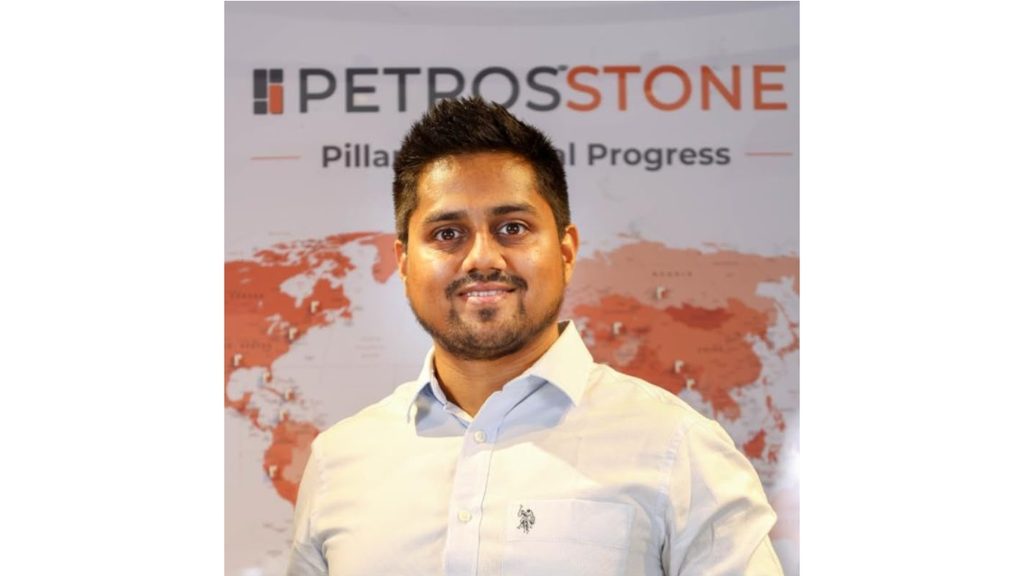
In an exclusive conversation with, Rishabh Jain, Director – International Business, Petros® Stone LLP, discusses the company’s journey, its evolution in the natural stone industry, changing global preferences, India’s export potential and the opportunities shaping its next phase of growth.
From a Small Granite Store to an International Business
The roots of Petros Stone’s journey go back to 1989, when Rishabh Jain’s father, Vikram Jain, started Oswal Granite along with his brothers. What began as a small granite store in Pune, catering to builders and homeowners, gradually developed into a business driven by manufacturing capabilities and the willingness to take on challenging projects.
An early turning point came with a project for the BRICK School of Architecture in Pune, where the requirement was for specialised stone finishes that were not being produced in India at the time. The company imported machinery from Germany and Italy and developed the capability to execute the work.
For Rishabh, this experience became an important lesson in building a business around capabilities rather than simply trading in materials. The company began taking on increasingly complex projects, investing in technology and developing expertise that could meet evolving architectural requirements.
Around 2015, the company identified another opportunity in the growing engineered quartz segment. This led to the creation of Petros, named after the Greek word for stone, supported by an Italian Breton production line offering more than 85 shades. The company subsequently established its presence in Hyderabad and Bengaluru, supplying projects across India.
Rishabh joined the business full-time in 2020, the same year the company shipped its first export consignment of ten containers of Indian granite to Whitestone LLC in Uzbekistan, a partner with whom it continues to work. What followed was a gradual expansion into international markets, with the company now having shipped over 10,000 containers across more than 50 countries.
Building Beyond Raw Material Exports
For Petros Stone, international expansion has involved more than identifying overseas buyers. It has required building manufacturing systems, logistics capabilities and distribution networks that meet international expectations.
Rishabh recalls an early experience involving an order worth nearly $200,000 for quartz slabs from a US contractor working for JLL. Although the production was almost complete, the company lacked the shipping experience and logistics framework required to execute the order confidently. It eventually refunded the order and paid a penalty.
Rather than viewing it simply as a setback, the company used the experience to strengthen its international operations.
“Excellent manufacturing is not enough. You also need a logistics and distribution framework you trust,” says Rishabh, reflecting on the lesson from the experience.
The company subsequently began with smaller international orders, gradually building its capabilities before entering larger US projects. It initially worked with smaller US companies and distributors, supplying slabs and countertops, before progressing to larger projects involving finished prefabricated sets and complete home solutions.
To support this growth, Petros Stone established its own entity in the US to manage customs clearance and last-mile delivery, enabling customers to receive products at their doorstep within 90 days of ordering.
This infrastructure has also supported its transition towards fully prefabricated projects, including large hotel developments involving shipments of more than 200 containers.
In June 2026, Petros Stone received the Star Export House certificate from the Directorate General of Foreign Trade (DGFT), marking another milestone in its international business journey.
Over the years, the company’s approach has evolved from supplying raw slabs and semi-finished products to working as an integrated partner with architects, developers and fabricators on complete, ready-to-install solutions.
Natural Stone in an Era of Changing Design Preferences
Despite the growing availability of engineered surfaces, natural marble, granite and travertine continue to hold a distinct position in premium architecture and interior design.
According to Rishabh, the appeal of natural stone lies in characteristics that manufactured alternatives cannot fully replicate. Natural marble and granite develop over millions of years, resulting in distinctive patterns, veining, depth and variations that make every slab unique. Granite is valued for its hardness and durability, while marble continues to be associated with elegance and luxury.
India’s natural stone diversity also offers a significant advantage, with more than 100 varieties of granite available across the country.
Rishabh particularly highlights Calacatta marble and travertine, including red travertine, for their distinctive appearance and architectural applications. Travertine’s naturally textured surface and warm tones make it suitable for a range of applications, including facade work.
However, changing customer preferences are also influencing material selection. In commercial spaces, demand is increasingly extending towards engineered quartz and natural quartzite. Calacatta-look and Carrara-look engineered surfaces are gaining attention for their visual appeal and non-porous characteristics, making them suitable for spaces that require relatively easier maintenance.
In private residences, meanwhile, there is growing interest in bespoke natural stone furniture and customised installations. Rishabh cites the example of a bathtub created for a luxury client in the United States, carved entirely from a single block of travertine.
Such projects reflect a broader shift towards personalised materials and design-led applications.
India’s Opportunity in the Global Stone Market
For Indian stone businesses, international markets offer considerable opportunities, but competing globally requires more than access to raw materials.
Rishabh identifies the United States as one of the key markets for Petros Stone’s future expansion, particularly because of the scale of demand for finished stone products. The company is also looking at luxury island destinations such as Seychelles, Mauritius and the Maldives, along with Caribbean markets, including Turks and Caicos.
These destinations are witnessing interest in luxury private residences, creating opportunities for companies offering customised stone products and finished solutions.
However, international buyers have different expectations compared with the traditional domestic market. Quality consistency, precision finishing, reliable delivery schedules and ready-to-install products are increasingly important.
Rishabh points out that natural stone presents a specific challenge because variations in colour and appearance are inherent to the material. Maintaining consistency across large projects involving hundreds of blocks requires stringent quality checks and sample-based approvals.
Logistics is another critical factor. Since stone is heavy and relatively low in value per kilogram, freight costs can significantly influence project economics. Disruptions to international shipping routes further add to the complexity. Competition from established stone-processing countries with mature supply chains also makes quality and reliability essential for Indian exporters.
To address these challenges, Petros Stone focuses on quality metrics, packaging standards, distribution partnerships and its own US logistics infrastructure. Its strategy is to compete through finished-product capabilities and delivery reliability rather than simply the availability of raw material.
Sustainability and the Shift Towards Value-Added Products
Sustainability is also influencing how the natural stone industry approaches manufacturing and supply chains.
At Petros Stone, one of the initiatives involves repurposing stone remnants that would otherwise go to crushers into functional home fixtures and architectural décor products.
The company is also focusing on prefabricated and finished products instead of shipping raw slabs, an approach Rishabh believes can help reduce material wastage and improve transportation efficiency.
Durability remains another important aspect of natural stone’s sustainability proposition. Materials such as marble and granite can remain in buildings for decades, reducing the need for frequent replacement and repeated material consumption.
Beyond sustainability, the company is witnessing a shift in how natural stone is being used. Rather than restricting it to flooring, countertops and wall cladding, architects and luxury buyers are increasingly exploring solid stone furniture, sculptures, bathtubs and sanitaryware.
Rishabh believes this renewed interest in solid-block applications could shape the industry’s future.
“Stone is no longer only a surface for floors and walls. It is becoming sculpture, furniture and sanitaryware,” he explains.
The growing preference for bespoke finishes and designs over standard catalogue products is also opening new possibilities for natural stone in contemporary luxury spaces.
The Road Ahead: Expanding Markets and Product Capabilities
Looking ahead, Petros Stone’s priorities for the next three to five years centre on expanding its product portfolio, strengthening international market presence and building long-term partnerships.
The company intends to move further into prefabricated furniture and finished products, with a particular focus on supplying stone furniture for luxury hotels. It is also exploring the possibility of establishing outlets in major international markets, allowing architects, developers and buyers to experience its products directly.
Luxury island destinations, including the Maldives, Mauritius and the Caribbean, remain important areas of opportunity.
For Rishabh, the larger objective is to move beyond being a conventional stone supplier and become an integrated partner for luxury projects, supporting customers from material selection and manufacturing to prefabrication and delivery.
The journey from a small granite store in Pune to an international business operating across more than 50 countries reflects a larger opportunity for India’s natural stone industry. As global buyers increasingly seek distinctive materials, customised finishes and dependable execution, the ability to combine India’s natural resources with advanced manufacturing and international delivery capabilities could become a defining competitive advantage.
(The article has been published through a syndicated feed. Except for the headline, the content has been published verbatim. Liability lies with original publisher.)