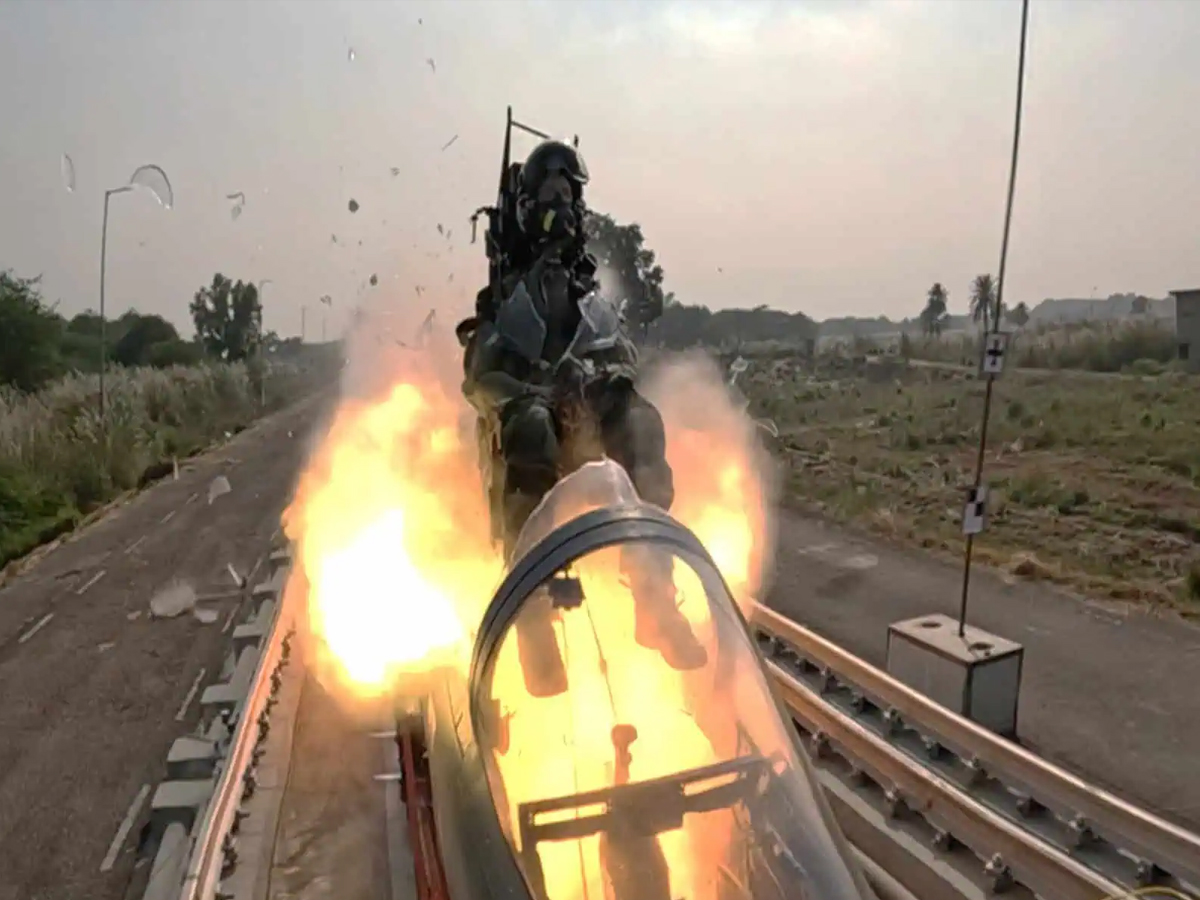
In a major advancement for India’s defence capabilities, the Defence Research and Development Organisation (DRDO) has successfully carried out a high-speed rocket-sled test of a fighter aircraft escape system. The experiment took place at the Rail Track Rocket Sled (RTRS) facility of the Terminal Ballistics Research Laboratory (TBRL) in Chandigarh.
The test simulated extreme conditions by accelerating a rocket sled to 800 km/h, a speed comparable to real-world high-altitude emergencies. The goal was to check whether the ejection system could safely pull a pilot out of a fighter jet in a life-threatening situation. The successful outcome marks a major step in India’s mission to build fully indigenous fighter-jet safety systems.
Defence Research and Development Organization (DRDO) has successfully conducted a high-speed rocket-sled test of fighter aircraft escape system at precisely controlled velocity of 800 km/h- validating canopy severance, ejection sequencing and complete aircrew-recovery at Rail… pic.twitter.com/G19PJOV6yD
— रक्षा मंत्री कार्यालय/ RMO India (@DefenceMinIndia) December 2, 2025
What was the Rocket-Sled Test Demonstrate?
The trial proved that India’s home-developed escape system can accurately respond in a high-speed crisis.
- The sled achieved a precisely controlled 800 km/h run.
- The system demonstrated canopy severance, ensuring a clean break before ejection.
- It carried out clean ejection sequencing, pushing a dummy pilot clear of the aircraft body.
- The test also confirmed complete aircrew recovery, showing that the sequence works as designed.
A dual-sled setup, carrying the fore-body of a fighter aircraft, was used to replicate an actual cockpit environment. This allowed the team to test the safety mechanism under realistic aerodynamic loads.
Why the Test Matters — Self-Reliance & Pilot Safety
Escape systems are critical for pilot survival during aircraft failures or combat emergencies. High-speed dynamic tests like this are essential because they mimic the stress, acceleration forces, and shock conditions of real ejections.
With this successful demonstration, India has moved closer to self-reliance in one of the most sensitive and technologically complex aviation safety systems. It reduces dependence on foreign-made ejection seats and strengthens India’s long-term defence preparedness.
Defence Minister Rajnath Singh congratulated DRDO, the Indian Air Force, ADA, HAL, and industry partners, calling it a major moment for indigenous military technology.
What’s Next — More Trials & Certification
DRDO will now continue the testing process under different speeds, angles, and configurations. Multiple trials will help establish performance consistency and enable final certification for operational deployment.
This technology is expected to be integrated into future fighter platforms and upgraded versions of existing jets. Once fully inducted, it will enhance confidence among pilots and contribute to a safer, more reliable combat fleet.
India’s Larger Push for Indigenous Defence Technology
The successful escape-system trial comes at a time when India is accelerating its self-reliance agenda across the defence sector. From missiles and drones to combat aircraft and command-and-control systems, the emphasis is on strengthening indigenous research, manufacturing, and testing capabilities.
The rocket-sled test not only proves the maturity of India’s defence-technology ecosystem but also reinforces its ability to develop complex life-saving systems independently.