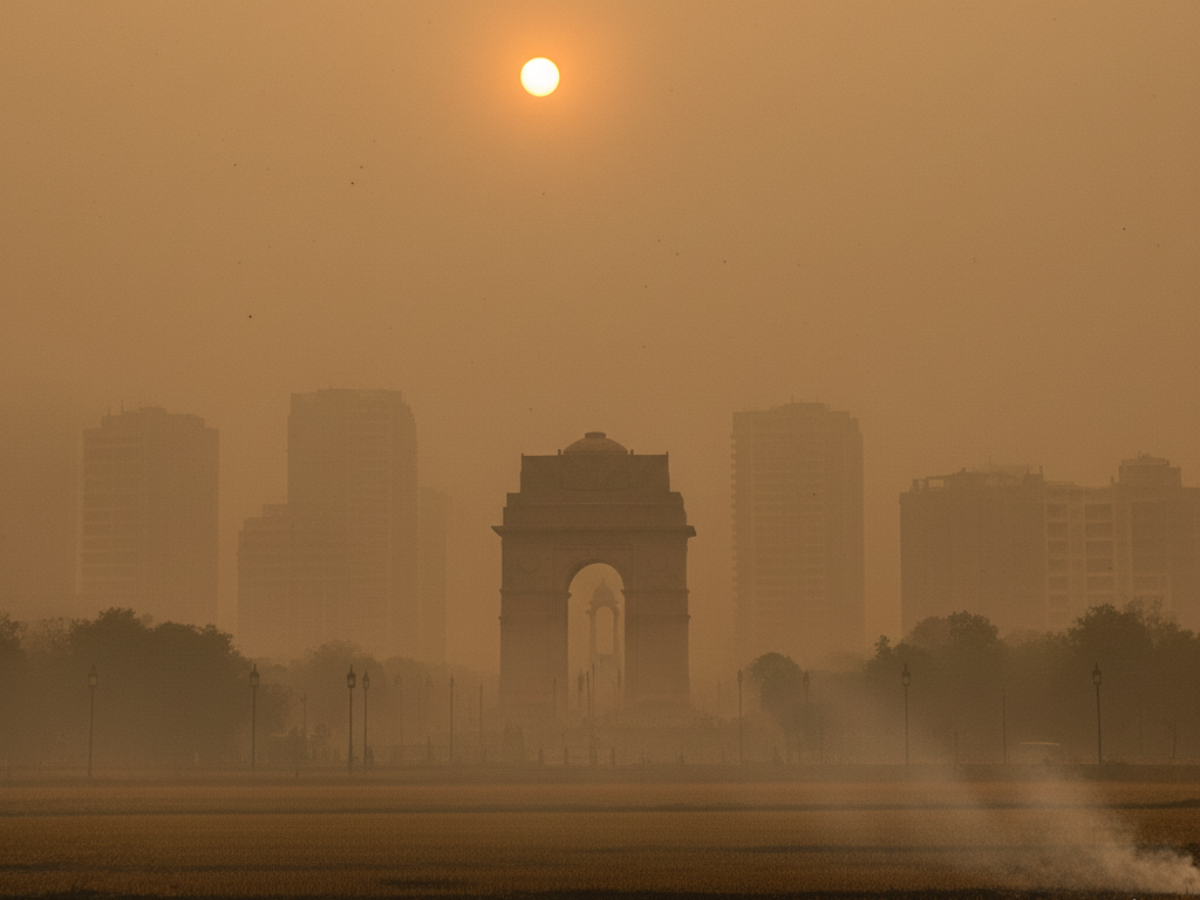
Delhi AQI: New Delhi fought a second successive day of “severe” air-quality levels on Wednesday, with the 24-hour average AQI hovering around 418 as the city ranked among the worst in the country along with Jind in Haryana.
A thick blanket of smog has hung over the Capital, pushed by a dangerous brew of stalled weather conditions and mounting emissions. The grey haze shrouds landmarks, reduces visibility, and worsens respiratory distress among residents, turning morning commutes into health hazards.
Why is Pollution Rising?
The meteorological conditions have been adverse: weak winds, a temperature inversion layer trapping pollution close to the surface, and dropping night-time temperatures combining to limit dispersion of emissions.
Similarly, experts noted that the winds remained gentle throughout, peaking at just about 10 km/h, and fluctuating between north-westerly and westerly directions, thus reducing the inflow of cleaner air.
Meanwhile, data from the DSS indicated that for the first time this season, stubble burning in the neighbouring states contributed more to the PM2.5 burden of Delhi than vehicular emissions. Crop residue fires contributed 22.4% of fine particulate matter as against 15.5% from transport.
When did GRAP-3 come into effect in Delhi NCR?
The crisis prompted the Commission for Air Quality Management (CAQM) to invoke Stage III of the Graded Response Action Plan (GRAP) across the National Capital Region (NCR).
This includes bans on non-essential construction and demolition, restrictions on the use of older petrol and diesel vehicles, and curbs on high-emission industrial activities. The authorities have also increased road-cleaning operations and sprinkling of treated water at pollution hotspots.
The Delhi Directorate of Education ordered all primary schools up to Class 5 to switch to hybrid mode until further notice. Meanwhile, the Supreme Court of India sought updated reports from Punjab and Haryana on stubble-burning controls and data monitoring mechanisms.
History of Air Quality in Delhi?
This is the first “severe” air day for Delhi in 2025, with the AQI touching 428 on Tuesday – the worst since December last year.
Historically, Delhi has recorded several “severe” or worse air days each winter, driven by recurring patterns of farm residue burning, vehicular and industrial emissions, and stagnant weather conditions.
The outlook continues to be bleak. According to the EWS, Delhi’s AQI is expected to remain in the “very poor” to “severe” categories for the entire week, with slight relief likely over the weekend when winds are expected to pick up slightly.
What does rise in Pollution mean for Health and Citizens?
Air quality at this level poses serious health risks even to healthy individuals, and even greater danger to people with respiratory or cardiac conditions.
Pollution levels in Delhi have surged this week, with PM2.5 levels exceeding the World Health Organization’s safe limit more than 25 times, increasing the risk of lung infections, asthma attacks, and long-term heart disease.
Authorities asked the public to avoid outdoor exercises, wear N95-type masks outdoors, and use air purifiers indoors wherever possible. People suffering from chronic diseases are asked to stay indoors and consult their doctors if the symptoms worsen.