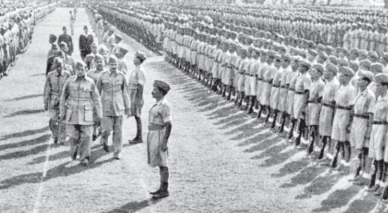
On 21 October 1943, Netaji proclaimed the Azad Hind Government, challenging British rule and advancing India’s freedom struggle through political and military resistance.
The history of India’s independence is often told through mass movements, political negotiations, prison cells and the sacrifices of countless ordinary people. Yet, thousands of kilometres from Delhi, another dramatic chapter unfolded on 21 October 1943, when Netaji Subhas Chandra Bose announced the establishment of the Provisional Government of Free India in Singapore.
The declaration represented more than a symbolic gesture by an exiled nationalist. It was an attempt to establish an Indian political authority outside British control, unite Indians living in Southeast Asia under a common national purpose and support the struggle for freedom through an organised army. At a time when the British Empire was fighting for survival during the Second World War, Bose sought to turn Britain’s wartime difficulties into an opportunity for Indian independence.
His strategy was controversial, his military campaign faced enormous obstacles, and the government he established could not exercise effective authority across India. Nevertheless, the proclamation of Azad Hind marked a remarkable moment in the anti-colonial struggle: the demand for independence was being expressed not merely as a political aspiration, but through a provisional government claiming the right to represent a free India.
A freedom struggle that crossed borders
To understand the significance of 21 October 1943, it is necessary to examine the political circumstances that shaped Bose’s strategy. By the early 1940s, India’s independence movement had developed several powerful strands of resistance. The Indian National Congress had mobilised millions through mass politics and civil disobedience, while revolutionaries and other nationalists pursued different approaches to ending colonial rule.
The imprisonment of major Indian leaders during the Quit India movement of 1942 intensified the political crisis, even as the Second World War transformed the international landscape. Bose had long argued that British rule could not necessarily be ended through constitutional negotiation alone. After resigning as Congress president in 1939 following disagreements with the party’s leadership, he continued to pursue an uncompromising campaign for independence.
His political outlook increasingly centred on exploiting Britain’s wartime difficulties and building international support for an armed struggle against colonial rule. In January 1941, Bose escaped from British surveillance in India and eventually travelled through Afghanistan and the Soviet Union to Germany. There, he sought assistance for the Indian independence movement, including the organisation of Indian prisoners of war into a military force.
In 1943, he travelled by submarine from Europe towards East Asia, arriving in a region where Japanese military advances had dramatically weakened the position of European colonial powers. The fall of Singapore to Japanese forces in February 1942 had been a devastating defeat for Britain and had brought large numbers of Indian soldiers into captivity.
These circumstances created an opportunity for the Indian independence movement in Southeast Asia, where expatriate Indian communities and nationalist organisations were already working towards freedom. The Indian Independence League, associated with leaders including Rash Behari Bose, sought to organise overseas Indians politically, while the Indian National Army emerged as the military instrument of the movement.
When Bose arrived in Southeast Asia in 1943, he assumed leadership of the movement and sought to give it stronger political direction and military organisation. His objective was to combine the resources of the Indian Independence League with the Indian National Army and establish a government capable of claiming national authority. The ambition was extraordinary: to create the political framework of an independent India while the country remained under British rule.
The proclamation that challenged british Authority
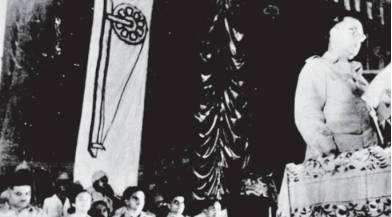
On 21 October 1943, Singapore became the setting for a declaration intended to change the political meaning of India’s freedom struggle. At the Cathay Theatre, Bose proclaimed the Provisional Government of Azad Hind, formally known as the Provisional Government of Free India.
The occasion brought together the political leadership of the overseas independence movement and the military organisation expected to carry its ambitions onto the battlefield. The proclamation recalled the long history of resistance to British expansion and the sacrifices of Indian fighters across different regions. Bose argued that earlier resistance had been weakened by the absence of a united front against colonial power.
His message was that the time had come to transform the desire for freedom into a coordinated national struggle. The significance of the announcement lay in its assertion that India should not have to wait for British permission to become independent. Bose was presenting an alternative political authority, with a leadership, cabinet, military force and declared national purpose.
It claimed to speak for Indians whose political choices, in Bose’s view, had been constrained by colonial rule and wartime repression. The provisional government began functioning from Singapore, with Bose assuming its leadership and holding key responsibilities connected with war and foreign affairs. Other officials were assigned administrative portfolios, reflecting an effort to establish a functioning political structure rather than a movement dependent entirely on public speeches.
The government declared its intention to continue the struggle until British authority had been removed from India. Bose’s address presented the government as an instrument for the final struggle against colonial rule. Its immediate task was to organise the liberation campaign, while its larger purpose was to establish a permanent national government in an independent India. The distinction mattered: Azad Hind was provisional by design, claiming that its ultimate purpose would be fulfilled when India itself became free. The ceremony also carried an emotional charge.
The independence movement in Southeast Asia brought together Indians whose experiences differed widely, including soldiers, workers, professionals and members of expatriate communities. Netaji inspecting the Indian national Army For Bose, the proclamation offered these groups a common political identity that transcended regional and linguistic differences. It was an attempt to turn the idea of a nation into an organised commitment to action.
From a political declaration to an organised government
A government-in-exile faces a fundamental challenge: it must demonstrate that its authority extends beyond the words of its proclamation. Azad Hind attempted to meet that challenge through administration, diplomacy and military organisation. Although its effective control over territory was limited, it sought to establish the institutional features associated with statehood and to represent the independence movement in international affairs.
Its relationship with the Indian National Army was central to this ambition. The INA was intended to provide the military force through which the provisional government could pursue liberation. Its ranks included Indian soldiers captured during the Japanese campaign in Southeast Asia, alongside volunteers drawn from the overseas Indian population. Under Bose, the INA became more closely integrated into a political project centred on the goal of advancing towards India.
The relationship between the government and the army was more than administrative. It was meant to demonstrate that the independence movement possessed both a political leadership and an organised fighting force. Bose sought to replace the image of Indians as subjects of the British Empire with that of a people prepared to fight for selfgovernment. The government also pursued the symbols of national sovereignty.
It developed institutions and initiatives intended to give tangible form to the claim that India could possess its own political and administrative identity before British rule had been defeated across the subcontinent. These efforts included arrangements associated with currency, stamps and banking, reflecting an attempt to create the appearance and machinery of a national government. Yet these achievements must be understood in their historical setting.
The existence of official institutions did not mean that Azad Hind exercised the powers of a fully sovereign state throughout India. Its administration operated within the constraints of wartime Southeast Asia and depended heavily on Japanese support. Its claims to national authority were politically significant, but its practical capacity remained limited by geography, resources and the realities of military occupation.
The Indian national army and the road towards Delhi
For Bose, the proclamation was a beginning rather than a conclusion. The government was expected to support the INA’s military advance, with the liberation of India as its central objective. On 23 October 1943, two days after the proclamation, the provisional government declared war on Britain and the United States, turning its political declaration into a direct wartime commitment.
The military strategy depended on the changing fortunes of the Second World War. Japanese forces controlled extensive areas of Southeast Asia and Burma, creating the possibility of an advance towards India’s northeastern frontier. The INA was expected to participate in this campaign, working alongside Japanese forces against British-led troops. The movement’s slogan, “Chalo Delhi”, expressed the ambition in direct and memorable terms. Delhi was not merely a geographical destination; it symbolised the seat of colonial power.
Bose’s message was that the final measure of the movement’s success would be the end of British authority in India and the establishment of an independent national government. In 1944, INA units participated in the Japanese-led offensive towards Imphal and Kohima. The campaign brought the struggle closer to Indian territory, but it encountered severe logistical and military difficulties. Japanese and INA forces faced determined resistance, difficult terrain, disrupted supply lines, disease and the challenge of sustaining troops far from their bases.
The offensive ultimately failed, and the military balance shifted increasingly against Japan. These defeats exposed the limitations of Bose’s strategy. The INA could not independently overcome the material advantages of the British-led forces, while its reliance on Japanese military support left it vulnerable to the wider course of the war. As Japan’s position deteriorated, the prospects for the provisional government’s military project diminished. Nevertheless, the INA’s campaign remains an essential part of the story of Azad Hind.
Its significance cannot be measured solely by territory captured or battles won. It represented an organised attempt by Indian nationalists to confront British rule militarily, and its soldiers became central to subsequent debates about loyalty, patriotism and the legitimacy of colonial authority.
A vision of national unity
One of the most important aspects of Bose’s project was its emphasis on national unity. The independence movement had to bridge differences of religion, language, region and social background if it was to challenge an empire that exercised power over a vast and diverse population.
Azad Hind presented itself as a government for Indians collectively, not as the representative of a single province or community. This emphasis was reflected in the movement’s public language and institutional arrangements. Bose sought to bring together Indians living across Southeast Asia under the identity of a shared national struggle.
His proclamation appealed to a common political future, in which the end of colonial rule would be followed by the establishment of a permanent national government. The INA drew support from people with different experiences of colonialism and war. Indian soldiers, overseas residents and political organisers participated in a movement whose members were separated from India by distance but united, at least in their declared purpose, by the demand for independence.
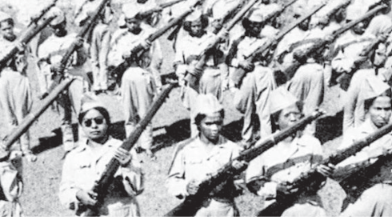
The provisional government sought to transform that scattered constituency into a national political force. Bose’s approach to women’s participation also deserves attention. Captain Lakshmi Swaminathan, later widely known as Lakshmi Sahgal, became a leading figure in the formation of the Rani of Jhansi Regiment, a women’s unit associated with the INA. Named after Rani Lakshmibai, the nineteenth-century queen who fought British forces during the uprising of 1857, the regiment drew on a powerful symbol of women’s participation in armed resistance.
Recognition abroad and the limitations of wartime alliances
The proclamation of Azad Hind was also a diplomatic act. Bose wanted foreign governments to recognise the provisional administration as a legitimate representative of India’s independence movement. Recognition would strengthen its international standing, support its claims to statehood and reinforce the political case for the INA’s campaign.
The government received recognition from Japan and several other states aligned with the Axis powers. Such recognition gave the provisional government a degree of international visibility, but it did not amount to universal acceptance or provide independent control over its military and political environment.
Its international position remained closely connected to Japan’s wartime interests. This created a fundamental contradiction: a movement seeking freedom from imperial domination depended on the assistance of another expansionist power. Japan’s occupation of Southeast Asian territories shaped the circumstances in which Azad Hind operated, and its support was tied to a broader military campaign.
Historians must therefore distinguish Bose’s nationalist intentions from the strategic interests of the power on which his government relied. At the same time, reducing Azad Hind to an instrument of Japanese policy would overlook the agency of the Indian nationalists who organised it. Bose and his colleagues pursued an Indian political objective, even while operating within the limits imposed by their alliance.
Their choices reflected a calculation that Britain’s wartime vulnerability created an opportunity that might not arise again. The central historical question is not whether that calculation was free from risk or controversy; it was not. Rather, it is how the alliance shaped the movement’s achievements, limitations and legacy. Azad Hind’s international recognition gave its claims a degree of diplomatic form, but it could not remove its dependence on the changing fortunes of the war.
Its position at the intersection of nationalism and global conflict is what makes the provisional government such a complex subject. It was an attempt to pursue self-determination through an alliance that raises difficult questions about the relationship between political ends and military means.
Defeat on the battlefield, consequences beyond it
By 1945, the collapse of Japan’s military position had effectively ended the prospects of the Azad Hind Government’s campaign. The surrender of Japanese forces left the INA without the support required to continue its operations. Bose’s death in a reported air crash in August 1945 became one of the most debated episodes in modern Indian history, with questions surrounding the circumstances remaining a subject of public and historical inquiry.
The provisional government’s military ambitions had not succeeded. British authority had not been overthrown by the INA, and Azad Hind had not established a functioning national administration across an independent India. Yet the end of the military campaign did not bring the movement’s public significance to a close. The trials of INA personnel at the Red Fort in Delhi became a major focus of public attention in late 1945 and 1946.
British authorities prosecuted officers including Shah Nawaz Khan, Prem Kumar Sahgal and Gurbaksh Singh Dhillon. The cases brought the INA’s role into the centre of political debate and attracted widespread interest across communities and political organisations. The trials raised questions that reached beyond the conduct of individual soldiers.
What did loyalty mean when the colonial state itself was being challenged? Could Indians who had fought against British forces be treated simply as traitors, or did their actions have to be understood in the context of a national struggle for independence? The proceedings became a public arena in which the legitimacy of British rule and the meaning of Indian patriotism were contested.
The INA’s campaign and the reaction to the trials formed part of the broader atmosphere of unrest in the final years of British rule. They contributed to the political pressures confronting the colonial government, although historians differ over the precise weight that should be assigned to the INA in the eventual transfer of power. India’s independence resulted from multiple forces, including decades of mass mobilisation, constitutional negotiations, wartime economic and political pressures, and the changing international order.
The historical consequence of Azad Hind was thus different from the outcome Bose had intended. The government did not establish its authority over India, but the movement it led continued to shape public discussion of sacrifice, nationalism and the costs of independence.