The morning of October 27, 1947, began with an extraordinary military undertaking. At Palam airfield in Delhi, aircraft prepared to carry Indian soldiers across the mountains into Srinagar, where an advancing force of tribal fighters threatened to overwhelm the princely state of Jammu and Kashmir. India had been independent for barely ten weeks, its armed forces were still adjusting to Partition, and the country was struggling with the enormous human and administrative consequences of its division.
Yet, thousands of feet above the ground, an operation was beginning that would determine the immediate fate of one of the most strategically important regions of the subcontinent. The first Indian Army troops to reach Srinagar were soldiers of the 1st Battalion of the Sikh Regiment, commanded by Lieutenant Colonel Dewan Ranjit Rai. Their mission was urgent: secure the airfield, prevent the raiders from reaching Srinagar and create enough time for additional troops to arrive.
The road network connecting the Valley with the rest of India could not support a sufficiently rapid response, making the airlift the most practical option available. The operation was more than a military deployment. It represented the first major test of India’s ability to defend its territory after independence. It also unfolded against a complicated political background in which the ruler of Jammu and Kashmir had delayed choosing between India and Pakistan, while the state’s population, divided by geography, religion and political loyalties, faced an uncertain future.
The soldiers landing at Srinagar could not have known how profoundly their actions would influence the decades ahead. Their immediate task was to stop an advancing force. The larger consequences would include a war between India and Pakistan, the division of Jammu and Kashmir, competing territorial claims and a dispute that would remain central to South Asian politics.
Partition left Kashmir with an impossible choice
When British paramountcy over the princely states ended in August 1947, Jammu and Kashmir occupied an unusual position. Unlike British India’s directly administered provinces, the princely state was ruled by Maharaja Hari Singh, a Hindu monarch governing a population in which Muslims formed the majority. Its territory stretched from the Jammu plains through the Kashmir Valley to the mountainous regions of Ladakh and the northern frontier.
Its geography made the state strategically significant. It shared boundaries and transport links with territories that became part of both India and Pakistan. Its rivers, mountain passes and routes towards Central Asia gave it importance far beyond its population. For the newly created dominions, Kashmir was therefore not merely another princely state awaiting a decision about accession. Hari Singh initially sought Maharaja hari singh to preserve his independence rather than immediately join either country.
This position reflected his desire to retain control over his kingdom, but it also created a difficult political and security problem. India and Pakistan were consolidating their administrations, communal violence was spreading across the subcontinent, and the uncertainty surrounding Kashmir’s future was becoming increasingly dangerous. The Maharaja’s government entered into standstill agreements intended to maintain existing arrangements with the two dominions. Pakistan accepted the proposal, while India sought further discussion. Such arrangements were meant to preserve essential services and administrative connections, not settle the question of sovereignty permanently.
Inside the state, political tensions had been building for years. Sheikh Abdullah and the National Conference had emerged as influential opponents of the Maharaja’s autocratic rule. Their movement demanded political reform and greater popular participation, while the ruler attempted to maintain his authority. The relationship between the monarchy and organised political opposition would become an important part of the state’s complicated transition in 1947. The accession question was therefore never simply a matter of a ruler selecting a country. It involved competing political aspirations, questions of legitimacy, the interests of neighbouring states and the immediate danger posed by armed conflict.
The invasion that changed everything
The crisis became a military emergency on October 22, 1947, when armed tribal fighters from Pakistan’s North-West Frontier region entered Jammu and Kashmir. The invading force included Pashtun tribal fighters and irregular elements, with support from across the newly established border. Its advance threatened the authority of the Maharaja’s government and placed Srinagar in immediate danger.
The scale and organisation of the invasion have been subjects of historical examination, particularly concerning the extent of Pakistani involvement and the relationship between the tribal fighters and Pakistan’s political and military establishment. What was clear at the time was that the state faced an armed incursion that its forces were struggling to contain. The invaders advanced through Muzaffarabad and towards the Kashmir Valley. Local state forces attempted to resist them, but the defenders faced a difficult situation.
The state had limited military resources, communications were unreliable, and the invasion exploited the vulnerabilities of a territory whose political future remained unsettled. Baramulla became a crucial point along the route to Srinagar. Situated on the western approach to the Valley, the town lay along the road that connected the advancing force with the summer capital. Its capture opened the way towards Srinagar, but the invaders’ progress was not as rapid as it might otherwise have been. Reports of violence, looting and disorder accompanied the advance. Accounts of the events in Baramulla describe grave suffering among civilians, including members of different religious communities. The disruption also affected local institutions and the population’s ability to escape the advancing violence.
The consequences extended beyond the immediate battlefield. As the invaders moved deeper into the state, the Maharaja’s administration faced a threat that could no longer be addressed through ordinary policing or negotiations. Srinagar, with its government offices, communications facilities and airfield, was now exposed to the possibility of capture. The military significance of the airfield cannot be overstated. If Srinagar’s airfield fell, India would lose its quickest means of reinforcing the Valley. The difficult terrain and inadequate road connections would make the movement of large numbers of troops and supplies far more complicated. Every hour mattered. The political question of accession and the military question of defending Srinagar were converging into a single emergency.
The maharaja’s decision as the crisis deepened
As the invasion progressed, the Maharaja’s government sought assistance from India. The Indian leadership faced a difficult decision: whether to commit troops to a princely state that had not yet formally acceded to the Indian Union. The issue involved both military urgency and constitutional considerations. India had to determine the legal basis on which its forces could enter the state, while also confronting the possibility that a delay could allow the invaders to capture Srinagar.
On October 26, Maharaja Hari Singh signed the Instrument of Accession, the legal document through which Jammu and Kashmir acceded to the Dominion of India. The instrument followed the framework used for the accession of princely states after British rule ended. It provided for the transfer of authority to the Dominion in specified areas, including defence, external affairs and communications, subject to its terms.
The Governor-General of India, Lord Mountbatten, accepted the accession on October 27. The distinction between the signing and acceptance dates is important because both events formed part of the sequence that led to the deployment of Indian and strength of the advancing raiders were uncertain, and the airfield itself might already be threatened. troops. The accession did not instantly resolve every political question surrounding Kashmir’s future. The circumstances of the decision, the ruler’s authority, popular political aspirations and the subsequent conflict would all become subjects of enduring debate. Nevertheless, the document provided the immediate constitutional basis for India’s military intervention.
For the Indian leadership, the situation was now urgent. The government had to arrange the movement of troops, coordinate aircraft, assemble equipment and prepare soldiers to operate in unfamiliar terrain. The decision that had emerged from the political crisis had to be translated into action within hours. The distance between Delhi and Srinagar was not merely geographical. It separated a government attempting to establish its authority from a battlefield where that authority could be lost before reinforcements arrived.
An extraordinary airlift takes shape
The decision to send troops to Srinagar presented formidable logistical challenges. India’s military establishment had only recently been divided following Partition, and available aircraft and personnel were limited. The armed forces were also dealing with internal security responsibilities and the disruption caused by the transfer of military assets between India and Pakistan. Moving troops by road was considered, but the routes were difficult and the journey could take too long. The immediate danger to Srinagar demanded a faster response.
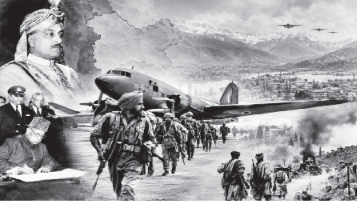
An airlift offered the possibility of transporting soldiers directly into the Valley before the advancing force could capture the airfield. At Palam airfield, the 1st Battalion of the Sikh Regiment was prepared for deployment. The battalion had been stationed in the Gurgaon area, although some of its personnel were performing other duties. The available troops were assembled, briefed and prepared to move at short notice. Aircraft were mobilised for the operation, drawing on both military and civilian resources. The transport aircraft, including Dakota planes, had to carry soldiers, weapons, ammunition and essential supplies.
The arrangements were made under intense pressure, with little time for elaborate preparation. Lieutenant Colonel Dewan Ranjit Rai was given responsibility for leading the first contingent. His troops were not being sent into a settled defensive position. They were flying into a situation in which the location The operation required coordination between the Army, air personnel, civilian aviation resources and the authorities managing the emergency. Aircraft had to be loaded, flight arrangements coordinated and reinforcements organised for subsequent sorties. It was a remarkable undertaking for a country still struggling with the consequences of Partition.
The immediate objective was not to launch a large offensive but to establish a foothold, secure a critical transport facility and prevent the collapse of the state’s defence. The success of the first flights would determine whether India could sustain a military presence in the Valley. If the airfield remained usable, additional soldiers and supplies could be brought in. If it fell, the entire operation would become considerably more difficult.
October 27: The soldiers arrive in Srinagar
As the aircraft reached Srinagar on October 27, the urgency of the operation became clear. The first Indian Army troops had landed in the Valley, marking the beginning of India’s direct military intervention in the conflict. The initial contingent included elements of the 1st Sikh Battalion and supporting personnel. Their first responsibility was to secure the airfield and ensure that subsequent aircraft could land safely.
The soldiers then had to move beyond the immediate landing area and confront the advancing raiders. The airfield was the operation’s lifeline. Every reinforcement depended on its continued availability, and every successful landing increased the defenders’ ability to resist an advance towards the city. The troops soon moved towards the western approaches to Srinagar. The raiders were advancing through the Baramulla sector, and the Indian soldiers had to establish positions capable of slowing their movement.
They were operating under conditions in which reliable intelligence was limited and the enemy’s intentions could change rapidly. For Lieutenant Colonel Rai, the mission demanded an immediate balance between securing the airfield and confronting the advancing force. He moved towards the Baramulla area to assess the situation and help delay the raiders’ advance. The importance of the initial deployment lay partly in its timing. The arrival of a limited number of soldiers could not, by itself, settle the conflict. It could, however, buy the time required to bring in further reinforcements and prevent the enemy from reaching Srinagar before the defence strengthened.
The first flights also demonstrated that India could move military forces rapidly into a geographically isolated region when conventional transport routes were inadequate. The airlift became a defining example of the coordination required between air transport and ground operations during an emergency. By the end of that critical day, the military situation had not been completely resolved, but the balance had changed. Indian troops were present in the Valley, the airfield remained available for further landings, and the defence of Srinagar had begun.
The Price Paid by the first defenders
The men who arrived in Srinagar faced a difficult task. They had to operate against a numerically threatening force while reinforcements were still being assembled and transported. Their immediate objective was to prevent the raiders from advancing towards the capital, but the terrain and the uncertainty of the battlefield made every movement dangerous. Lieutenant Colonel Dewan Ranjit Rai became one of the operation’s most prominent figures.
After the initial landing, he moved towards the Baramulla sector in an effort to check the advancing force. He was killed during the fighting near the area, becoming one of the earliest senior Indian Army officers to lose his life in the Kashmir campaign. His death underscored the risks faced by the first contingent. The soldiers had arrived with little opportunity to establish a secure defensive system, and their commander had to make decisions in rapidly changing circumstances. Their ability to delay the advance helped create time for additional Indian forces to reach the Valley.
Rai was posthumously awarded the Maha Vir Chakra for his courage and leadership. His actions became part of the military history of the campaign, but his story also illustrates the human cost of decisions made during moments of national crisis.The soldiers who fought in those first days were not operating in isolation from the civilian population. The invasion had already disrupted communities, damaged the sense of security and forced people to confront the possibility of losing their homes. The fighting would bring further displacement and suffering to a region already affected by political uncertainty.
The defence of Srinagar therefore involved more than the movement of military formations across a map. It was a struggle over the safety of a city and the survival of an administration facing an advancing armed force. The consequences of failure would have extended to civilians, government institutions and the future of the state.
From emergency deployment to a wider war
The airlift of October 27 was the beginning of a larger military campaign rather than the end of the crisis. Additional Indian troops and supplies were flown into Srinagar, strengthening the defence of the Valley. Ground operations continued as the Army attempted to push back the raiders and protect strategic locations. The campaign placed enormous demands on transport and logistics.
The difficult terrain limited movement, while the weather and geography complicated military planning. The road connections required for a sustained campaign were inadequate, making air transport essential during the early stages. The fighting expanded beyond the immediate defence of Srinagar. Military operations spread across different parts of Jammu and Kashmir, including areas around Jammu and the approaches to Ladakh.
The conflict became a prolonged struggle involving strategic passes, supply routes, towns and mountain positions. The involvement of Indian troops also transformed the political dimensions of the crisis. What had begun as an invasion by tribal forces supported from across the border developed into a wider confrontation between India and Pakistan. Both countries had inherited military institutions and territorial responsibilities from British India, and the Kashmir conflict placed them on a collision course. The war continued into 1948.
As the fighting intensified, the question of how to end the conflict became increasingly urgent. The issue was taken to the United Nations, and international diplomacy became part of the effort to secure a ceasefire. A ceasefire came into effect on January 1, 1949. It halted large-scale fighting but did not restore the entire princely state to a single administration. The territory remained divided between areas administered by India and areas administered by Pakistan. The ceasefire line, subsequently known as the Line of Control following the 1972 Simla Agreement, became a central feature of the dispute.
A date that continues to shape memory
October 27 is commemorated in India as Infantry Day, honouring the soldiers who landed in Srinagar in 1947 and the wider contribution of the Army’s infantry. The date also serves as a reminder of the difficult circumstances in which independent India’s armed forces undertook their first major operation. For military historians, the airlift illustrates the importance of speed, logistical coordination and the ability to adapt to unfamiliar conditions.
The successful movement of troops into Srinagar showed how air transport could overcome geographical obstacles when conventional routes were too slow For political historians, the events of October 1947 reveal the challenges created by Partition and the unresolved status of the princely states. The accession of Jammu and Kashmir took place under the pressure of an advancing armed force, making the relationship between constitutional decisions and military necessity central to the historical debate. For Kashmiris, the events of that period form part of a much broader and more complicated history of political aspirations, violence, displacement and competing claims.
Different communities and political traditions remember the accession and the subsequent conflict in different ways. A serious historical account must acknowledge these differences without losing sight of the established sequence of events.The anniversary is consequently both a commemoration of military service and an opportunity to examine how the decisions of 1947 continue to influence the region. The conflict’s origins cannot be understood through a single event alone. They lie in the interaction of Partition, princely-state politics, the invasion, the accession and the competing national ambitions that followed.
The morning that altered the course of history
Looking back from 2026, the significance of October 27, 1947, rests on the convergence of several decisive events. The invasion had placed Srinagar in danger, the Maharaja had signed the Instrument of Accession, and the Indian government had decided that military assistance could no longer wait. The airlift transformed that decision into action. The operation was extraordinary not because it instantly settled Kashmir’s future, but because it prevented an immediate military outcome that might otherwise have been difficult to reverse.
By securing the airfield and bringing reinforcements into the Valley, the first contingent helped preserve India’s ability to defend Srinagar and sustain operations in the region. The wider consequences were profound. The campaign became India’s first major military engagement after independence, developed into a war with Pakistan and left behind a territorial division that continues to influence regional politics. The questions raised during those weeks—about sovereignty, popular aspirations, national identity and the limits of military power—have never entirely disappeared.
History often remembers turning points through dramatic images: aircraft on a runway, soldiers preparing their weapons, commanders studying maps and a city waiting anxiously for news. Yet the true significance of such moments lies in the choices they force upon governments and the consequences those choices create for generations. On October 27, 1947, the aircraft landing at Srinagar carried more than soldiers and equipment. They carried the immediate possibility of defending a threatened city and preventing the collapse of a fragile political arrangement. Their arrival bought time, altered the military balance and shaped the course of the conflict that followed.