How Flying Went from a Luxury for the Few to a Necessity for Millions
In July 2026, air fares are once again making headlines. Rising ticket prices during peak travel seasons, debates over passenger rights, fuel surcharges imposed by airlines, and record passenger traffic have reignited a national conversation about the cost of flying. For many Indians frustrated by expensive last-minute tickets, the situation may seem unprecedented. Yet the story of air fares in India has always been intertwined with larger economic, political, and technological developments.
The journey of Indian aviation is not merely about aircraft and airports. It is also a story of economic liberalization, changing consumer aspirations, government policy, and the emergence of a new middle class. Few sectors illustrate India’s transformation as vividly as aviation. In less than a century, India has moved from an era when flying was the privilege of maharajas and industrialists to one in which millions of people travel by air every month.
The Birth of Civil Aviation in India
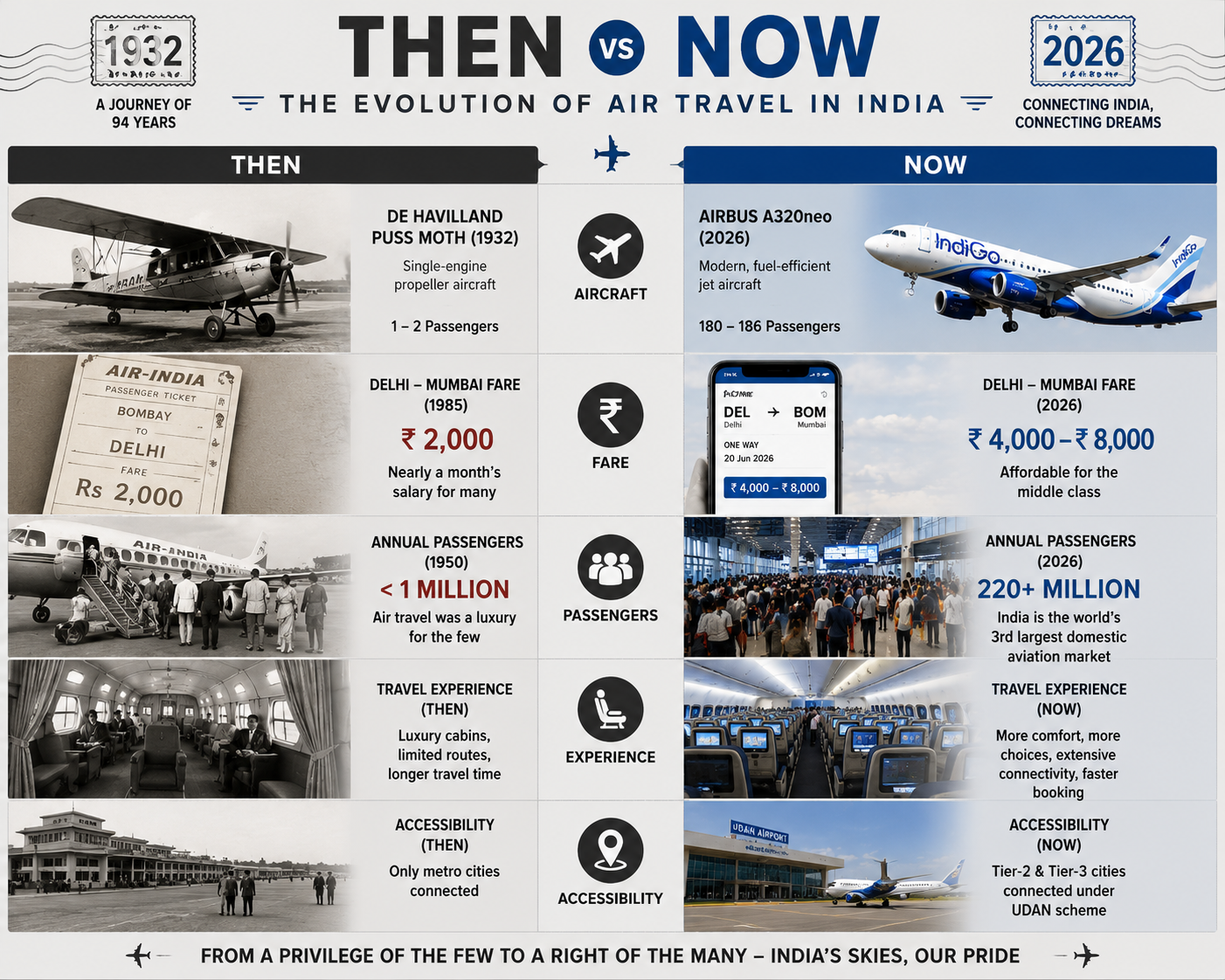
India’s civil aviation history began on October 15, 1932, when J.R.D. Tata piloted a single-engine de Havilland Puss Moth carrying mail from Karachi to Bombay and then to Madras. This marked the beginning of Tata Air Mail, the precursor to Air India.
At the time, air travel was an extraordinary experience. Aircraft were small, airports were rudimentary, and passenger services were limited. The cost of operating airplanes was extremely high, which naturally translated into expensive tickets.
Flying was reserved for:
· British colonial administrators
· Indian princes and maharajas
· Wealthy businessmen
· Military officers
· Foreign travelers
For ordinary Indians, railways remained the dominant mode of long-distance transport. A train ticket cost a fraction of an air ticket and offered much wider connectivity.
Historical Fact
In the 1930s and 1940s, an air ticket on certain routes could cost more than the annual income of a rural household.
Thus, aviation began as an exclusive mode of transportation rather than a public service.
The Golden Age of Air India
After Independence, aviation became a symbol of national pride.
In 1953, the Government of India nationalized the airline industry through the Air Corporations Act.
Two corporations emerged:
Air India
Responsible for international operations.
Indian Airlines
Responsible for domestic services.
The government viewed aviation as a strategic sector and sought to ensure reliable connectivity across the country.
During the 1950s and 1960s, Air India gained a global reputation under the leadership of J.R.D. Tata. Known for luxury, elegance, and excellent service, the airline was often ranked among the world’s best carriers.
Domestically, however, flying remained expensive.
Why Air Fares Were So High
Several factors contributed to high fares during the nationalization era.
1. Monopoly Structure
Indian Airlines faced little competition. Without rival carriers, there was limited pressure to reduce prices.
2. Small Passenger Base
Airlines had fewer passengers over whom to spread operational costs.
3. Expensive Aircraft
Most aircraft were imported and required costly maintenance.
4. Limited Airports
India’s aviation infrastructure was underdeveloped.
5. Regulated Pricing
The government controlled fare structures, reducing incentives for innovation and price competition.
As a result, flying became associated with prestige and privilege.
Air Travel in the 1970s and 1980s
By the 1970s, Indian Airlines had expanded its network significantly.
Major routes included:
· Delhi–Mumbai
· Delhi–Kolkata
· Mumbai–Chennai
· Delhi–Chennai
· Mumbai–Bengaluru
Yet flying remained inaccessible for most Indians.
Liberalization: The Turning Point
Everything changed in 1991.
Facing an economic crisis, India launched sweeping economic reforms under Prime Minister P.V. Narasimha Rao and Finance Minister Dr. Manmohan Singh.
The aviation sector gradually opened to private participation.
New airlines emerged:
· Jet Airways
· Sahara Airlines
· East-West Airlines
· Modiluft
· Damania Airways
For the first time, Indian Airlines faced competition.
Passengers now had alternatives.
Competition led to:
· Better service
· More routes
· Improved aircraft quality
· Promotional fares
Although tickets remained expensive, the monopoly era was ending.
The Repeal of the Air Corporations Act
A major milestone came in 1994 when the Air Corporations Act was repealed.
Private airlines could now operate scheduled services.
This decision fundamentally altered the economics of Indian aviation.
The number of flights increased.
Passenger traffic rose steadily.
The middle class began viewing flying as an attainable option rather than an impossible luxury.
The Air Deccan Revolution
No single event transformed Indian air fares more dramatically than the arrival of Air Deccan in 2003.
Founded by Captain G.R. Gopinath, Air Deccan introduced India’s first true low-cost carrier model.
Its famous slogan was:
“Now Every Indian Can Fly.”
The airline eliminated unnecessary luxuries and focused on affordability.
Passengers paid only for essentials.
Most importantly, Air Deccan introduced the legendary:
Re 1 Ticket
The campaign became one of the most famous marketing innovations in Indian aviation history.
For millions of Indians, it symbolized a new era.
How Low-Cost Airlines Changed India
The success of Air Deccan inspired a wave of budget carriers:
· IndiGo
· SpiceJet
· GoAir
· Kingfisher Red
The impact was revolutionary.
Fares Collapsed
Routes that once cost ₹6,000–₹8,000 became available for ₹2,000–₹3,000.
Passenger Numbers Soared
|
Year |
Domestic Passengers |
|
2003 |
20 million |
|
2005 |
24 million |
|
2008 |
45 million |
|
2010 |
53 million |
Millions of first-time flyers entered the aviation system.
The Digital Revolution
Another major factor reducing air fares was technology.
Before the internet:
· Tickets were purchased through travel agents.
· Airlines incurred significant distribution costs.
After online booking platforms emerged:
· Customers booked directly.
· Operational costs fell.
· Airlines could offer discounts.
Web-exclusive fares became common.
Price comparison websites increased competition further.
Consumers benefited enormously.
The Rise of IndiGo
Founded in 2006, IndiGo perfected the low-cost model.
Its strategy included:
· One aircraft family
· Fast aircraft turnaround
· High punctuality
· Cost efficiency
IndiGo grew rapidly and became India’s largest airline.
Today it carries more passengers annually than the entire Indian aviation industry carried during the 1980s.
Its success transformed consumer expectations regarding affordability.
UDAN: Making Flying Accessible
In 2016, the Government launched the UDAN scheme.
The acronym stands for:
Ude Desh ka Aam Nagrik
The goal was simple:
Bring affordable air travel to ordinary citizens.
The programme:
· Subsidized regional routes
· Revived dormant airports
· Connected remote regions
Many routes featured fare caps around ₹2,500 for one-hour flights.
For the first time, small towns gained access to commercial aviation.
Air Fares and Inflation
One of the most overlooked aspects of aviation history is inflation.
A ₹2,000 ticket in 1985 would be worth approximately ₹15,000–₹20,000 today.
Yet many modern routes are available for:
· ₹3,000
· ₹4,000
· ₹5,000
This means air travel is significantly cheaper in real terms than it was four decades ago.
Why Air Fares Are Rising Again in 2026
Despite the success of low-cost aviation, air fares have once again become a major issue.
Several factors are responsible:
Fuel Costs
ATF accounts for nearly 35–40% of airline operating expenses.
Aircraft Shortages
Global supply-chain disruptions have delayed aircraft deliveries.
Strong Demand
Domestic aviation is experiencing record passenger growth.
Airport Charges
Infrastructure expansion increases operating costs.
Dynamic Pricing
Airlines continuously adjust prices based on demand.
As a result, passengers often experience dramatic fare fluctuations.
India is now the third-largest domestic aviation market in the world, behind only the United States and China.
Conclusion: The Democratization of the Skies
The history of air fares in India is ultimately a story of democratization. What began as an exclusive privilege for colonial administrators, princes, and industrialists has evolved into a service used by students, migrant workers, entrepreneurs, pilgrims, and families.
The transformation was driven by liberalization, competition, technology, low-cost airlines, and government initiatives such as UDAN.
Yet the story is not over. As India debates fare regulation, passenger rights, and the future of aviation in 2026, the central challenge remains the same: balancing affordability with sustainability.
One thing, however, is beyond doubt. Few developments in modern India have been as transformative as the opening of the skies to ordinary citizens. The journey from the age of maharajas to the age of mass aviation stands as one of the country’s most remarkable economic and social success stories.