
From a young nationalist shaped by Punjab’s political upheavals to a revolutionary, journalist and political thinker, Bhagat Singh’s 23 years left behind a legacy that extended far beyond the gallows.
On September 28, 1907, Bhagat Singh was born in Banga village in Lyallpur district of undivided Punjab, now in Pakistan. He would live for less than 24 years, but the political and intellectual journey compressed into those years would make him one of the most recognisable figures of India’s freedom struggle. His life unfolded during a period when Punjab was witnessing intense political activity, revolutionary movements, agrarian unrest and growing opposition to British rule. The environment in which he grew up therefore exposed him from an early age to the political questions that would eventually shape his own ideas.
Bhagat Singh is remembered most prominently as a revolutionary who was executed by the British government on March 23, 1931, along with Shivram Rajguru and Sukhdev Thapar. Yet reducing him to the image of a young man walking to the gallows overlooks a significant part of his story. He was a reader, writer, journalist and political organiser whose surviving writings show a young revolutionary wrestling with questions that extended beyond the immediate objective of ending British rule. He thought about what should replace colonial rule, what revolution actually meant, what role workers and peasants should play in society, whether political freedom could exist without social and economic equality, and what place religion should have in public life.
Punjab shaped the boy who would become Bhagat Singh
Bhagat Singh was born into a family with links to the nationalist movement. His father Kishan Singh and uncle Ajit Singh were involved in political activity against colonial policies, while the wider political atmosphere of Punjab exposed the family to the nationalist currents of the period. The Government of India’s Dictionary of Martyrs records his early life and subsequent education at Lahore’s National College, an institution associated with Lala Lajpat Rai and established as an alternative to colonial educational institutions. His family background and the political environment around him meant that the struggle against British rule was not an abstract idea that he encountered only in adulthood.
Punjab itself occupied a distinctive place in the politics of British India. The province had witnessed resistance to colonial policies, the Ghadar movement, agrarian discontent and growing nationalist mobilisation. The execution of Kartar Singh Sarabha, the young Ghadar revolutionary who was hanged in 1915, left a particularly strong impression on Bhagat Singh. Sarabha became one of the revolutionary figures whom Bhagat Singh admired, and his example formed part of the political tradition that influenced the young revolutionary’s understanding of sacrifice and resistance.
The massacre at Jallianwala Bagh in Amritsar in 1919 further intensified the political atmosphere in Punjab. Bhagat Singh was still a child when British troops under General Reginald Dyer opened fire on a gathering at the site, killing hundreds of people. The event became a defining moment in the history of the Indian freedom movement and had a profound effect on the political consciousness of the generation that came of age in its aftermath. Bhagat Singh’s later political development unfolded against this background of deepening distrust of colonial authority.
As a student, Bhagat Singh eventually moved to Lahore and joined the National College. The institution was intended to provide an education outside the framework of government-controlled institutions and became a meeting place for young people influenced by nationalist politics. His years in Lahore exposed him to political debates and literature that extended beyond conventional nationalism. He developed a deep interest in history, political theory, economics and revolutionary movements in other countries, and reading became an increasingly important part of his political development.
From nationalist youth to political organiser
Bhagat Singh’s political activity developed rapidly during the 1920s. In March 1926, he became one of the principal organisers of the Naujawan Bharat Sabha in Lahore. The organisation sought to mobilise young people, encourage political consciousness and oppose communal divisions. Its activities reflected Bhagat Singh’s growing belief that political independence required an organised and politically aware population rather than simply a change in the identity of those exercising power.
The Sabha was also significant because it demonstrated the shift taking place in Bhagat Singh’s political thinking. His opposition to British rule remained central, but his concerns were increasingly connected with questions of social and economic transformation. He was becoming interested in socialism and in the political role of workers and peasants. The young revolutionary was therefore beginning to think about the society that should emerge after colonialism rather than concentrating exclusively on the removal of British authority.
Bhagat Singh was simultaneously becoming involved in revolutionary organisations. The Hindustan Republican Association, which had been associated with revolutionaries including Ram Prasad Bismil and Ashfaqulla Khan, was reorganised in 1928 as the Hindustan Socialist Republican Association. The addition of “Socialist” to the organisation’s name reflected the increasing influence of socialist ideas among its members and their desire to link the struggle for independence with a broader transformation of society.
His political work was not confined to underground activity. Bhagat Singh wrote for newspapers and journals and used pseudonyms while contributing to publications including Pratap, Vir Arjun and Kirti. His journalism provided another means of reaching young Indians and discussing political developments. The image of Bhagat Singh as only a man of action therefore leaves out an important part of his political life: he was also attempting to influence people through arguments, articles and political education.
This intellectual side became increasingly visible in his later writings. Bhagat Singh did not regard revolution merely as an isolated act of violence against a colonial official. In his statement following the Assembly bombing, he and Batukeshwar Dutt presented revolution as a fundamental transformation of an unjust political and social order. His conception of revolution therefore had a political and social meaning that extended beyond the dramatic acts for which he became famous.
When grief turned into revenge
The arrival of the Simon Commission in India in 1928 generated widespread opposition because the commission contained no Indian member. In Lahore, nationalist protesters demonstrated against it under the leadership of Lala Lajpat Rai. Police used force to disperse the protesters, and Rai was injured during the demonstration. He died on November 17, 1928.
Bhagat Singh and his associates decided to retaliate against the police officer whom they believed had ordered the lathi charge. Their intended target was James A Scott, but on December 17, 1928, the revolutionaries mistakenly shot John P Saunders, an Assistant Superintendent of Police, outside the Lahore police headquarters. The Government of India’s historical records describe the incident as a case in which Saunders was killed when the revolutionaries had intended to target Scott.
The Saunders killing changed the course of Bhagat Singh’s life. The revolutionaries went underground while the colonial authorities intensified their efforts to identify and arrest those responsible. Bhagat Singh subsequently became one of the most wanted young revolutionaries in northern India, and the secrecy surrounding his movements became an increasingly important part of his life.
The episode also illustrates the complexity of his political journey. At the time of the killing, Bhagat Singh was already becoming interested in mass political mobilisation, socialist thought and the use of political communication. Yet he remained committed to armed revolutionary action. His later writings would reveal a more developed understanding of revolution, but they cannot be separated from the fact that he had participated in a violent campaign against the colonial state.
A bomb, a courtroom and a message to the Raj
On April 8, 1929, Bhagat Singh and Batukeshwar Dutt entered the Central Legislative Assembly in Delhi and threw bombs in the chamber. The action was connected with opposition to the Public Safety Bill and the Trade Disputes Bill, which the revolutionaries regarded as measures designed to strengthen colonial repression.
The action was fundamentally different from the Saunders killing in one important respect. After throwing the bombs, Bhagat Singh and Dutt did not attempt to flee. They remained at the scene, distributed revolutionary literature and allowed themselves to be arrested. Their intention was to use the subsequent trial as a political platform and explain their ideas to a wider public. Their statement explained the political reasoning behind the action and famously described its purpose as an attempt to “make the deaf hear”. The statement also presented their understanding of revolution as a transformation of an unjust order rather than simply an act of destruction. The courtroom consequently became an extension of the political campaign.
Bhagat Singh understood the importance of publicity. His arrest ensured that his name could no longer remain confined to underground revolutionary circles. Newspapers reported the case, his statements reached a much wider audience, and the young revolutionary became a public political figure. His photograph in a felt hat, taken by photographer Ramnath in Delhi’s Kashmere Gate area before the Assembly bombing, subsequently became one of the most recognisable images associated with the Indian freedom struggle.
The prison became another political battlefield
Following their arrests, Bhagat Singh and other revolutionary prisoners protested against the conditions in which they were being held. They demanded better treatment for political prisoners and objected to the differences in prison conditions between European and Indian inmates. The protest developed into a prolonged hunger strike that attracted considerable public attention. Jatin Das, another revolutionary prisoner, joined the hunger strike in Lahore jail. He died on September 13, 1929, after 63 days of fasting. His death generated widespread public reaction, and his funeral procession in Calcutta drew enormous crowds. The episode transformed the issue of prison conditions into a wider political question and further increased public attention surrounding Bhagat Singh and his fellow revolutionaries.
The hunger strike demonstrated the changing nature of revolutionary politics. The prisoners were no longer relying solely on secret organisations and armed action. Their bodies, their legal proceedings and their prison conditions had themselves become instruments of political communication. The colonial government could imprison the revolutionaries, but their protests inside prison continued to reach the public outside.
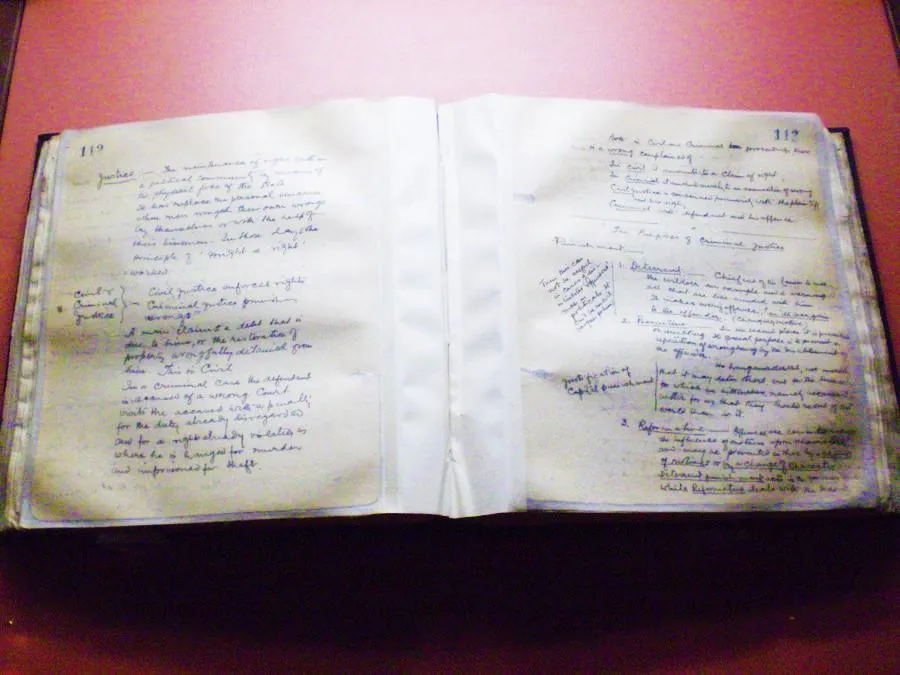
For Bhagat Singh, imprisonment also became a period of intense intellectual activity. He continued to read and write and maintained a prison diary. The National Archives of India holds archival material relating to Bhagat Singh, including his diary, letters from Lahore Central Jail and material connected with the Lahore Conspiracy Case. These records provide evidence of the extent to which reading and writing remained central to his political life even as he faced the possibility of execution.
The revolutionary who questioned everything
One of Bhagat Singh’s most significant writings from prison was “Why I Am an Atheist”. Written in Lahore Central Jail, the essay was not simply a declaration of disbelief. Bhagat Singh used it to examine the development of his own thinking and to explain why he had rejected religious belief. He discussed questions of reason, faith, human suffering and the charge that his atheism was a product of arrogance.
The essay is important because it shows the degree to which Bhagat Singh was prepared to examine his own beliefs. His political writings repeatedly reveal a young man attempting to understand the world through political theory, history and reason rather than accepting inherited ideas without examination.
His conception of revolution similarly developed beyond the popular image of the armed revolutionary. Bhagat Singh increasingly connected political freedom with social and economic questions. He wrote about the exploitation of workers and peasants and argued that the transfer of political power alone would not necessarily produce the kind of society he envisaged. This was also why the socialist element of the HSRA mattered to him. The objective was not simply to replace British rulers with Indian rulers while leaving existing structures of economic exploitation untouched. His political writings suggested that independence had to be accompanied by a wider transformation in social relations.
The courtroom becomes a political stage
The Lahore Conspiracy Case brought Bhagat Singh, Rajguru and Sukhdev into one of the most closely watched political trials of the period. The colonial government established a special tribunal to try the case, and the proceedings became another opportunity for the accused revolutionaries to present their political arguments.
The National Archives of India preserves material relating to the Lahore Conspiracy Case, including proceedings and judgments.