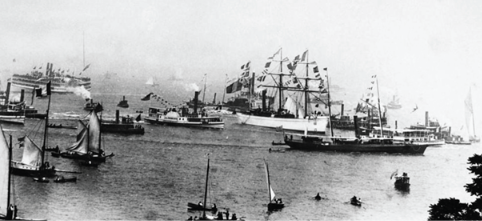
October 28, 1886, marked the dedication of one of the world’s most recognisable monuments. What began as a gesture of friendship between France and the United States eventually acquired a meaning that extended far beyond the two nations, becoming a symbol of liberty, immigration, democracy and the enduring human search for a better life. As the anniversary of its dedication returns each year, the Statue of Liberty offers an opportunity to revisit the history of a monument whose significance has continued to evolve across generations.
Standing at the entrance to New York Harbor, the statue welcomed ships approaching the American coastline and, in the decades that followed, became closely associated with millions of immigrants arriving in search of safety, opportunity and a new beginning. Its raised torch came to represent enlightenment and hope, while its tablet and broken chains evoked the ideals of liberty and emancipation. Yet the monument’s journey from a diplomatic gift to a global symbol was neither immediate nor straightforward.
Its construction required cooperation between two nations, its financing depended on ordinary citizens, and its public meaning evolved through political change, migration and cultural interpretation. The story of the Statue of Liberty is therefore not merely the history of a monument but also an exploration of how societies express their ideals and how those ideals acquire meaning across generations.
An idea born out of revolution And political change
The origins of the Statue of Liberty can be traced to 1865, when the American Civil War came to an end and the United States began confronting the consequences of slavery and the challenges of rebuilding the nation. The conflict had tested the survival of the American republic, while the abolition of slavery raised fundamental questions about the meaning of freedom and equality. In France, political thinker Édouard René de Laboulaye followed American developments with considerable interest.
A supporter of democratic government and an authority on the American constitutional system, Laboulaye believed that the United States offered an important example of republican ideals. He also opposed slavery and supported the abolitionist cause. Laboulaye proposed that France present a monument to the American people to commemorate the centenary of their independence, which would fall in 1876.
The proposed gift would celebrate the historical alliance between the two nations and express the hope that democratic principles would continue to advance. The idea also carried a domestic political message. France had experienced repeated changes in government during the nineteenth century, moving between monarchy, empire and republican rule. For Laboulaye, celebrating American liberty was also a way to encourage support for democratic government in his own country. The monument was thus conceived as more than a decorative structure. It would embody a political philosophy and serve as a reminder of the principles that its supporters believed should guide modern societies.
Laboulaye’s proposal found an enthusiastic supporter in sculptor Frédéric Auguste Bartholdi, who was drawn to the challenge of creating a monumental figure visible from a considerable distance. Bartholdi had already developed an interest in colossal sculptures and believed that an enormous representation of liberty could combine artistic expression with a powerful public message. The project gradually took shape, although it would take another decade before the statue stood completed in New York Harbor.
Bartholdi’s vision takes shape
Bartholdi envisioned a monumental female figure dressed in flowing robes, holding a torch aloft in her right hand and a tablet in her left. The torch would represent enlightenment, while the tablet would refer to the principles of American independence. The statue was given the French title La Liberté éclairant le monde, meaning Liberty Enlightening the World. The figure drew upon classical representations of liberty and freedom, particularly the tradition of depicting abstract ideals as female figures.
Rather than representing a specific historical individual, Bartholdi’s creation embodied an idea that could transcend national boundaries. Its tablet bears the date July 4, 1776, in Roman numerals, commemorating the adoption of the United States Declaration of Independence. At the statue’s feet are broken chains and shackles, partly obscured by the flowing robes, representing liberation from oppression. These details gave the monument a deeper meaning than its sheer size might initially suggest. It was intended to celebrate the emergence of a nation founded on declarations of political liberty while also reflecting the wider struggle against bondage.
The abolitionist dimension was particularly important to Laboulaye and other supporters of the project. The end of slavery in the United States had reinforced their belief that the monument could commemorate not only national independence but also the expansion of human freedom. Bartholdi travelled to the United States in 1871 to promote the project and identify a suitable location. He selected Bedloe’s Island, situated at the entrance to New York Harbor, because approaching ships could see the monument from the water. The location was crucial to the statue’s eventual identity. Positioned at the gateway to one of the world’s busiest ports, it would greet travellers before they reached the city itself. The island, later renamed Liberty Island, offered the setting for a monument intended to communicate its message to people arriving from across the Atlantic.
A monumental collaboration between France and America
The Statue of Liberty was designed as a joint undertaking. France would finance and construct the statue, while Americans would raise money for its pedestal and foundation. This division reflected the political symbolism of the project: the French would offer the monument, but its permanent home would depend on the participation of the American public. The Franco-American Union was established in 1875 to organise fundraising and coordinate the work.
Contributions were sought from individuals, organisations and supporters on both sides of the Atlantic. The financing proved difficult. The statue was an ambitious undertaking, requiring vast quantities of material, specialised labour and complex engineering. Its cost also exceeded what could easily be raised through the enthusiasm surrounding the original proposal. The pedestal became a particular obstacle. The American committee struggled to secure sufficient funding, and construction was threatened by financial uncertainty.
Newspaper publisher Joseph Pulitzer eventually played an important role in reviving the campaign. Through his newspaper, The New York World, he appealed to ordinary Americans to contribute, arguing that the project should not depend exclusively on wealthy donors. The campaign attracted thousands of small contributions. Many donors gave modest sums, demonstrating how a project associated with national pride could mobilise public participation even when its immediate benefits were difficult to quantify.
The episode also revealed a tension that would remain part of the statue’s history: a monument celebrating democratic ideals depended on resources and cooperation that were not always easy to secure. Meanwhile, the French project moved ahead. Bartholdi’s workshop in Paris produced the statue in sections, with the copper exterior formed into thin sheets that could be shaped and assembled around a supporting framework. The result would combine traditional sculptural craftsmanship with engineering techniques that made a structure of unprecedented scale possible.
Gustave Eiffel And the engineering behind the monument
The Statue of Liberty’s exterior is its most recognisable feature, but its survival depends on the engineering concealed beneath the copper surface. As the project developed, the designers faced the challenge of supporting a very large structure exposed to strong winds in New York Harbor. A solid sculpture of that size would have been impractical because of its weight and the stresses it would place on the foundation.
Bartholdi’s project therefore required an internal framework that could support the copper sheets while allowing the monument to withstand changing weather conditions. Following the death of the original engineer, Eugène Viollet-le-Duc, Bartholdi brought in engineer Alexandre-Gustave Eiffel in 1879. Eiffel, who would later become internationally famous for the Eiffel Tower, developed the statue’s internal support system with his engineering team.
The framework allowed the copper skin to remain relatively light while distributing the structure’s weight and accommodating movement caused by wind and temperature changes. The design brought together artistic ambition and practical engineering. The exterior had to preserve the flowing lines of Bartholdi’s sculpture, while the supporting structure had to make the monument stable and durable. The statue was constructed in Paris between 1875 and 1884. Its head, arm and other sections were assembled during the construction process, allowing the public to see portions of the work before the entire monument was completed.
The torch-bearing arm was displayed at the Centennial Exposition in Philadelphia in 1876, introducing many Americans to the project as the country marked the hundredth anniversary of its independence. The completed statue was formally presented to the United States in Paris in 1884. It was then dismantled into sections for transportation across the Atlantic. The scale of the undertaking was considerable. The monument was packed into 214 wooden cases and shipped aboard the French vessel Isère, which arrived in New York Harbor on June 17, 1885.
There, the sections awaited reassembly while work on the pedestal continued. Once the foundation and pedestal were ready, workers began the painstaking task of putting the monument back together. The engineering achievement was central to the statue’s significance. Its combination of copper craftsmanship and structural innovation demonstrated how advances in technology could make a monumental artistic vision a reality.
The day liberty was dedicated
By the autumn of 1886, the Statue of Liberty was ready for its formal dedication. The date chosen was October 28, marking the culmination of a project that had involved years of planning, fundraising, construction and international cooperation. The ceremony drew dignitaries, public officials and spectators to New York Harbor. US President Grover Cleveland formally accepted the monument on behalf of the United States, acknowledging it as a gift from the French people.
Bartholdi, who had devoted years to the project, witnessed the culmination of his artistic vision. During the ceremony, the French flag covering the statue’s face was removed, revealing the monumental figure to the assembled audience. The celebrations extended beyond the island. A naval procession passed through the harbor, while a major parade moved through New York City. The occasion became a public demonstration of the close relationship between France and the United States. The weather was poor, with fog and rain affecting visibility.
Nevertheless, the dedication proceeded, and the statue was formally unveiled. The day also revealed a contradiction in the society celebrating the monument. Women associated with the suffrage movement were unable to obtain tickets to the island ceremony because women attending without male escorts were excluded. Members of the New York State Woman Suffrage Association instead chartered a boat to watch the proceedings from the water. Their exclusion offered a reminder that political liberty was not equally accessible to everyone.
The monument celebrated freedom, but the society gathered to honour it continued to debate who should enjoy full political rights. The episode became part of the statue’s wider historical significance. Its ideals could be celebrated in public while also exposing the distance between national principles and social realities. The dedication therefore marked more than the completion of an engineering project. It introduced a monument whose meaning would continue to change as the country confronted questions of citizenship, equality, migration and political participation.
From A national monument to a gateway for immigrants
The Statue of Liberty’s association with immigration grew over time, particularly during the late nineteenth and early twentieth centuries, when millions of people arrived in the United States from Europe and other parts of the world. For many passengers approaching New York Harbor, the statue became one of the first striking sights of their new country. Its position at the entrance to the harbour made it an unmistakable landmark, visible to ships carrying people who had travelled long distances in search of work, security or escape from political and religious persecution.
The experience of immigration was rarely simple. Many newcomers faced poverty, discrimination, difficult working conditions and the challenge of adapting to an unfamiliar society. Yet the statue became associated with the possibilities that had drawn them across the ocean. The nearby immigration station at Ellis Island, which opened in 1892, processed millions of arrivals. The statue was not itself an immigration inspection station, but its presence in the harbour helped shape the experience and memory of entering the United States.
For people who had left their homes behind, the torch could represent the hope of beginning again. For families separated by distance and circumstance, the monument became part of a larger story of migration and belonging. Its symbolism was strengthened by literature. In 1883, American poet Emma Lazarus wrote The New Colossus to help raise funds for the statue’s pedestal. Her poem offered a different interpretation of the monument, portraying it as a welcoming figure for people seeking refuge and opportunity.
The poem was not part of the original dedication ceremony. In 1903, a bronze plaque bearing its text was installed inside the pedestal. Its language helped establish the statue as a symbol of welcome, particularly for immigrants and refugees. The monument increasingly came to represent not simply the political independence of an established nation but also the promise of a country shaped by people arriving from elsewhere.
This interpretation did not erase the difficulties faced by immigrants or the restrictions imposed on different groups. Instead, it gave the statue an additional meaning that often existed in tension with the realities of American immigration policy. The monument’s transformation demonstrated how public symbols can acquire meanings beyond those intended by their creators. What began as a gift celebrating national independence gradually became an emblem of migration, opportunity and the search for a place to call home.
The symbols hidden in plain sight
The Statue of Liberty’s enduring influence rests partly on its carefully chosen visual details. The torch is perhaps its most immediately recognisable feature. Raised above the figure’s head, it represents enlightenment and the spread of ideas. It suggests that freedom is not merely the absence of restraint but also the ability to pursue knowledge, exercise judgement and participate in public life. The tablet held in the statue’s left hand carries the date of American independence.
It connects the monument to the Declaration of Independence and its assertion that people possess fundamental rights. The broken chains at the statue’s feet evoke emancipation and liberation from oppression. Although they are not immediately visible from every viewing angle, they provide an important clue to the ideals that informed the original project. Together, these elements communicate a vision of liberty grounded in political independence, human dignity and the rejection of bondage. The statue’s scale also contributes to its symbolic power. Its total height, measured from the ground to the tip of the torch, is approximately 93 metres, including the pedestal and foundation.
The monument’s copper exterior has gradually developed its familiar green appearance through oxidation. Its size makes it visible across the harbour, while its silhouette remains recognisable even in photographs, illustrations and popular culture. The monument has also become a setting for political expression. Its symbolism has been invoked in debates over immigration, civil rights, national identity and the meaning of democracy. Different groups have interpreted the statue in different ways, sometimes celebrating its promise and sometimes drawing attention to the gap between its ideals and contemporary policies. This continuing debate is part of what makes the monument historically significant. It is not simply a relic of the nineteenth century but a symbol through which successive generations have examined their own societies.
Liberty And the Indian experience
For Indian readers, the history of the Statue of Liberty offers an opportunity to consider the relationship between political ideals and lived experience. India’s own modern history was shaped by the struggle against colonial rule, the demand for self government and the effort to establish a democratic republic after independence in 1947. The Indian national movement drew upon a range of ideas about liberty, equality, dignity and political participation. Leaders and reformers debated how freedom should be understood, who should enjoy its benefits and how it could be translated into institutions.