International Tiger Day Special | Protecting Tigers, Preserving Ecosystems
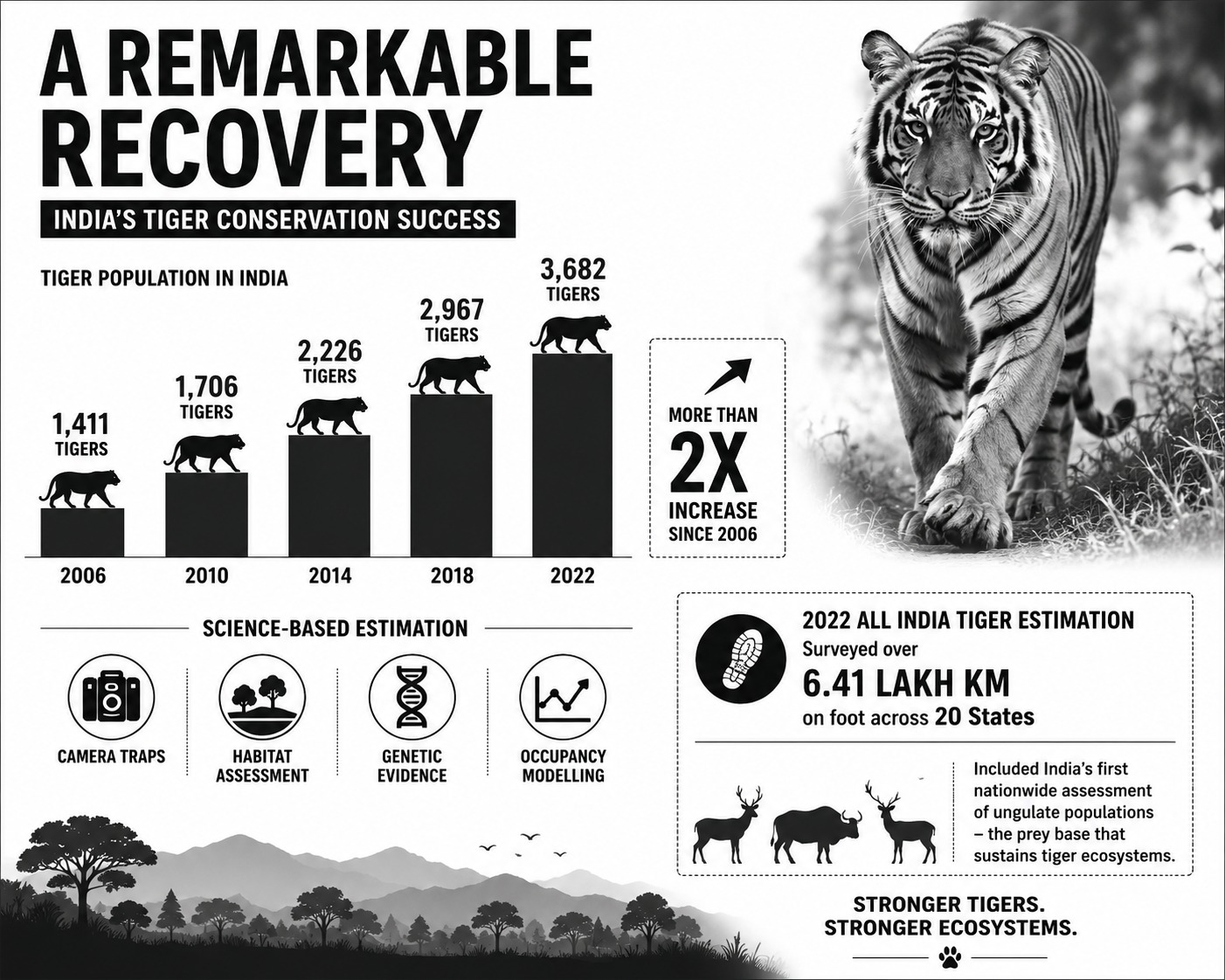
There are few conservation stories in the world as inspiring as India’s journey with the tiger. At the dawn of the 20th century, an estimated 40,000 tigers roamed the Indian subcontinent. By the early 1970s, relentless hunting, habitat destruction and poaching had pushed the species to the brink, leaving just 1,827 tigers in the country’s first official census in 1972. Fifty-three years later, India has rewritten that narrative. Today, with an estimated 3,682 wild tigers, India is home to nearly 70 per cent of the world’s wild tiger population, making it the undisputed global leader in tiger conservation.
As the world marks International Tiger Day on July 29, India’s conservation model stands as proof that political commitment, scientific management, community participation and technological innovation can reverse even the gravest ecological crises. More importantly, India’s success demonstrates that conserving tigers means safeguarding forests, rivers, biodiversity and the ecological foundations of human well-being.
A Legacy Rooted in Culture
India’s relationship with the tiger predates modern conservation by thousands of years. Tigers appear on ancient coins, temple sculptures, royal insignia and tribal art, symbolising courage, sovereignty and power. They are closely associated with Goddess Durga, who rides a tiger, representing the triumph of good over evil.
Recognising this deep cultural connection, the Government of India declared the Royal Bengal Tiger as the National Animal in 1972, replacing the Asiatic lion. The decision coincided with the growing realisation that the tiger, once abundant across the country, was disappearing at an alarming pace.
Yet the tiger is more than a cultural icon. As an apex predator and an umbrella species, it sits at the top of the food chain, regulating prey populations and maintaining ecological balance. Conserving tiger habitats protects thousands of plant and animal species, secures river systems, stores carbon, conserves soil and supports climate resilience. In many ways, protecting tigers means protecting the natural systems that sustain millions of Indians.
From Crisis to Conservation
The decades following Independence witnessed widespread deforestation, expansion of agriculture, infrastructure development and rampant trophy hunting. The situation became so alarming that the Government enacted the Wildlife (Protection) Act, 1972, India’s first comprehensive legislation for wildlife conservation.
A year later, on 1 April 1973, Prime Minister Indira Gandhi launched Project Tiger, one of the most ambitious wildlife conservation programmes in history.
Initially covering nine tiger reserves, the programme shifted the conservation approach from protecting individual animals to conserving entire ecosystems. Instead of focusing only on anti-poaching measures, Project Tiger emphasised habitat restoration, prey-base improvement, scientific monitoring and community engagement.
Over the decades, Project Tiger evolved into the backbone of India’s wildlife conservation framework.
Today, according to the National Tiger Conservation Authority (NTCA), India has 58 tiger reserves across 18 tiger-range States, covering nearly 84,500 square kilometres, or about 2.56 per cent of India’s geographical area. This network represents one of the largest protected landscapes anywhere in the world.
Science Drives Conservation
Modern tiger conservation in India is powered by technology.
The Monitoring System for Tigers – Intensive Protection and Ecological Status (M-STrIPES) enables forest personnel to digitally record patrol routes using GPS, GPRS and remote sensing technologies. Every patrol, wildlife sighting and illegal activity is logged in real time, creating a comprehensive database for management decisions.
Artificial intelligence has further transformed wildlife monitoring.
The Camera Trap Data Repository and Analysis Tool (CaTRAT) automatically identifies species captured by camera traps, while ExtractCompare recognises individual tigers through their unique stripe patterns, significantly improving the accuracy of population estimation.
These innovations have reduced human error, improved anti-poaching efforts and enhanced habitat management.
In fact, the NTCA’s camera-trap exercise has earned a Guinness World Record as the world’s largest camera trap wildlife survey, highlighting India’s global leadership in wildlife monitoring.
Institutions That Made the Difference
Project Tiger’s success rests on a robust institutional framework.
The National Tiger Conservation Authority (NTCA), established following amendments to the Wildlife (Protection) Act in 2006, provides scientific, financial and technical guidance to tiger-range States. Chaired by the Union Minister for Environment, Forest and Climate Change, the Authority oversees tiger reserves, approves Tiger Conservation Plans and regularly evaluates reserve management.
Every tiger reserve is legally required under Section 38V of the Wildlife (Protection) Act to prepare a comprehensive Tiger Conservation Plan, ensuring habitat protection, prey management and long-term ecological sustainability.
Equally important was the creation of the Wildlife Crime Control Bureau (WCCB), which strengthened India’s fight against organised wildlife trafficking.
Following the Sariska tiger crisis in Rajasthan—where poaching wiped out the reserve’s entire tiger population—the Government also constituted the Tiger Task Force. Its recommendations transformed India’s conservation strategy by emphasising transparency, local participation and stronger institutional accountability.
Measuring Success Beyond Numbers
India recognises that tiger conservation is not merely about increasing populations.
Through the Management Effectiveness Evaluation (MEE) framework, the Government regularly assesses the quality of reserve management.
The evaluation measures planning, protection, habitat improvement, governance and conservation outcomes.
By 2022, 51 tiger reserves had undergone evaluation, with 12 reserves receiving “Excellent” ratings. The overall average management score reached 78 per cent, reflecting significant improvements in governance and conservation effectiveness.
Such assessments ensure that conservation success is measured not only by tiger numbers but also by habitat quality and long-term ecological sustainability.
Conservation Beyond Borders
India’s leadership extends well beyond its own forests.
The country actively collaborates with Nepal, Bhutan, Bangladesh, Myanmar, Russia and China on transboundary wildlife conservation and anti-poaching initiatives.
India also cooperates with Botswana, Kenya, South Africa, Namibia, Cambodia and Guatemala on biodiversity conservation and wildlife management.
One of India’s most significant recent initiatives is the International Big Cat Alliance (IBCA), approved by the Union Cabinet in March 2024. Headquartered in India, the Alliance brings together 95 big cat range and partner countries to promote conservation of seven iconic big cats—the tiger, lion, leopard, snow leopard, cheetah, jaguar and puma.
India also hosts the Global Tiger Forum (GTF) in New Delhi, the world’s only intergovernmental organisation dedicated exclusively to tiger conservation. Bringing together 13 tiger-range countries, the Forum promotes scientific collaboration, landscape-level conservation and knowledge sharing across Asia.
Additionally, India participates in the Integrated Tiger Habitat Conservation Programme (ITHCP), the International Union for Conservation of Nature’s flagship initiative funded by Germany’s KfW Development Bank to support landscape-based conservation across Asia.
Global Recognition
International Tiger Day itself traces its origin to the 2010 Saint Petersburg Tiger Summit, where leaders from 13 tiger-range countries adopted the ambitious Tx2 Goal of doubling global tiger populations by 2022.
The global tiger population, estimated at around 3,200 in 2010, has risen to approximately 5,711 today, reflecting an increase of nearly 78 per cent. India’s conservation achievements have been the single largest contributor to this global recovery.
Another notable achievement is the international recognition of India’s tiger reserves under the Conservation Assured | Tiger Standards (CA|TS), the world’s only accreditation system specifically designed for tiger conservation areas. So far, 23 Indian tiger reserves have earned this prestigious certification, reflecting global best practices in habitat management, protection, community participation and scientific monitoring.
Tigers Mean Healthy Ecosystems
The benefits of tiger conservation extend far beyond wildlife.
Tiger landscapes secure forests that regulate water flow, recharge groundwater, prevent soil erosion, absorb carbon dioxide and support climate resilience.
Many of India’s major rivers originate or flow through tiger habitats, making forest conservation essential for water security, agriculture and urban economies.
Healthy forests also reduce the risks of floods, landslides and droughts while supporting pollination and sustaining rural livelihoods.
In other words, protecting tigers protects ecosystems—and protecting ecosystems safeguards people.
The Road Ahead
Despite extraordinary progress, new challenges continue to emerge.
Rapid infrastructure development threatens wildlife corridors. Climate change poses serious risks to fragile habitats such as the Sundarbans. Human-tiger conflict is increasing as tiger populations expand beyond protected areas. Illegal wildlife trafficking remains a persistent threat.
Recognising these challenges, India is focusing on creating connected, climate-resilient landscapes rather than isolated protected areas.
Future priorities include strengthening wildlife corridors, expanding technology-enabled monitoring, enhancing frontline staff capacity, improving coexistence with local communities and deepening international cooperation against wildlife crime.
The Government also aims to encourage greater youth participation in conservation through awareness campaigns linked to International Tiger Day.
A Roar That Inspires the World
India’s tiger story is no longer merely a national success—it is a global conservation benchmark.
Few countries have demonstrated that wildlife recovery is possible alongside rapid economic development and a growing human population. India’s achievements show that strong laws, scientific research, effective institutions, community participation and political commitment can reverse decades of ecological decline.
As the world celebrates International Tiger Day, India’s forests echo with a message of hope. The roar that once seemed destined to disappear now resonates across 58 tiger reserves and countless connected landscapes.
The tiger’s comeback is not just about saving an endangered species. It is about preserving rivers, forests, biodiversity and ecological security for future generations. In protecting its tigers, India is protecting the very ecosystems that sustain life—and offering the world a model of conservation that is as inspiring as it is enduring.