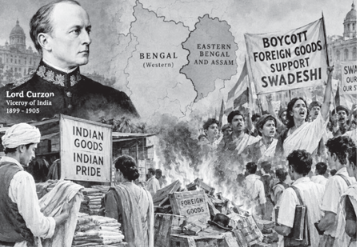
On October 16, 1905, the British government divided Bengal in the name of administrative efficiency. The decision instead sparked a movement that carried resistance into marketplaces, classrooms and cultural life, reshaping the methods and ambitions of India’s freedom struggle.
The British government drew a new boundary across Bengal in October 1905, but the consequences of that decision travelled far beyond the territory it divided. What was presented as an administrative reorganisation became a challenge to colonial authority, bringing economic resistance, cultural nationalism and public mobilisation together in ways that would influence India’s struggle for independence.
On October 16, the partition of Bengal came into effect under Viceroy Lord Curzon. The vast Bengal Presidency was reorganised, with Eastern Bengal and Assam established as a separate province and Dhaka made its capital. The government maintained that the change would improve administration in a region too large to be governed efficiently from Calcutta. For many opponents, however, the decision threatened Bengal’s political influence and its shared linguistic and cultural identity.
The reaction revealed something the colonial administration had failed to account for: a government could change provincial boundaries through an official order, but it could not necessarily determine how people would respond. Protests soon developed into a broader campaign that challenged British goods, encouraged indigenous enterprise, drew students into political activity and gave patriotic songs a new public significance. The partition was eventually reversed in 1911, but its consequences extended beyond the administrative question that had initially provoked the agitation.
The campaign helped popularise methods of resistance that connected the freedom struggle with ordinary life. A purchase could become a political statement, education could become a site of resistance, and a song could communicate a national aspiration more powerfully than a formal resolution. The story of October 16, 1905, is therefore not simply about the division of a province. It is about how an attempt to reorganise Bengal helped expand the possibilities of opposition to British rule.
The decision that set Bengal ablaze
At the turn of the twentieth century, Bengal occupied an influential position in British India’s political and intellectual life. The Bengal Presidency covered an extensive territory and had a population of approximately 78.5 million. Calcutta, then the capital of British India as well as the provincial capital, was a major centre of education, journalism, commerce and political debate.
Building an India Beyond British control
An educated Indian middle class was increasingly questioning colonial policies and demanding greater participation in government. Newspapers circulated political arguments, associations organised meetings, and public figures criticised the limited opportunities available to Indians under British rule. Bengal had become an important centre of this developing nationalist consciousness.
Lord Curzon, who served as Viceroy from 1899 to 1905, argued that the province had become too large to administer effectively from a single centre. According to the government’s position, separating eastern districts would allow officials to address regional needs more efficiently and improve governance. Opponents viewed the proposal differently. They feared that the division would weaken the connections among Bengali speaking people and reduce the political influence of a region that had become increasingly critical of colonial rule.
The creation of Eastern Bengal and Assam also changed the political balance between communities, making the reorganisation more contentious than a simple adjustment of administrative boundaries. The disagreement was not merely about whether Calcutta could govern a vast territory efficiently. It concerned who had the authority to decide how Bengal should be organised and whose interests that decision would serve. The colonial administration possessed the power to impose the change, but its insistence on administrative necessity did not persuade those who saw the partition as a threat to their political and cultural connections.
The controversy exposed the distance between colonial authority and public consent. It also provided an opportunity for nationalist leaders to connect a specific government decision with a larger argument about Indian self-government. By the time the partition took effect, opposition had already developed into an organised campaign. October 16 gave that campaign a defining moment and transformed the dispute into a sustained test of the government’s authority.
When a Boycott Became a Weapon
The resistance to Bengal’s partition acquired a new dimension when nationalists began encouraging people to reject foreign goods and support Indian-made products. The Swadeshi movement gave the agitation a practical method of resistance, allowing people to challenge colonial rule through everyday economic choices rather than relying solely on petitions and political meetings.
A major meeting at Calcutta’s Town Hall on August 7, 1905, had adopted a resolution supporting the boycott of foreign goods and the promotion of Swadeshi. The implementation of the partition gave the campaign greater urgency, turning the purchase of indigenous products into a visible expression of political commitment. Imported textiles became a particular focus of the boycott. Nationalist campaigners argued that India’s dependence on British manufactured goods weakened its economic position and made political freedom difficult to achieve.
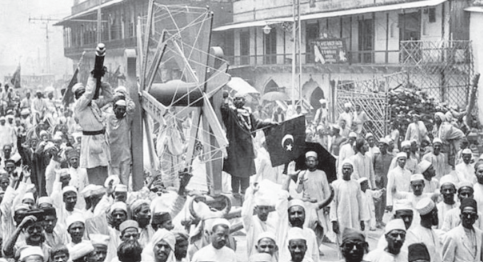
They encouraged consumers to choose Indian-made alternatives, while traders and domestic producers were urged to strengthen indigenous enterprise. The campaign brought nationalism into ordinary life. People who had little access to formal politics could participate through their purchasing decisions, while public demonstrations and boycott drives gave the movement a collective presence. The marketplace became a site of resistance, connecting individual choices with the wider demand for self-government.
Swadeshi also encouraged a constructive vision of independence. Its supporters wanted India to develop its own industries and reduce its dependence on imported manufactures. Although domestic producers faced practical challenges and the boycott’s economic impact varied, the movement established economic self reliance as an important part of nationalist politics. Its significance extended beyond the immediate demand for Bengal’s reunification. The campaign demonstrated that resistance could involve both rejecting colonial economic dependence and building alternatives to it.
Political freedom was increasingly understood not merely as a change in government, but as the ability of Indians to shape their own economic future. The campaign against the partition gradually extended into education and institution-building. Its supporters increasingly argued that India needed institutions capable of developing its own intellectual, scientific and technical resources if it was to reduce its dependence on colonial rule. Education became an important field of nationalist activity.
Critics of the existing system wanted institutions that would promote national consciousness while providing scientific and technical learning. The partition controversy intensified the search for educational alternatives that could operate outside the conventional government controlled framework. The establishment of the National Council of Education in 1906 reflected this growing interest. Its supporters sought to develop an indigenous educational system that would connect learning with India’s wider national aspirations.
The emphasis on science and technology also reflected a recognition that political freedom would require the ability to develop expertise and institutions within the country. These efforts revealed that the movement was concerned with more than forcing the government to abandon a particular policy. It also sought to build institutions that could serve Indian society on its own terms. The demand for self-government was increasingly accompanied by efforts to develop the skills, knowledge and institutional capacity an independent society would need. The initiatives did not replace the colonial educational system, nor did they immediately overcome the challenges facing Indian industry.
Their importance lay in the ambition behind them. Rather than limiting resistance to opposition, nationalists were beginning to explore how Indians could organise education and public life according to their own priorities. This constructive dimension added depth to the movement. The agitation against the partition was not simply a campaign to restore an earlier administrative arrangement; it also helped stimulate a wider discussion about the kind of society Indians wanted to build beyond colonial control.
When newspapers, songs and slogans joined the fight
The struggle over Bengal’s partition was also fought through words, music and cultural expression. Newspapers helped circulate arguments against the division, report public activity and connect local grievances with a wider debate about colonial rule. Vernacular publications were particularly important in reaching readers who did not necessarily follow English-language political discussions. Through reporting, commentary and appeals for public participation, newspapers helped carry the controversy beyond established political circles and into a broader public sphere.
The press did more than record events. It helped explain why the partition mattered, encouraged debate about the government’s intentions and provided a means of communicating nationalist ideas across different places. The growing political significance of publications also brought them into conflict with a colonial administration increasingly concerned about organised opposition. Culture provided another means of building collective feeling. Rabindranath Tagore supported the movement and contributed to its cultural expression.
His song Amar Sonar Bangla, inspired by his attachment to Bengal, later became the national anthem of Bangladesh. The slogan Vande Mataram, drawn from Bankim Chandra Chattopadhyay’s literary work, also became a prominent expression of nationalist sentiment. At public gatherings, patriotic songs and slogans offered people a shared language through which to express their opposition to the partition. Such expressions could travel beyond the boundaries of formal politics. A newspaper could introduce an argument to readers, while a song could be remembered and repeated at gatherings.
Literature and public performances helped transform a dispute over administration into a wider question of belonging and identity. The cultural dimension of the movement mattered because political resistance required more than a list of Bengal’s Battle reshaped The freedom struggle Lord Curzon, Viceroy of India from 1899 to 1905. demands. It needed ways to communicate a shared purpose and sustain public interest. In Bengal, the press, literature and music helped give that purpose a recognisable voice.
A movement united by protest, divided by interests The agitation drew students, women, traders, writers and political leaders into different forms of nationalist activity. Students participated in demonstrations and boycott campaigns, while women contributed through public activity and the promotion of indigenous products. The movement helped bring political questions into educational institutions and households, widening the range of people who could participate in resistance. Yet Bengal’s population did not respond to the partition in a single, uniform way. Eastern Bengal and Assam had a Muslim-majority population, and some Muslim leaders and sections of the region’s population welcomed the prospect of a separate provincial administration.
They believed that a new administrative centre in Dhaka could provide greater attention to eastern districts and improve their access to government. Their expectations differed from those of opponents who regarded the partition as a threat to Bengal’s linguistic and cultural unity. The disagreement reflected different regional interests and expectations about political representation under colonial rule. This complexity matters because the history of the partition cannot be reduced to a simple confrontation in which every Indian stood on one side.
The reorganisation affected communities differently, and the resulting political responses were shaped by local concerns as well as broader questions of nationalism. At the same time, the agitation intensified fears that religious and regional divisions could weaken the emerging nationalist movement. The controversy demonstrated how changes to administrative boundaries could affect the distribution of political influence and sharpen disagreements over identity and representation. The movement’s importance lies in its ability to mobilise substantial opposition, not in an assumption that it eliminated every division within society. Its achievements coexisted with disagreements over the meaning of the partition and the best way to respond to it.
The partition controversy helped change the methods and ambitions of Indian nationalism. A significant section of the Indian National Congress had relied on petitions, resolutions and appeals for constitutional reform. The failure to prevent the partition strengthened arguments that more assertive forms of opposition were necessary. Swadeshi offered a model of resistance that could operate outside formal negotiations with the colonial government. Boycotts, public mobilisation and the development of indigenous institutions connected political demands with economic and social action.
The movement also influenced nationalist activity beyond Bengal, helping turn a provincial grievance into a wider concern. Nationalist leaders disagreed over the extent of the boycott, the role of colonial educational institutions and the methods that should be used against British rule. Some revolutionaries adopted secretive and violent methods, believing that conventional political activity would not achieve independence. These activities were distinct from the wider Swadeshi campaign, but they emerged within the intensified political atmosphere of the period.
The movement did not immediately produce a united national campaign on the scale of later mass movements, nor did it end colonial rule. Its importance was that it expanded the possibilities of resistance and demonstrated how public participation could challenge the government in several areas at once. The experience also helped connect the demand for political freedom with economic self-reliance, cultural identity and institutionbuilding. Later campaigns would develop their own methods and leadership, but the anti-partition agitation had already shown that nationalism could extend beyond political associations and reach into everyday life.

Six years later, The British Backed down
The partition remained a major political controversy after Curzon left India in 1905. The agitation continued, and the government faced the consequences of a decision that had generated sustained opposition. In December 1911, the British government announced that Bengal would be reunited. The announcement came at the Delhi Durbar during the reign of King George V.
The administrative structure of the region was subsequently changed: Bihar and Orissa became a separate province in 1912, Assam again became a separate administrative unit, and the capital of British India was shifted from Calcutta to Delhi. The reversal was a significant outcome for the anti-partition movement. It demonstrated that sustained public resistance could compel the colonial administration to reconsider a major decision.
The government had been able to impose the partition in 1905, but it had not been able to prevent the controversy from becoming a continuing political challenge. However, reversing the partition did not resolve every issue raised during the agitation. Reunification could restore a territorial arrangement, but it could not automatically settle competing regional interests or disagreements about political representation. Nor did the reversal bring British rule to an end.
The deeper consequences of the movement had already taken shape. The boycott had helped popularise economic nationalism, national education initiatives had encouraged institution-building, and cultural expression had given political resistance a wider public presence. The partition was reversed, but the experience of opposing it remained part of India’s developing nationalist tradition. When a colonial setback became a nationalist victory October 16, 1905, is significant because it demonstrates how a decision intended to strengthen colonial administration instead created the conditions for a broader political challenge.
The partition of Bengal brought together economic resistance, public mobilisation, cultural nationalism and efforts to build Indian institutions. The movement did not achieve all its objectives, and its participants did not share a single vision of Bengal’s future. Nevertheless, it demonstrated that resistance could extend beyond established political leaders and formal organisations. People could take part through their purchases, their education, their cultural expression and their support for indigenous enterprise.
The reversal of the partition in 1911 settled the immediate dispute over the province’s boundaries, but it did not erase the questions the controversy had exposed. Who should decide how a region is governed? Whose interests are served by administrative reorganisation? And what happens when the people affected by a decision believe their voices have been disregarded? The anti-partition movement did not answer these questions once and for all.
Its lasting importance was to make them central to a wider struggle over colonial authority and Indian self-government. The British government divided Bengal through an administrative order. The resistance that followed helped strengthen a movement that would continue to challenge colonial rule for decades, until India achieved independence in 1947. The boundary was eventually redrawn. The political awakening that grew around it proved far harder to reverse.