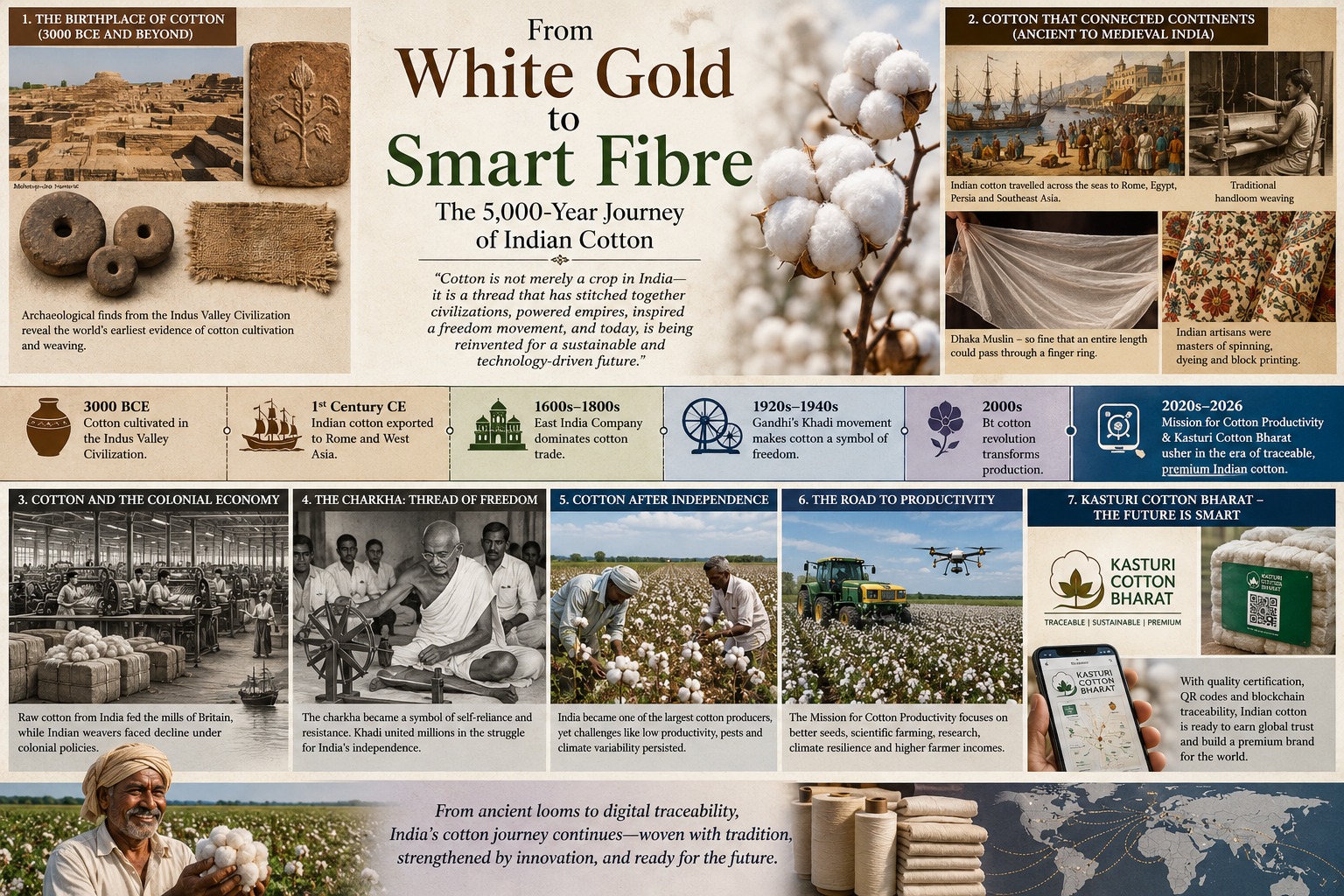
“Cotton is not merely a crop in India—it is a thread that has stitched together civilizations, powered empires, inspired a freedom movement, and today, is being reinvented for a sustainable and technology-driven future.”
India’s relationship with cotton stretches back more than 5,000 years. Few commodities have influenced the country’s economy, politics, culture and identity as profoundly as this soft white fibre. Cotton has clothed ancient civilizations, connected India to global trade routes, transformed colonial economies, fuelled the Swadeshi movement, and built one of the world’s largest textile industries. Today, as the Government of India launches ambitious initiatives such as the Mission for Cotton Productivity and expands the Kasturi Cotton Bharat certification programme, cotton is once again taking centre stage—not only as an agricultural commodity but as a symbol of innovation, sustainability and global competitiveness.
The latest policy push comes at a time when India is seeking to reclaim its position as a leader in high-quality cotton production. It is also an opportunity to revisit the remarkable historical journey of what has often been called India’s “white gold.”
The Birthplace of Cotton
Long before cotton became a global commodity, it flourished in the fertile plains of the Indus Valley Civilization.
Archaeological discoveries at Mohenjo-daro and Harappa have unearthed cotton fibres dating back to nearly 3000 BCE, making India one of the earliest known regions in the world to cultivate and weave cotton. While many ancient civilizations depended on flax or wool, India’s climate proved ideal for cotton cultivation, allowing local communities to spin, weave and dye fabrics thousands of years before mechanised textile production existed.
Excavations have revealed spindle whorls, woven fragments and textile impressions on pottery, indicating that cotton weaving had already become a specialised craft. These fabrics were not only used locally but also travelled through trade networks connecting Mesopotamia and the Persian Gulf.
Greek historian Herodotus later described India as the land where “trees bore wool more beautiful than that of sheep,” reflecting the astonishment of foreign travellers at the quality of Indian cotton.
Cotton that Connected Continents
During the Mauryan and Gupta periods, cotton cultivation expanded significantly across the Indian subcontinent. By the early centuries of the Common Era, Indian cotton textiles had become prized commodities in international markets.
Roman merchants eagerly imported fine muslins, dyed fabrics and printed cotton cloth from Indian ports along the western and eastern coasts. Historical records indicate that Roman gold flowed steadily into India in exchange for textiles, spices and precious stones.
Trade routes linked Indian cotton with Egypt, Arabia, Persia, Southeast Asia and later East Africa. Cities such as Surat, Masulipatnam, Burhanpur and Dhaka emerged as renowned centres of weaving and textile craftsmanship.
Among the most celebrated products was Dhaka muslin, so delicately woven that European travellers claimed entire lengths of fabric could pass through a finger ring. Indian artisans mastered techniques of spinning ultra-fine yarn, natural dyeing and intricate block printing centuries before industrial textile manufacturing transformed Europe.
For much of history, India’s reputation rested not on mass production but on extraordinary craftsmanship.
Cotton and the Colonial Economy
The arrival of European trading companies dramatically altered India’s cotton story.
Initially, the Portuguese, Dutch, French and British competed to purchase Indian textiles because European consumers found them lighter, more colourful and more comfortable than locally produced woollen fabrics.
However, the Industrial Revolution changed the equation.
Britain’s newly mechanised textile mills required vast quantities of raw cotton. Instead of importing finished Indian textiles, colonial policies gradually encouraged the export of raw cotton while restricting the growth of India’s traditional textile industry.
Indian handloom weavers faced heavy taxation, shrinking markets and intense competition from machine-made British cloth. Many weaving communities that had prospered for generations experienced economic decline.
Raw cotton from Indian farms increasingly travelled to factories in Lancashire, where it was transformed into finished textiles before being sold back to Indian consumers.
Cotton became one of the clearest examples of how colonial economic policies restructured India’s agriculture and industry to serve imperial interests.
The Charkha That Became a National Symbol
No chapter in India’s cotton history is more powerful than its role in the freedom movement.
When Mahatma Gandhi returned from South Africa, he recognised that cotton represented both India’s economic exploitation and its opportunity for self-reliance.
The spinning wheel—or charkha—became much more than a tool for making yarn.
It evolved into a political symbol of resistance.
Gandhi urged Indians to boycott imported British textiles and instead wear khadi, hand-spun and handwoven cotton produced locally. Every thread spun on the charkha became an act of economic independence.
The Swadeshi movement transformed cotton into an instrument of national unity. Millions participated in spinning and weaving not simply to produce cloth but to challenge colonial economic control.
Even today, the charkha remains embedded in India’s collective memory as one of the most recognisable symbols of the independence movement.
Cotton After Independence
Following Independence, India inherited one of the world’s largest cotton-growing areas but also many structural challenges.
Agriculture became the nation’s immediate priority, with food shortages demanding urgent attention. As a result, wheat and rice received much of the investment during the Green Revolution, while cotton production continued to depend heavily on traditional farming practices and monsoon rainfall.
Despite these limitations, cotton remained vital to India’s economy.
The textile and apparel sector grew into one of the country’s largest employers after agriculture, providing livelihoods to millions across farming, ginning, spinning, weaving, garment manufacturing and exports.
India eventually became the world’s largest cotton-growing country in terms of area under cultivation and one of the leading producers globally.
Yet productivity remained lower than many competing countries.
Fragmented landholdings, erratic rainfall, pest attacks—particularly pink bollworm—declining soil health and limited access to improved seed varieties continued to affect farmer incomes.
Climate change further complicated the situation through unpredictable weather patterns and prolonged droughts in major cotton-producing regions.
The Bt Cotton Revolution
One of the most significant turning points came in the early 2000s with the introduction of Bt cotton, genetically engineered to resist bollworm infestations.
The technology initially increased yields, reduced pesticide use and improved farmer incomes across several states.
Cotton production expanded rapidly, helping India emerge as one of the world’s largest cotton exporters.
However, over time, new challenges emerged.
Pests developed resistance, input costs increased and productivity growth began to slow. Scientists increasingly recognised the need for continuous research, improved breeding programmes and better agronomic practices rather than relying solely on one technological intervention.
This experience underscored the importance of sustained innovation in agriculture.
Cotton in the Era of Climate Change
Today, Indian cotton farmers face a very different set of challenges from those encountered by previous generations.
Changing rainfall patterns, rising temperatures, declining groundwater availability and increasing pest pressures threaten both productivity and profitability.
Global markets are also changing.
International buyers increasingly seek sustainably produced natural fibres with verified quality, lower environmental impact and complete traceability across the supply chain.
Simply producing more cotton is no longer enough.
Quality, sustainability and transparency have become equally important.
The New Mission for Cotton Productivity
Recognising these challenges, the Government of India has launched the Mission for Cotton Productivity, one of the country’s most ambitious cotton development programmes in recent years.
The five-year mission seeks to increase productivity, strengthen research, improve farmer incomes and encourage climate-resilient cultivation practices.
The programme promotes high-density planting systems, improved seed varieties, scientific nutrient management, better irrigation practices and stronger collaboration with agricultural research institutions.
Special emphasis is being placed on developing climate-resilient and extra-long staple cotton capable of competing in premium international markets.
The initiative also aims to bridge the gap between laboratory research and farmers’ fields through improved extension services and technology dissemination.
For millions of cotton growers, the mission represents an effort to move from quantity-driven production towards quality-focused agriculture.
Kasturi Cotton Bharat: Branding India’s White Gold
Perhaps the most transformative development in recent years is the creation of Kasturi Cotton Bharat.
For decades, Indian cotton largely entered international markets as a commodity with limited brand recognition.
Kasturi Cotton Bharat seeks to change that.
The initiative establishes strict quality standards for long and extra-long staple cotton while introducing laboratory testing, QR code-based certification and blockchain-enabled traceability.
Every certified bale carries information about its quality, origin and movement through the supply chain.
For international buyers increasingly concerned about transparency, sustainability and ethical sourcing, this digital traceability provides greater confidence.
It also allows Indian cotton to compete not merely on volume but on reputation.
The initiative reflects a broader shift in Indian agriculture—from selling raw produce to creating trusted national brands.
From Commodity to Premium Fibre
Modern consumers increasingly ask important questions before purchasing clothing.
Where was the cotton grown?
Was it sustainably cultivated?
Can its quality be verified?
Was it ethically sourced?
Kasturi Cotton Bharat directly addresses these concerns by combining traditional agricultural excellence with modern digital technologies.
Blockchain-enabled traceability ensures that the journey of each certified cotton bale can be tracked through multiple stages of processing.
This represents a remarkable transformation from anonymous commodity trading to data-backed quality assurance.
Cotton and India’s Textile Future
India’s textile sector remains one of the country’s largest manufacturing industries and among its biggest employers.
As global demand shifts towards sustainable natural fibres, Indian cotton possesses significant advantages.
It is biodegradable, renewable and supported by centuries of agricultural expertise.
Government initiatives are increasingly linking cotton production with textile manufacturing, exports, innovation and rural development.
If productivity improves while maintaining sustainability, India could strengthen its position as a preferred supplier in global textile value chains.
A Thread That Connects Past and Future
Few agricultural products have influenced India’s destiny as profoundly as cotton.
It clothed the people of the Indus Valley Civilization.
It connected ancient India with Roman merchants and Silk Route traders.
It enriched medieval weaving centres.
It fuelled colonial commerce while simultaneously inspiring resistance against imperial rule.
It became the fabric of the freedom movement through Gandhi’s charkha.
Today, it is entering a new era defined by climate-smart agriculture, scientific research, blockchain technology and premium global branding.
The story of Indian cotton is therefore far more than the history of a crop.
It is the story of India’s resilience, innovation and ability to reinvent itself across changing centuries.
As the nation invests in productivity, traceability and sustainability, the ancient thread first spun thousands of years ago continues to weave together India’s agricultural heritage with its economic future.
From the looms of Harappa to the digital supply chains of the twenty-first century, India’s white gold continues to tell a story that is as relevant today as it was five millennia ago.