Introduction
In July 2026, India and Australia entered a new chapter in their bilateral relationship as both countries deepened cooperation in defence, trade, critical minerals, maritime security and civil nuclear energy. The development marks a dramatic transformation from a period when Australia strongly opposed India’s nuclear programme and imposed restrictions on uranium exports. Today, the two nations are among the most important strategic partners in the Indo-Pacific region. The story of India–Australia relations is one of changing geopolitics, growing economic interdependence and a shared commitment to maintaining stability in a rapidly evolving world order.
Early Ties: Commonwealth Connections and Limited Engagement
India and Australia established diplomatic relations soon after India’s independence in 1947. Both countries were members of the British Commonwealth and shared democratic institutions, parliamentary traditions and legal systems inherited from British rule.
Despite these similarities, the relationship remained modest for several decades. Geography, differing foreign policy priorities and the Cold War created distance between New Delhi and Canberra. Australia was closely aligned with the United States and Western security alliances, while India pursued a policy of non-alignment under Prime Minister Jawaharlal Nehru.
Economic exchanges were limited and political engagement remained sporadic. Although both nations participated in Commonwealth meetings and maintained cordial ties, neither viewed the other as a major strategic partner.
Diverging Paths During the Cold War
The Cold War years exposed significant differences in outlook.
Australia regarded the Soviet Union as a primary security concern and became a member of alliances such as ANZUS. India, meanwhile, sought strategic autonomy and maintained close relations with Moscow while avoiding formal military blocs.
The two countries also differed on issues such as nuclear policy and regional security. Australia’s foreign policy was heavily influenced by its alliance with the United States, while India focused on regional challenges in South Asia.
As a result, bilateral relations lacked momentum. Trade remained small, and political visits were relatively infrequent.
The Nuclear Divide Emerges
The most serious challenge to India–Australia relations arose from the issue of nuclear weapons.
In 1974, India conducted its first nuclear test at Pokhran in Rajasthan, describing it as a “peaceful nuclear explosion.” Australia, a strong supporter of global nuclear non-proliferation efforts, reacted cautiously.
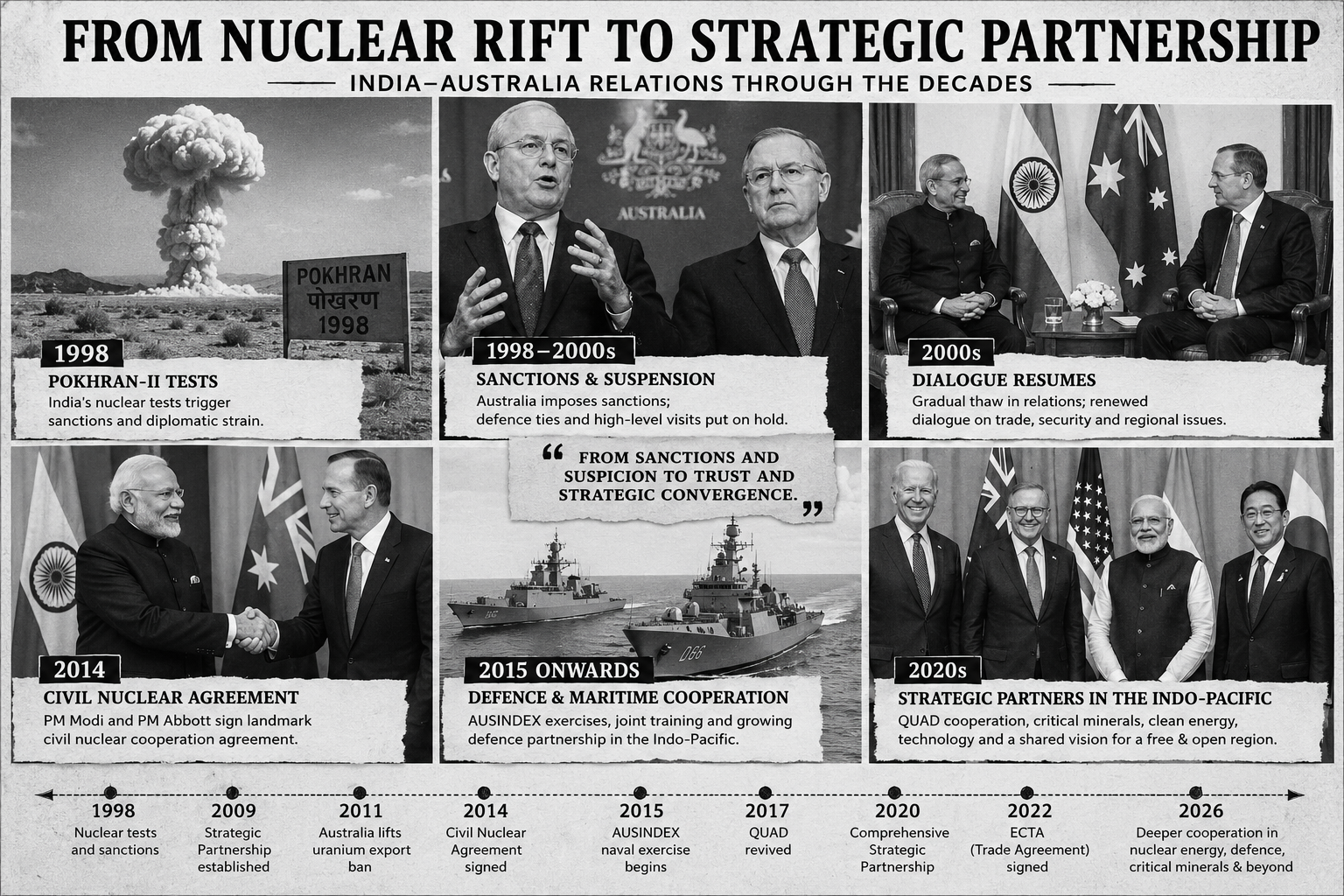
The gap widened significantly after India’s second series of nuclear tests in 1998, known as Pokhran-II. Australia strongly criticized the tests and imposed sanctions. Defence cooperation was suspended, and diplomatic relations entered a difficult phase.
Canberra maintained a policy that uranium exports would only be permitted to countries that were signatories to the Nuclear Non-Proliferation Treaty (NPT). Since India was not a signatory, it was effectively excluded from Australian uranium supplies despite being one of the world’s fastest-growing energy markets.
For much of the late 1990s and early 2000s, nuclear disagreements overshadowed broader opportunities for cooperation.
The Turning Point: A New Strategic Environment
The first decade of the twenty-first century brought major geopolitical changes.
India’s economic growth accelerated, transforming it into one of the world’s largest emerging economies. At the same time, Australia began to recognize India’s growing strategic significance in the Indian Ocean and Asia-Pacific regions.
China’s rapid rise also altered regional calculations. Concerns about maritime security, freedom of navigation and the balance of power encouraged greater cooperation among democratic nations across the Indo-Pacific.
In 2009, India and Australia elevated their relationship to a Strategic Partnership, signalling a willingness to move beyond past disagreements.
The relationship was no longer viewed solely through the lens of nuclear politics. Trade, education, defence and regional security became increasingly important areas of engagement.
The Uranium Breakthrough
A major breakthrough came during the 2010s.
Recognizing India’s strong non-proliferation record and growing energy needs, Australia reconsidered its longstanding uranium policy.
In 2011, Australia’s ruling Labor Party voted to lift the ban on uranium sales to India. The decision reflected changing geopolitical realities and acknowledgement of India’s status as a responsible nuclear power.
The next milestone came in 2014 when Prime Minister Narendra Modi visited Australia, becoming the first Indian Prime Minister to do so in nearly three decades. During the visit, the two countries signed the Civil Nuclear Cooperation Agreement.
The agreement opened the door for Australian uranium exports to India and symbolized the end of a major diplomatic dispute that had affected bilateral relations for decades.
What had once been the principal source of tension now became a platform for cooperation.
Defence and Maritime Cooperation
As nuclear differences faded, defence cooperation emerged as one of the strongest pillars of the relationship.
India and Australia share a common interest in maintaining peace and stability across the Indian Ocean and the wider Indo-Pacific region.
Naval cooperation expanded through exercises such as AUSINDEX, launched in 2015. These exercises enhanced interoperability between the two navies and strengthened maritime domain awareness.
Defence dialogues became more frequent, and military exchanges increased steadily.
The relationship gained further momentum through participation in the Quadrilateral Security Dialogue, commonly known as the QUAD, which includes India, Australia, Japan and the United States.
Although first conceived in 2007, the QUAD gained renewed importance after its revival in 2017 amid growing concerns about regional security and maritime stability.
Today, India and Australia work closely on issues ranging from cybersecurity and disaster relief to maritime surveillance and defence technology.
Trade and Economic Partnership
Economic cooperation has expanded dramatically over the past two decades.
Historically, trade between India and Australia focused on commodities such as coal, gold and wool. However, the relationship has diversified considerably.
Australia has become an important supplier of energy resources and critical minerals, while India represents one of the world’s largest and fastest-growing markets.
The signing of the Economic Cooperation and Trade Agreement (ECTA) in 2022 marked a major milestone. The agreement reduced tariffs on numerous goods and facilitated greater market access for businesses in both countries.
Trade volumes increased significantly following the agreement, encouraging investment and supply-chain partnerships.
The two countries are now working toward a broader Comprehensive Economic Cooperation Agreement (CECA), which aims to deepen trade integration and expand opportunities across sectors such as manufacturing, services, technology and agriculture.
Critical Minerals and the Green Transition
One of the newest areas of collaboration involves critical minerals.
As countries around the world transition toward renewable energy and electric mobility, minerals such as lithium, cobalt and rare earth elements have become strategically important.
Australia possesses some of the world’s largest reserves of these resources, while India is seeking secure supply chains to support its clean energy ambitions and manufacturing sector.
The partnership in critical minerals reflects how bilateral relations have evolved from traditional trade to cooperation in emerging technologies and future industries.
It also demonstrates how economic and strategic interests increasingly overlap in the Indo-Pacific era.
Education and People-to-People Links
The growth of the Indian diaspora has transformed bilateral relations at the societal level.
Thousands of Indian students began choosing Australia for higher education from the 1990s onward. Today, Indian students constitute one of the largest international student communities in Australia.
The Indian-origin population in Australia has grown rapidly and is now among the country’s fastest-expanding migrant communities.
This diaspora acts as a bridge between the two nations, strengthening cultural understanding, business ties and political engagement.
Educational partnerships, research collaborations and academic exchanges have become important components of the relationship.
These people-to-people connections ensure that India–Australia relations extend beyond government policies and strategic calculations.
The Indo-Pacific Partnership
Perhaps the most significant factor driving the relationship today is the emergence of the Indo-Pacific concept.
For both India and Australia, the Indian Ocean and Pacific Ocean are increasingly viewed as a single strategic space.
Sea lanes connecting the Middle East, Africa, South Asia and East Asia are essential for global trade and energy security.
Both countries support a free, open and rules-based Indo-Pacific where international law and freedom of navigation are respected.
This shared vision has created unprecedented convergence in foreign policy priorities.
Whether addressing maritime security, climate challenges, cyber threats or resilient supply chains, India and Australia increasingly find themselves working together.
2026: A Relationship at Its Strongest
The developments of 2026 highlight how far the relationship has progressed.
Defence cooperation is expanding, trade negotiations are advancing, uranium exports have become a reality, and collaboration in critical minerals and emerging technologies is deepening.
The transformation is remarkable when viewed against the backdrop of the tensions that followed India’s nuclear tests in 1998.
Few bilateral relationships illustrate such a dramatic shift from disagreement to strategic alignment.
The history of India–Australia relations is a story of adaptation to changing global realities. What began as a limited Commonwealth connection evolved into a relationship strained by nuclear disagreements and later transformed into one of the Indo-Pacific’s most important strategic partnerships.
The journey from uranium bans to civil nuclear cooperation symbolizes a broader evolution built on trust, shared democratic values and converging interests. As both countries navigate the challenges of the twenty-first century, their partnership is likely to play an increasingly significant role in shaping the future of the Indo-Pacific region. Far from being distant democracies, India and Australia have emerged as indispensable partners in a rapidly changing world.