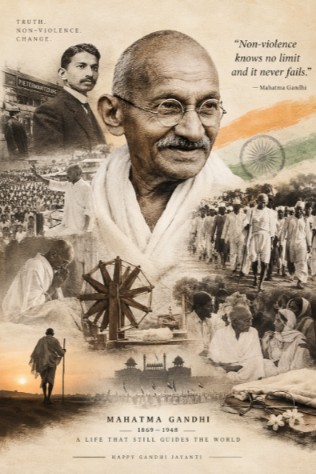
There was no army behind him, no throne beneath him and no treasury at his command. He carried neither a sword nor a gun. Yet, over several decades, Mohandas Karamchand Gandhi became one of the most consequential figures of the Indian freedom struggle, turning resistance into a mass political instrument and making non-violence a language understood far beyond India.
His life was filled with contradictions. The man who preached ahimsa had once encouraged Indian recruitment for the British war effort during World War I. The lawyer who had lived and worked in the British Empire eventually became one of its most formidable challengers. The political leader who mobilised millions repeatedly called off movements when they crossed the line into violence. And when India finally became independent, Gandhi was not at the centre of celebrations in Delhi. He was in violence-torn Bengal, fasting and praying while Hindus and Muslims confronted each other with hatred.
Gandhi’s importance lies not merely in the fact that he helped lead India’s freedom movement. It lies in the method he developed: the idea that ordinary people could confront an unjust system through truth, discipline, sacrifice and non-violent resistance. That method would eventually travel beyond India’s borders and influence civil rights and freedom movements across the world.
From Porbandar to London
Mohandas Karamchand Gandhi was born on October 2, 1869, in Porbandar in present-day Gujarat. His father, Karamchand Gandhi, served as a diwan in several princely states, while his mother, Putlibai, was deeply religious. Gandhi grew up in a household shaped by Vaishnava traditions, Jain influences and an emphasis on religious devotion, fasting and moral discipline.
His childhood was not that of a born political rebel. He was shy and, by his own later account, an ordinary student. He married Kasturba at a young age, as was customary at the time, and continued his education in Rajkot.
After matriculation, Gandhi briefly attended Samaldas College in Bhavnagar but found the course difficult. His path eventually took him to England in 1888, where he studied law at the Inner Temple. He was called to the Bar in 1891 and returned to India as a young barrister.
London exposed him to a world beyond the social and religious environment in which he had grown up. He studied law, experimented with aspects of Western culture and read widely. But education did not immediately transform him into a political leader.
That transformation would begin thousands of kilometres away.
The railway compartment that changed his life
In 1893, Gandhi travelled to South Africa to work as a lawyer for an Indian firm. There he encountered the racial discrimination faced by the Indian community. The experience that became symbolic of his transformation occurred at Pietermaritzburg railway station.
Gandhi had a valid first-class ticket but was thrown out of the first-class carriage because of his race. It became a decisive moment in his political evolution.
He could have returned to India after completing his legal assignment. Instead, he stayed and increasingly became involved in the struggle for the rights of Indians in South Africa.
In 1894, he helped establish the Natal Indian Congress. He began organising, writing, negotiating and mobilising the Indian community. He published Indian Opinion and experimented with communal living at Phoenix Settlement.
It was in South Africa that the foundations of his political philosophy took shape.
In 1906, Gandhi launched what became known as Satyagraha against discriminatory legislation. The word came to represent more than passive resistance. Gandhi conceived it as resistance rooted in truth and moral courage, in which the resister accepted suffering rather than inflicting it on the opponent.
He was imprisoned repeatedly. His wife Kasturba and other associates also participated in the struggle. By the time Gandhi left South Africa in 1914, he was no longer simply a lawyer. He had become an organiser and political experimenter who had tested his ideas against an actual state.
Gandhi returns to India
Gandhi returned to India in 1915 after more than two decades abroad. He arrived with an international reputation, but he did not immediately claim leadership of the national movement.
He travelled, observed and listened. Gopal Krishna Gokhale became an important influence during this period, and Gandhi sought to understand Indian society before attempting to lead it.
His first major interventions in India were rooted in local grievances rather than grand declarations of independence.
In Champaran in 1917, he investigated the problems faced by indigo cultivators. He challenged official orders restricting his presence and ultimately became involved in an inquiry into the conditions of the peasants. The episode established his ability to turn a local economic grievance into a larger political movement.
He subsequently became involved in the Ahmedabad mill workers’ dispute and the Kheda Satyagraha. These campaigns established a pattern that would define his later politics: identify a specific injustice, mobilise ordinary people, demand reform and maintain discipline against violence.
His Sabarmati Ashram became an important centre for these experiments. The ashram was not merely a residence; it became a place where Gandhi and his associates experimented with self-reliance, spinning, communal living, education, sanitation, service and non-violence.
From local leader to national force
The First World War and its aftermath changed Indian politics dramatically.
The Rowlatt Acts of 1919, which extended extraordinary powers of detention and repression, prompted Gandhi to launch a nationwide Satyagraha. The movement coincided with growing anger after the Jallianwala Bagh massacre.
Gandhi increasingly emerged as the central figure capable of translating political grievances into mass mobilisation.
In 1920, he launched the Non-Cooperation Movement, calling on Indians to withdraw cooperation from British institutions. The movement drew students, workers, professionals and ordinary citizens into the national struggle.
But Gandhi’s insistence on non-violence had a practical consequence: he was prepared to stop a movement if its participants lost control.
That happened after Chauri Chaura in February 1922, when a crowd attacked and killed policemen. Gandhi called off the broader movement, believing that the campaign had moved away from the discipline required for Satyagraha. He was subsequently arrested and sentenced to six years in prison.
The decision demonstrated one of the defining features of his politics: independence was not, in his view, sufficient if the means used to obtain it destroyed the moral foundation of the movement.
The Salt March
By 1930, Gandhi had become perhaps the most recognisable face of India’s anti-colonial struggle.
His next great campaign began with something seemingly ordinary: salt.
The British monopoly and tax on salt offered Gandhi a simple issue that could be understood across class and regional divisions. On March 12, 1930, he left Sabarmati Ashram with 78 fellow marchers and began the 385-km journey to Dandi. After 25 days, he reached the coast and broke the salt law.
The Salt March transformed a commodity into a symbol of colonial power.
People across India began making or selling salt in defiance of the law. Arrests followed. The campaign drew international attention and demonstrated Gandhi’s ability to turn civil disobedience into a mass spectacle without an armed uprising.
He later travelled to London for the Second-Round Table Conference as the sole Congress representative. But negotiations failed to produce the political settlement he sought.
Quit India and the final struggle
The 1940s brought a different kind of crisis.
World War II had begun, and Britain involved India in the war without securing the consent of Indian political leaders. Gandhi’s position during the two World Wars reveals one of the complicated aspects of his political journey.
During World War I, Gandhi actively appealed to Indians to enlist for military service. In 1918, he participated in recruitment efforts and delivered speeches urging Indians to join the war service.
During World War II, however, the political situation was different. The demand for Indian independence had become central to the Congress position, and Gandhi increasingly opposed continued British rule during the war.
In August 1942, the Congress adopted the Quit India resolution. Gandhi gave the call that became synonymous with the movement: “Do or Die.”
The British government responded with mass arrests. Gandhi and other Congress leaders were imprisoned, with Gandhi held at the Aga Khan Palace.
The Quit India Movement became the final major mass uprising led under Gandhi’s political influence before independence.
What Gandhi actually believed
At the centre of Gandhi’s politics were two words: Satya and Ahimsa — truth and non-violence.
But Gandhi’s non-violence was not simply the absence of physical violence. He regarded it as a method of resistance. The objective was to confront injustice without reproducing the hatred and violence of the system being challenged.
Satyagraha demanded discipline, willingness to suffer and refusal to surrender one’s principles.
His philosophy also included Swaraj, which meant more to Gandhi than the transfer of political power from British rulers to Indian rulers. He connected freedom with individual responsibility, self-restraint and social reform.
He promoted Swadeshi, encouraged khadi and hand-spinning, criticised excessive materialism and advocated village industries.
His ashrams became laboratories for these ideas. He experimented with food, sanitation, education, manual labour, communal living and religious prayer.
Gandhi also campaigned against untouchability and sought greater social equality, although his approach and terminology regarding caste and untouchability have themselves been subjects of later historical debate.
For Gandhi, politics could not be separated from personal conduct.
Gandhi and violence
Perhaps the most striking part of Gandhi’s final years was that he spent much of them trying to prevent Indians from killing one another.
As communal tensions intensified in the 1940s, Gandhi repeatedly appealed for Hindu-Muslim unity.
The violence surrounding Partition was a devastating test of everything he had preached.
Gandhi opposed Partition. Yet by June 1947, the Congress, Muslim League and Sikh representatives had accepted the Partition plan, and the Congress Working Committee subsequently accepted it.
Gandhi did not celebrate independence in Delhi on August 15, 1947.
He was in Calcutta, where communal violence had threatened to engulf the city. He spent Independence Day fasting and praying. His presence in Beliaghata, together with efforts involving political leaders including Huseyn Shaheed Suhrawardy, became associated with the reduction of violence in Calcutta. When violence returned, Gandhi began an indefinite fast on September 1. The fast ended after assurances from different leaders and groups
Later, he travelled to Noakhali and Bihar and continued his efforts to bring communities together.
His final political battle was therefore not against the British.
It was against hatred among Indians.
A legacy without a fortune
Gandhi’s public image was also shaped by his attitude towards possessions.
He deliberately embraced a life of simplicity. The loincloth, walking stick, spinning wheel and simple living became symbols associated with him.
His philosophy of non-possession went beyond personal austerity. Gandhi argued that people should not hoard what they did not need.
His family life, however, was not free from conflict. His relationship with his sons, particularly Harilal, was difficult, and Gandhi’s principles often created tensions within his own household.
He did not build a private financial empire for his children. His life was instead organised around public service, communal institutions and the principle that material accumulation should not become the purpose of life.
Gandhi even undertook a fast in 1916 over Manilal’s financial assistance to Harilal without his knowledge, illustrating how intensely he applied his principles of discipline and responsibility within his own family.
His legacy therefore cannot be measured in property passed down to his children.
It was measured in an idea.
The final walk
On January 30, 1948, Gandhi walked towards his evening prayer meeting in Delhi.
He was 78.
A few minutes later, Nathuram Godse shot him.
Gandhi’s death shocked India and the world. He had survived imprisonment, political defeats, personal criticism, communal violence and the collapse of his dream of a united India. But he did not survive the violence he had spent decades trying to prevent.
His funeral drew enormous crowds.
The man who had become internationally known as Mahatma — “Great Soul” — left behind no army, no political office and no personal empire.
What remained was a body of ideas that had already travelled far beyond India.
What remains of Gandhi
Gandhi’s legacy is neither simple nor beyond debate.
His methods have been questioned, his political decisions scrutinised and aspects of his social thought contested. Yet his central experiment remains historically significant: whether a mass political movement could challenge entrenched power while deliberately refusing to make violence its organising principle.
That experiment influenced figures and movements far beyond India, including later struggles for civil rights and racial equality.
Gandhi himself understood that philosophy could not survive merely as a slogan. It had to be lived.
Perhaps that is why the most enduring way to remember him is not simply as the man who helped India win independence, but as the man who spent his life testing whether truth could become a political force and whether resistance could exist without hatred.
For a man who spent his life experimenting with truth, perhaps that was the experiment he ultimately left to the world.