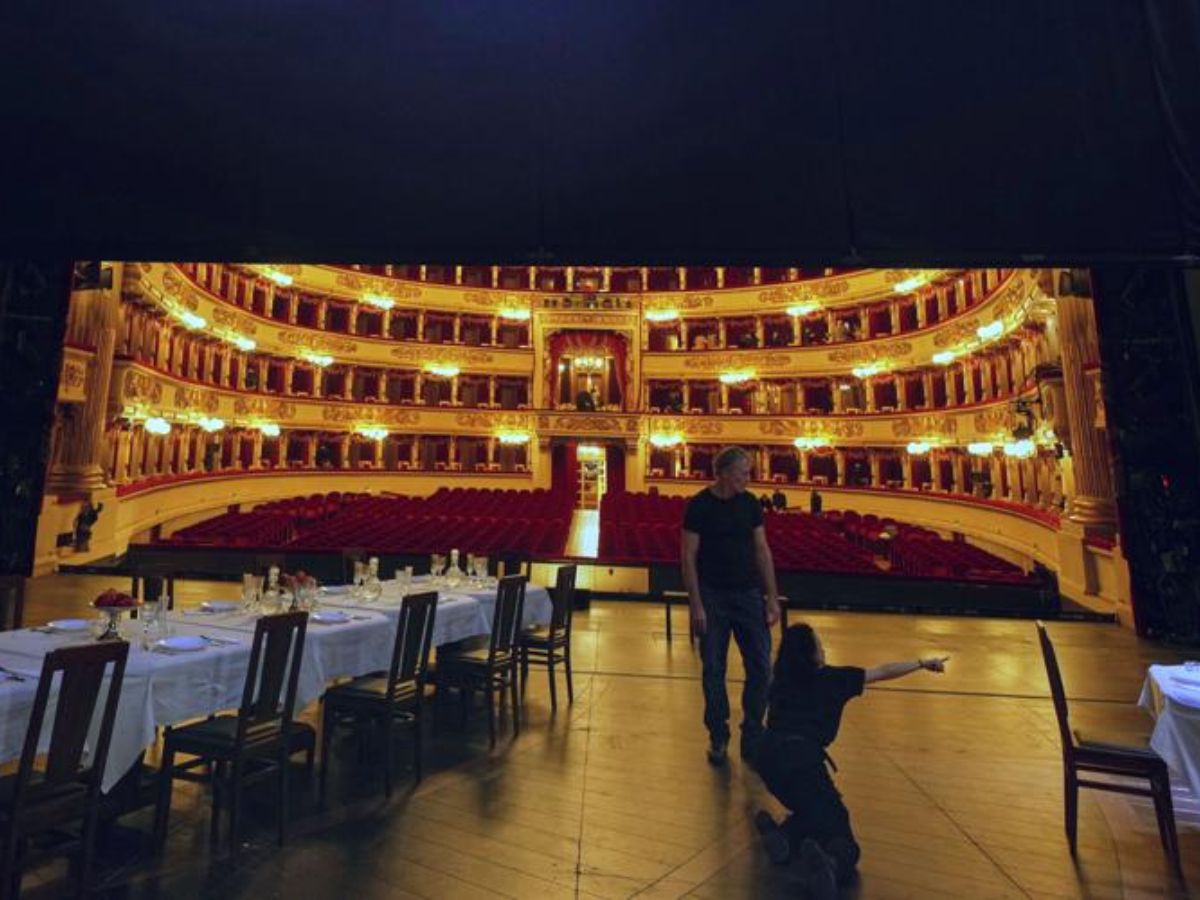
Milan’s famed Teatro alla Scala opened its new season Sunday with a powerful and politically resonant choice: Dmitri Shostakovich’s Russian opera, “Lady Macbeth of Mtsensk.” The gala premiere earned a roaring 12-minute standing ovation from an audience of luminaries, even as peaceful protests outside highlighted the ongoing war in Ukraine.
How Was the Performance Received?
The star-studded crowd fully embraced the production. U.S. soprano Sara Jakubiak, making her La Scala debut in the demanding title role, was showered with flowers and cheers for her portrayal of the murderous merchant’s wife, Katerina. Conductor Riccardo Chailly, leading his final December 7 gala as music director, was also met with strong applause. “No one ever expects this,” a joyful Jakubiak said backstage after the performance.
Also Read: High-Stakes India-EU Trade Talks Resume Monday, US Negotiations to Follow
What Made This Production Bold?
Stage director Vasily Barkhatov set the 1934 opera in the 1950s Soviet Union under Stalin, rather than its original 19th-century setting. His bold vision culminated in a jarring final scene where a Soviet truck crashes into a wedding. The opera itself has a fraught history; it was blacklisted by Stalin in 1936 after he attended a performance, coinciding with the start of his Great Purge. La Scala’s leadership defended the choice to stage Russian works, with General Manager Fortunato Ortombina stating, “Music is fundamentally superior to any ideological conflict.”
Were There Protests Outside?
Yes, but they were muted compared to the cheers inside. A dozen activists held up Ukrainian and European flags in a quiet demonstration for “liberty and European democracy.” A separate, larger group protested for Palestinian freedom near city hall, kept away by police. This contrasted with the 2022 season opener, also a Russian opera (“Boris Godunov”), which drew more vocal protests from the Ukrainian community.
Also Read: Mayor-Elect Zohran Mamdani Urges Immigrants to ‘Stand Up’ to ICE, Know Their Rights
Why is This Opera Significant Now?
The premiere represents a complex cultural moment. It is only the second time since Russia’s 2022 invasion of Ukraine that La Scala has opened with a Russian work. The opera’s themes of repression and a woman’s tragic struggle for agency resonated in the grand theater. For the artists and management, the message was clear: the power of Russian art, they argue, belongs to its people and transcends contemporary politics.
The evening demonstrated that the world of great art attempts to make its own messages even during a period of worldwide turmoil, striking a balance between celebration, historical reflection, and subdued political opposition.