
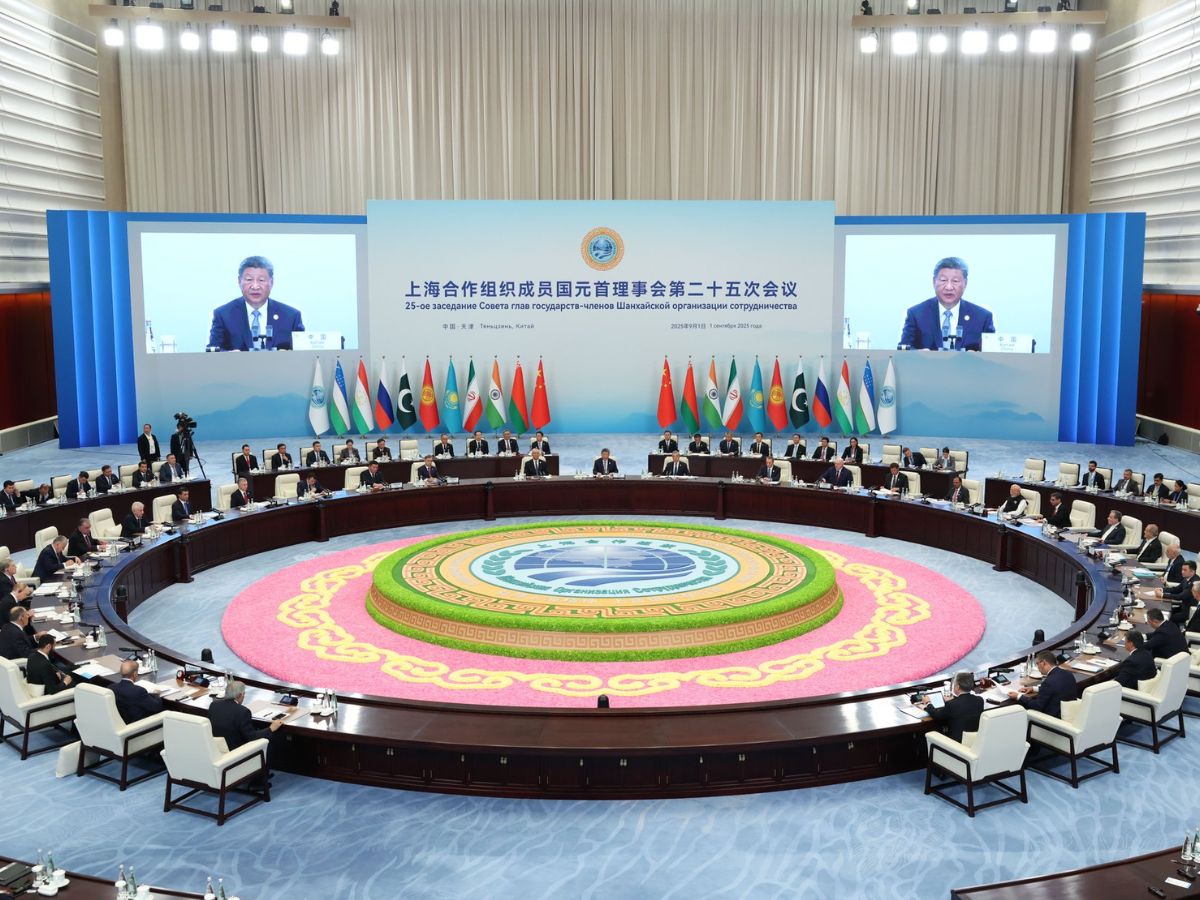
The Shanghai Cooperation Organization (SCO) is an intergovernmental body founded in 2001 in Shanghai, China. It brings together major Asian and Eurasian powers, including China, Russia, India, Pakistan, and several Central Asian nations, with Iran joining as a full member in 2023. The SCO’s significance lies in its role as one of the world’s largest regional organizations, covering 40% of the global population and nearly 30% of global GDP. It focuses on security, economic cooperation, and cultural exchange, making it a central player in shaping the balance of power between the East and the West.
The Shanghai Cooperation Organization (SCO) traces its roots back to 1996 when China, Russia, Kazakhstan, Kyrgyzstan, and Tajikistan formed the “Shanghai Five” to resolve border issues and build regional trust after the breakup of the Soviet Union. In 2001, with the inclusion of Uzbekistan, the grouping was formally established as the SCO in Shanghai, expanding its focus from security and counterterrorism to economic cooperation, connectivity, and cultural exchange. Over time, its influence widened with India and Pakistan joining in 2017, followed by Iran in 2023 and Belarus in 2024. Today, the SCO represents around 40% of the global population and nearly 30% of the world’s GDP, positioning it as one of the most significant regional organizations shaping global power dynamics.
Why Regional Blocs Matter
Regional blocs like the SCO, the European Union (EU), ASEAN, and BRICS have become critical in reshaping global geopolitics. Instead of relying solely on global institutions like the UN, countries increasingly turn to regional groups to pursue security, trade, and diplomatic goals. These blocs give nations collective bargaining power, helping them protect their interests in a multipolar world.
Also Read: From Shanghai To Berlin: How Chinese Women Are Quietly Reshaping Germany’s Sex Trade
The SCO’s Expanding Influence
At the 2025 SCO Summit in Astana, Kazakhstan, leaders discussed deeper economic integration, energy cooperation, and security challenges. With tensions rising in global trade and conflicts reshaping alliances, the SCO is positioning itself as an alternative to Western-led organizations like NATO and the EU.
Key highlights from the latest meeting include:
-
Counterterrorism efforts through joint military drills and intelligence sharing.
-
Energy security agreements to ensure stable oil and gas supplies among member states.
-
Digital connectivity projects, aiming to boost cross-border e-commerce and technology exchange.
-
Belarus joining as a full member, strengthening the SCO’s presence in Eastern Europe.
The EU and NATO vs SCO: Competing Models
While the EU and NATO represent a Western, democratic model of cooperation, the SCO is often seen as an Eastern-led counterbalance.
-
NATO focuses on military alliances.
-
EU centers around political and economic integration.
-
SCO emphasizes security, sovereignty, and non-interference, aligning with the interests of China, Russia, and Central Asian states.
This contrast shows how different blocs reflect the values and priorities of their regions, creating a new competitive but interconnected world order.
Impact on Global Power Balance
The rise of regional blocs like the SCO signals a shift away from a unipolar world dominated by the US toward a multipolar system.
-
The SCO strengthens the voice of Asia and Eurasia in global affairs.
-
It challenges Western dominance in setting global rules.
-
It gives smaller nations, especially in Central Asia, a platform to negotiate collectively with larger powers.