
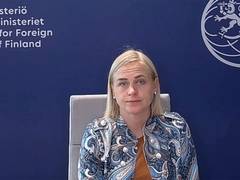
Helsinki [Finland], July 6 (ANI): Finland’s Foreign Affairs Minister Elina Valtonen on Monday called for diversification of imports of energy resources for both Finland and India following trade disruptions during the West Asia conflict, terming the regional crisis a “wake-up call.”
Speaking to ANI, Elina Valtonen said India’s imports of oil from Russia were “understandable”. However, she suggested that India move to diversified sources for the autonomy and sovereignty of the nation.
She noted that the European Union had imposed an oil price cap on Russian oil in the wake of the Ukraine war to reduce Moscow’s profit margin on energy exports.
Valtonen said, “The reason many countries, including the European Union, imposed the oil price cap on Russian oil is that Russia is waging an illegal war of aggression against a neighbouring country, Ukraine. Russia has been challenging the territorial integrity and sovereignty of Ukraine, which is completely against the principles of the UN Charter and international law. The reason that the oil price cap was introduced was that there wouldn’t be a massive disruption to the oil market, but rather the idea was to reduce the margin and the profit that Russia is able to achieve through its oil exports.”
“For a large country like India, it is understandable that it needs to import oil from sources which, unfortunately, are not in compliance with international law. At the same time, I do see this as a necessary transition period toward a more diversified energy mix, which also brings more autonomy and sovereignty to India going forward through the clean energy transition, as discussed, and through energy security so that a vast and important country like India is not reliant on one direction alone for its critical energy supplies,” she added.
Further, the Finnish Minister said that democratic nations should work together and not rely on autocratic nations for the supply of critical energy resources.
Valtonen said, “The recent crisis in the Middle East is again a wake-up call for all of us to work toward a more diversified, secure, and clean energy future. That is certainly high on the agenda between Finland and India as we look at both existing and future cooperation. We cannot rely on autocratic nations for the supply of oil and other critical energy or raw materials going forward. We need to be more self-reliant and, as democratic nations, work more closely together than ever before.”
When asked whether energy security can become a key pillar of India-Finland cooperation via green hydrogen and critical minerals, Valtonen termed the India-EU Free Trade Agreement the basis for the cooperation between the two nations.
She said, “The free trade agreement between the European Union and India is an extremely important stepping stone for further enhancing our cooperation in this front, both especially on the business side, but also through people-to-people exchanges. We have an extremely valuable diaspora of Indian people in Finland who work tirelessly in their respective businesses and bring their knowledge and know-how also to the use of Finnish society.”
“India is the world’s largest democracy, and we stand strong for freedom and individual liberties around the world, because both of those are challenged in the time we live in,” the Finnish minister added.
India has diversified its imports of energy resources. Prime Minister Narendra Modi on July 4 said that the country is importing fuel from more than 40 countries now.
During his visit to Finland in June, External Affairs Minister S Jaishankar took part in a discussion on ‘Emerging Powers and the New Geopolitical Competition’ at the Kultaranta talks, where he underlined the global impact of ongoing conflicts, the need for resilient supply chains, India’s energy priorities, and the growing strategic partnership between India and the European Union (EU).
Jaishankar highlighted the growing importance of securing global supply chains amid geopolitical uncertainties. He reiterated that India’s energy choices are guided by national interest, with purchases based on considerations of affordability and availability. (ANI)
The article has been published through a syndicated feed. Except for the headline, the content has been published verbatim. Liability lies with original publisher.