
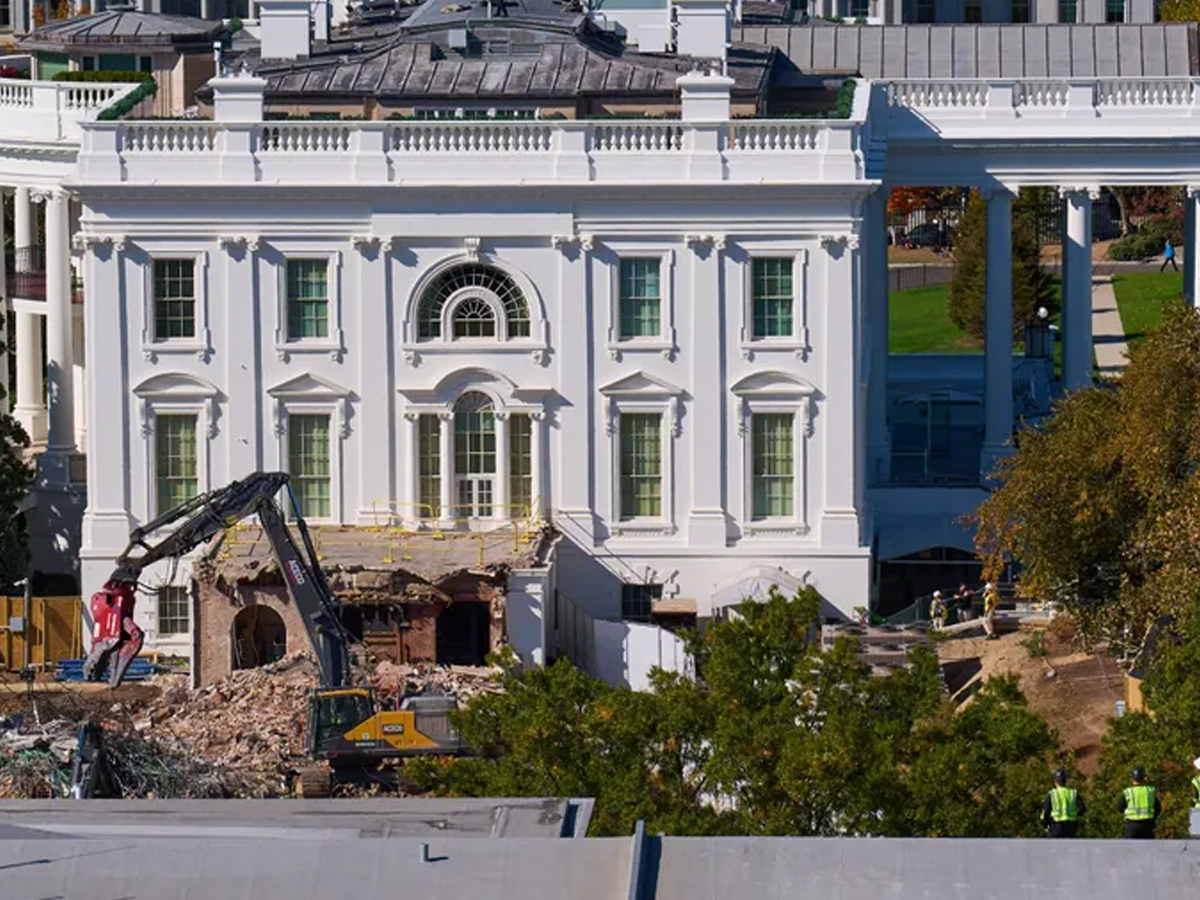
President Donald Trump has kicked off construction of a lavish new ballroom at the White House, demolishing part of the historic East Wing to make way for the project. The first major structural change to the executive complex since 1948 carries an estimated cost of up to $300 million. The funding comes from private donors—including major tech companies such as Google LLC, Amazon.com, Inc., and Apple Inc.—which has sparked concerns about donor access and influence.
A Ballroom Years in the Making
Trump has long expressed his desire for a grand ballroom at the White House. In a statement, he wrote, “For more than 150 years, every President has dreamt about having a Ballroom at the White House to accommodate people for grand parties, State Visits, etc. I am honored to be the first President to finally get this much-needed project underway – with zero cost to the American Taxpayer!”
The new space spans about 90,000 sq ft (approx. 8,360 m²) and is designed to seat 999 people, far surpassing the capacity of the current East Room. The project will be housed where the East Wing once stood—an area traditionally used for the First Lady’s offices and public tours.
Private Funding, Public Questions
The ballroom’s construction is being financed solely through private donations and Trump’s personal contribution. A pledge form reviewed by media outlets indicated that donors may receive “recognition associated with the White House Ballroom.” Further details remained vague, raising ethical concerns.
Donors include technology giants and major corporations already under regulatory scrutiny. For example, Google and Amazon have faced antitrust actions and consumer suits. The influx of donations from such companies has prompted questions about what kind of access or privileges the donors might gain.
Who is Finding?
Know who all are is funding the $300 million White House ballroom project:
- Major Tech Companies: Google, Amazon, Apple, Microsoft, Meta Platforms
- Aerospace & Defense: Lockheed Martin
- Cryptocurrency Firms: Coinbase, Ripple, Tether America, Winklevoss twins (Gemini founders)
- Energy & Manufacturing: NextEra Energy, Caterpillar, Union Pacific
- Telecom & IT: T-Mobile, HP, Booz Allen Hamilton, Palantir Technologies, Comcast
- Philanthropic Foundations & Wealthy Families: Adelson Family Foundation, Laura and Isaac Perlmutter Foundation, Betty Wold Johnson Foundation, Lutnick family
- Financial & Investment Figures: Howard Lutnick (Cantor Fitzgerald), Charles and Marissa Cascarilla, Stephen A. Schwarzman, Benjamin Leon Jr., Paolo Tiramani
- Others: Hard Rock International, Altria Group, Reynolds American, Micron Technology, Harold Hamm, Kelly Loeffler & Jeff Sprecher, Konstantin Sokolov
These donors range from tech and defense giants to billionaire families, raising questions about political influence and access to the Trump administration.
Oversight, Historic Preservation, and Transparency
Despite being a major renovation, the project lacks formal approval from the National Capital Planning Commission (NCPC), which normally oversees federal building changes. Demolition of the East Wing began while the NCPC was on shutdown, bypassing the usual review process. Preservationists, historians, and lawmakers have voiced concern that such rapid progress undermines oversight and threatens the integrity of the historic site.
Impact on the People’s House
While described as “separate” from the main structure, the ballroom’s construction will significantly alter the East Wing area. Visitor entry points, public tours, and staff offices have already been disrupted. For the first time in decades, the East Wing—and by extension parts of the White House’s public façade—will undergo major structural change.
Trump has defended the project as part of his legacy, calling it “a beautiful addition” and arguing that the current State-Dinner arrangements—often held in tents outside—are inadequate. Critics say it is part of a broader push to reshape the White House in Trump’s own image rather than preserve its heritage.
What This Means for Governance and Access
The project raises deeper questions about the influence of wealthy donors in federal institutions. With major corporations and high-net-worth individuals contributing to the ballroom, critics warn that lines between public and private power may blur. Who receives “recognition,” and what roles donors may play behind the scenes, remain unclear.
At the same time, the new ballroom signals a significant shift in how the White House—and by extension the U.S. presidency—will present itself on the global stage. For now, the construction stands as Trump’s boldest architectural imprint on the People’s House.