
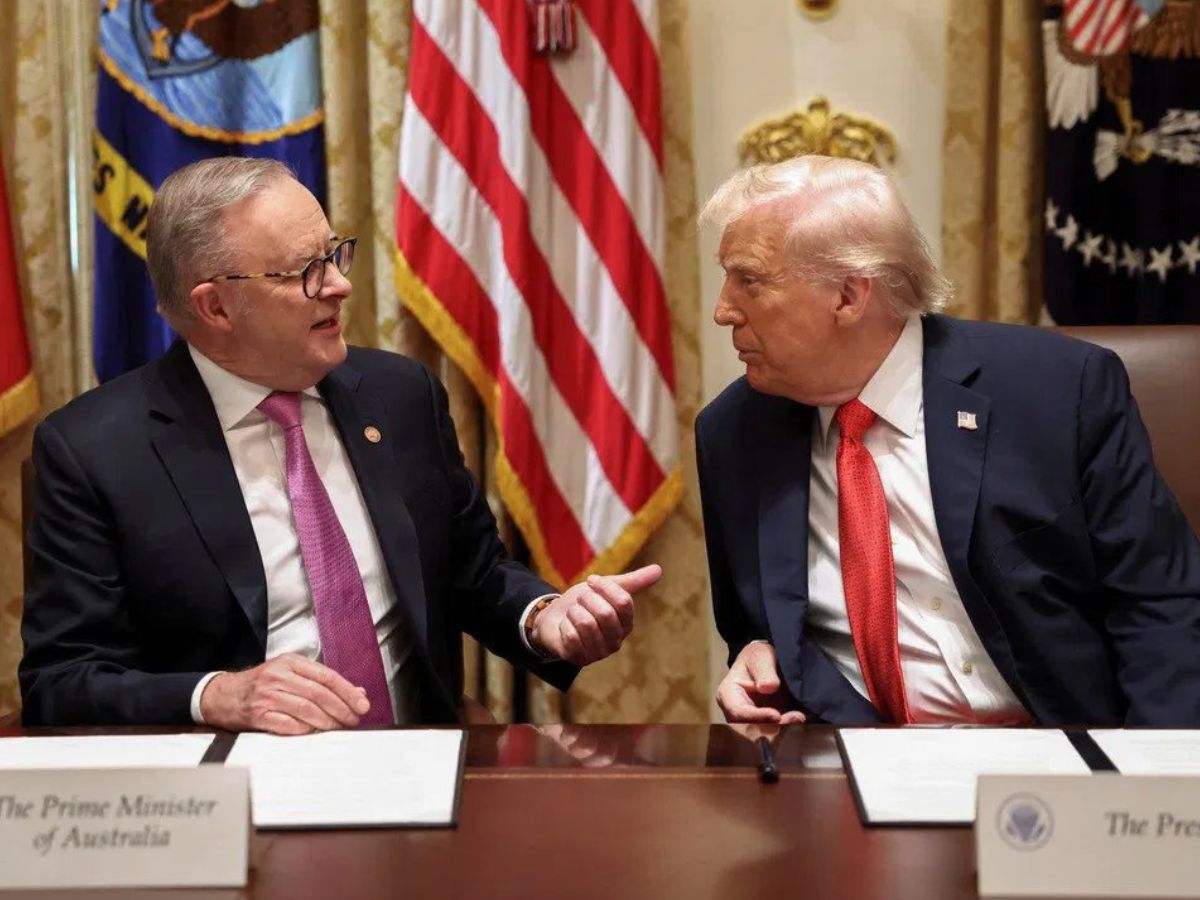
As trade tensions between the United States and China continue to rise, President Donald Trump welcomed Australian Prime Minister Anthony Albanese to the White House for a high-level meeting. The two leaders signed a landmark deal focusing on rare earth minerals — materials vital for modern technology and clean energy — and reaffirmed their shared commitment to defence cooperation.
The meeting highlighted how both nations are working closely to secure their economies and strengthen regional stability at a time when Beijing’s influence in the Indo-Pacific is growing rapidly.
$8.5 Billion Push for Critical Minerals
Speaking after the signing, Albanese said the new agreement would unlock $8.5 billion worth of critical mineral projects in Australia, boosting both economies and creating new opportunities for innovation.
Australia is one of the world’s top producers of lithium, cobalt, manganese, and rare earth metals — key ingredients in everything from electric cars and renewable energy systems to defence hardware and semiconductors.
To make this partnership a reality, both governments plan to invest over $1 billion each in the next six months, with the White House estimating a total $3 billion joint investment. The goal is to build stronger, more reliable supply chains that aren’t dependent on China’s exports.
Also Read: Trump Threatens 155% Tariffs on China Amid Key Talks with Australian PM Albanese
Strengthening Defence Through AUKUS
Beyond minerals, Trump and Albanese also reviewed the progress of the AUKUS submarine deal, a major defence pact involving the United States, the United Kingdom, and Australia.
Under this plan, Australia will acquire three Virginia-class nuclear-powered submarines from the US — a project that could cost up to $235 billion over 30 years. Trump confirmed that the submarine program was “moving forward rapidly,” aligning it with his “America First” priorities.
The deal will also allow Australia to build its own submarines in the future with American and British technology. It replaces a previous multi-billion-dollar contract with France for diesel-powered submarines that Australia scrapped in favour of a more advanced nuclear fleet.
Standing Firm on China
China was a key topic throughout the meeting. Both leaders voiced concerns over Beijing’s increasingly assertive actions in the Asia-Pacific region, especially around Taiwan and the South China Sea.
To counter this, Australia is creating a strategic reserve of critical minerals to limit its reliance on China, while Trump accused Beijing of “restricting exports” and threatened tariffs of up to 155 percent in response.
This new partnership further cements Australia’s role as a trusted US ally in maintaining stability and economic independence in the region.
A Moment of Awkward Humor
The otherwise serious discussions took an unexpected turn when Trump turned to Kevin Rudd, the former Australian Prime Minister and current ambassador to the US. Referring to Rudd’s past criticism on social media, Trump quipped, “I don’t like you either. I don’t. And I probably never will.”
The room fell silent for a moment before moving on, reminding everyone that diplomacy often comes with unscripted moments.
Looking Ahead
The rare earth agreement and AUKUS discussions mark a major milestone in the US-Australia alliance. By deepening cooperation on both energy security and defence, the two nations are preparing for a future shaped by competition with China — and by the shared goal of building a more stable Indo-Pacific.
Albanese summed up the moment best: this partnership, he said, “is about ensuring that our nations — and our region — have the resilience, the resources, and the relationships we need to thrive.”