
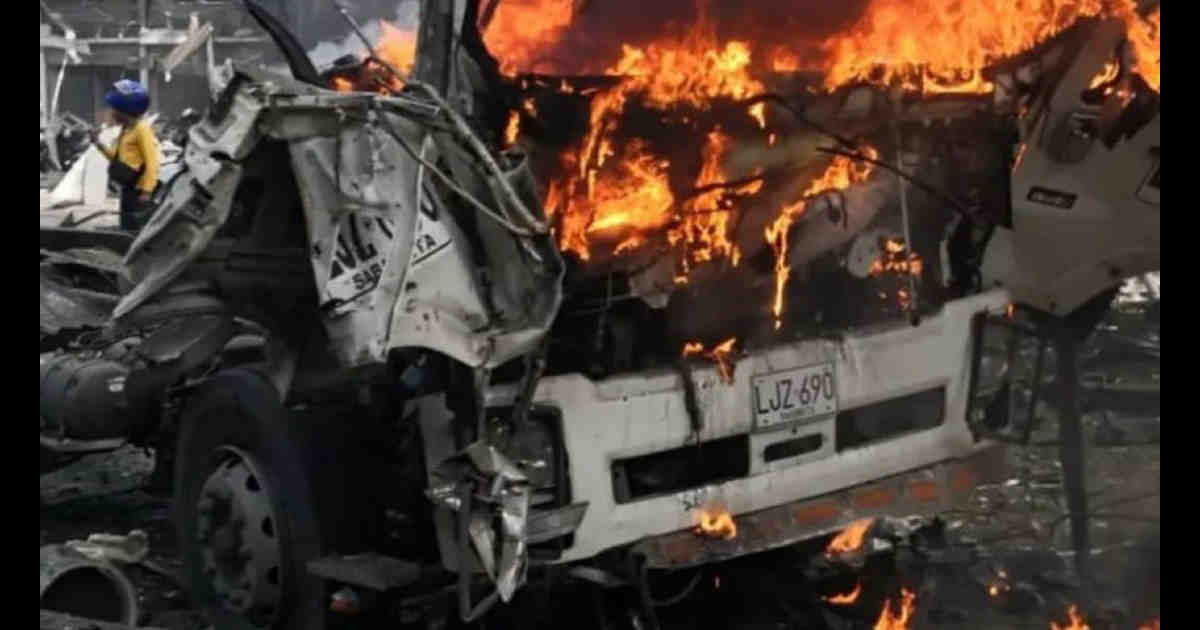
A powerful vehicle bomb exploded on a busy street in Cali, Colombia, on Thursday, leaving at least five people dead and dozens injured, local authorities confirmed. The blast has shaken the country at a time when its fragile peace process is already under strain ahead of the 2026 elections.
Military School Targeted
Police reported that the explosion appeared to be aimed at the Marco Fidel Suarez Military Aviation School in the northern part of Cali. The attack damaged several homes and businesses nearby, forcing emergency evacuations of nearby buildings and a school.
Eyewitness Hector Fabio Bolanos, 65, recalled, “There was a thunderous sound of something exploding near the air base. There were so many injured people. Many houses were damaged in front of the base.”
Another witness, Alexis Atizabal, 40, said civilians were also among the victims, stating, “There were fatalities among people passing by on the avenue.”
Also Read: Colombia Convicts Ex-President Álvaro Uribe of Bribery and Abuse of Office
Death Toll and Emergency Measures
Cali’s mayor Alejandro Eder confirmed that at least five people were killed and 36 others injured in the bombing. To prevent further incidents, he announced a ban on heavy trucks entering the city and offered a reward of US$10,000 for information about those responsible.
Regional governor Dilian Francisca Toro strongly condemned the incident, calling it a “terrorist attack.” She added, “Terrorism will not defeat us.”
Possible Rebel Involvement
Authorities have not yet confirmed who carried out the bombing. However, in June, the leftist guerrilla faction Central General Staff (EMC) admitted responsibility for a series of bombings and shootings in and around Cali that killed seven people. The EMC, which split from the main FARC group after rejecting the 2016 peace deal, has been stepping up violent operations in the lead-up to the 2026 elections.
Also Read: U.S. Reviews 55 Million Visa Holders for Possible Revocation or Deportation
Growing Violence in Colombia
Although Colombia has experienced over a decade of relative calm, guerrilla groups, paramilitaries, and drug cartels still control large parts of the country. Recently, there has been a noticeable increase in attacks, raising concerns about stability before the next presidential election.
On the same day as the Cali bombing, eight people were killed in separate clashes between guerrilla fighters and police near Medellín. The officers were carrying out coca crop eradication operations when the violence erupted.
Many of Colombia’s armed groups, regardless of ideology, rely heavily on the cocaine trade to fund their activities.
Pressure on the Government
These attacks have increased pressure on President Gustavo Petro, whose strategy of dialogue and conciliation with armed groups is now facing criticism. Opponents argue that his softer approach has contributed to the recent uptick in violence across the country.