
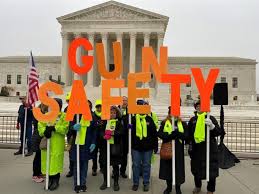
Washington: Disputes involving President Donald Trump‘s policies on tariffs, immigration and firing regulatory officials have drawn a lot of attention during the Supreme Court‘s current term, but the justices also are poised to decide major cases concerning U.S. “culture wars” issues such as guns and transgender athletes.
The court is expected to wrap up its nine-month term by around the end of this month. In two major cases, it is due to rule in challenges to a U.S. law barring users of illegal drugs from owning guns and a Hawaii law that restricts the carrying of handguns on private property open to the public, like most businesses, without the owner’s permission.
It also is set to decide the legality of laws in Idaho and West Virginia banning transgender athletes from female sports teams amid intensifying efforts by the Republican president and various states to restrict the rights of transgender people.
The court, which has a 6-3 conservative majority, has moved American law steadily rightward in recent years.
In a nation divided over how to address persistent firearms violence including frequent mass shootings, the court has taken an expansive view of the U.S. Constitution’s Second Amendment, which enshrines the right to keep and bear arms.
During January arguments in the Hawaii case, the conservative justices appeared ready to expand gun rights again, indicating skepticism on Second Amendment grounds toward the state’s law. Hawaii’s law requires a property owner’s “express authorization” to bring a handgun onto private property open to the public. Four other U.S. states have similar laws.
The court is expected to reject Hawaii’s defense of the law, according to Hayley Lawrence, a gun control advocate who serves as executive director of the Duke Center for Firearms Law.
“It seems to me Hawaii is going to lose 6-3,” Lawrence said.
The court, Lawrence said, also might shed further light on the legal framework it adopted in a 2022 decision in a case called New York State Rifle & Pistol Association v. Bruen for analyzing whether firearms control laws pass Second Amendment muster. The Bruen decision stated that any government regulation restricting firearms must be consistent with the U.S. historical tradition of gun regulation.
The court heard arguments in March over the legality of a federal criminal statute banning anyone who is an “unlawful user” of any controlled substance from possessing firearms or ammunition. That provision is part of the Gun Control Act of 1968, which outlines specific categories of people, such as felons and fugitives, who are barred from possessing firearms.