
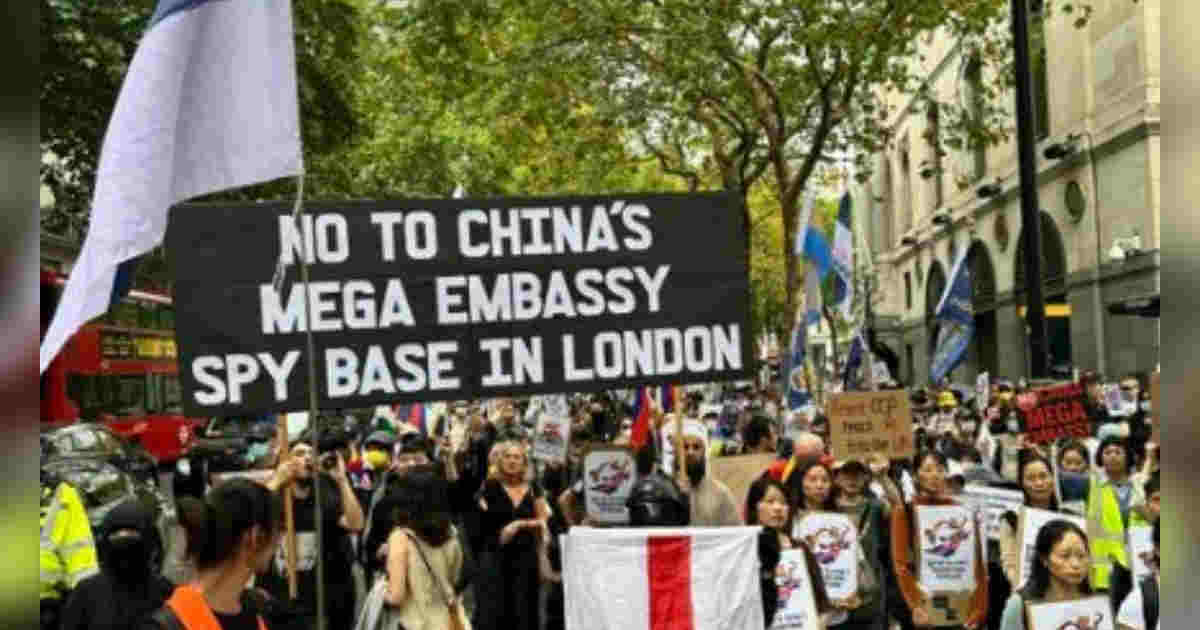
The UK government has postponed its decision on China’s proposed mega-embassy in London after Beijing refused to submit full, unredacted architectural layouts for several buildings in the project. The deadline, originally set for September 9, 2025, has now been extended to October 21, 2025, according to Phayul.
Demand for Full Layouts
Deputy Prime Minister and Housing Secretary Angela Rayner, who is overseeing the application, has requested complete internal layouts, especially for the Cultural Exchange Building and the Embassy House. Officials said the documents already provided by Beijing leave major gaps, raising concerns about transparency and security.
China has rejected the request, claiming the information shared is adequate and complies with standard planning norms. It further accused the UK of politicising a routine diplomatic process and dismissed security concerns as “slander.”
Largest Chinese Embassy in Europe
The embassy is planned at the Royal Mint Court site, directly opposite the Tower of London. If approved, it would become the largest Chinese diplomatic complex in Europe. However, its size and sensitive location have triggered strong objections from local residents, human rights organisations, and lawmakers in both the UK and the United States. Critics argue that the lack of full transparency could conceal potential espionage risks.
Protests Against the “Mega-Embassy”
On Saturday, Tibetan groups and allied organisations, supported by members of the Inter-Parliamentary Alliance on China (IPAC), held a major protest against the plan. Activists urged the government to block the embassy unless Beijing provides complete architectural details. Meanwhile, DP9, the planning consultancy representing China, has defended the submissions, insisting they meet all planning requirements.
Diplomatic Fallout
The embassy dispute has complicated initial interactions between Prime Minister Keir Starmer and President Xi Jinping. Starmer faces pressure from security advocates and protesters to adopt a tougher stance, while China has described the delay as a test of Britain’s willingness to honour its international responsibilities toward diplomatic premises.
Security and Human Rights Concerns
Critics argue that allowing a large, partially redacted facility so close to vital infrastructure would be reckless. They also warn it could restrict the rights of demonstrators outside the embassy, given Beijing’s track record on human rights in Tibet, Hong Kong, and Xinjiang. China has rejected these accusations, maintaining that the project is a standard embassy development and accusing Western powers of politicising the issue.
Also Read: U.S. Commerce Secretary Calls H-1B Program Scam, Proposes Gold Card for Wealthy Migrants