
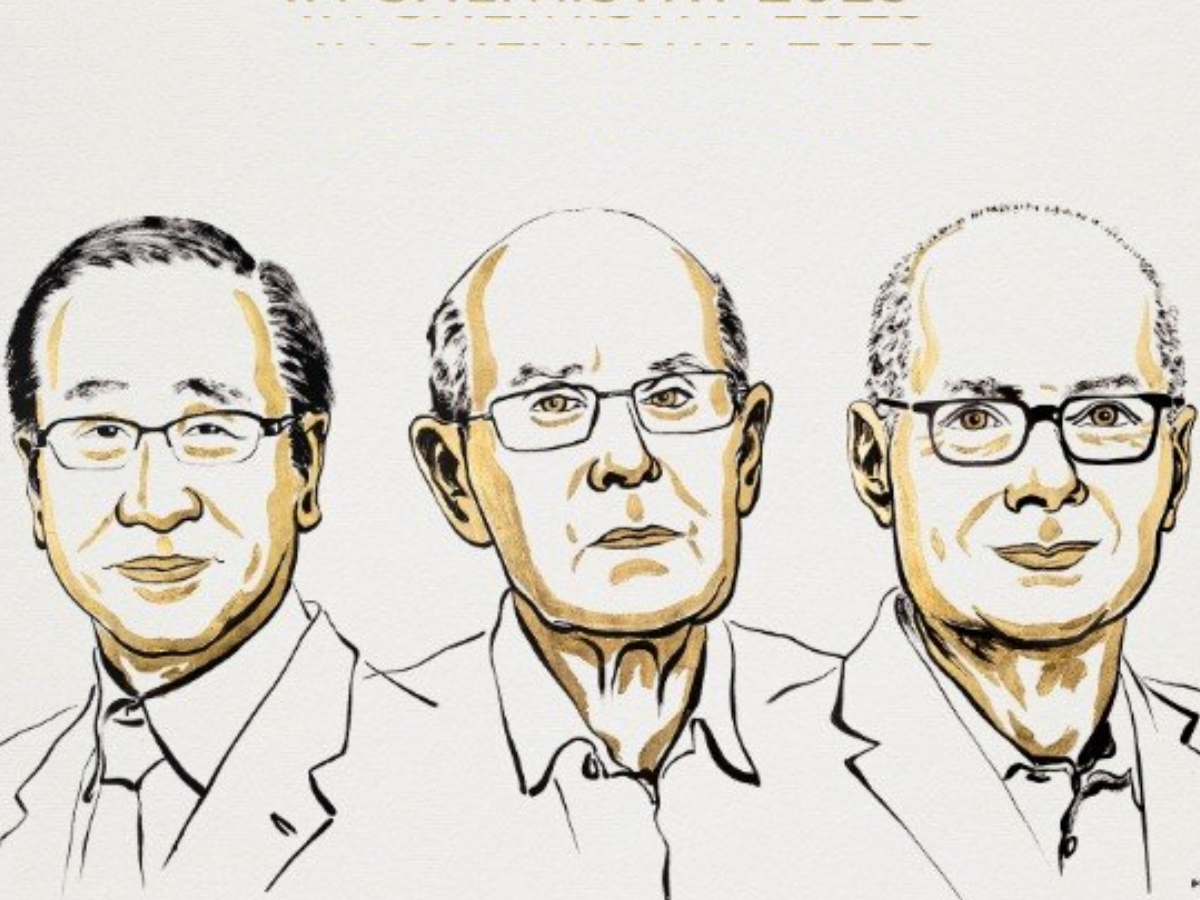
The Royal Swedish Academy of Sciences has confirmed that Susumu Kitagawa (Japan), Richard Robson (UK), and Omar M. Yaghi (USA) have shared the 2025 Nobel Prize in Chemistry for the invention of metal–organic frameworks (MOFs) a game-changing innovation that is changing the way scientists work with molecules.
Nobel Prize-Winning Discovery: What Are Metal–Organic Frameworks?
The Academy stated that the trio was recognized “for the development of metal–organic frameworks” with enormous sponge-like cavities that allow gases and molecules to pass through easily.
They are more than laboratory chemical curiosities. They have already been instrumental in trapping carbon dioxide, extracting water from air in deserts, storing hydrogen, and purifying pollutants from water providing real-world solutions to fight climate change and develop clean energy technology.
How the Nobel Chemistry Prize Discovery Evolve?
The history of MOFs started in 1989, when Richard Robson tested the interaction between positively charged copper ions and a four-armed molecule that was able to attract them. Despite the instability of the product, it indicated vast possibilities.
Subsequently, Susumu Kitagawa followed that concept, demonstrating that gases would flow unobstructedly through these structures even going so far as to forecast that MOFs would bend without breaking.
Omar Yaghi further developed the idea. He created a modifiable and stable MOF that could be precisely designed for targeted scientific and industrial applications from clean fuel storage to drug development.
Why This Discovery Matters?
By designing frameworks that can “breathe” and “trap” gases, the laureates have opened up chemists to a new approach to designing materials for environmental and technological problems.
In their official statement, the Academy pointed out that their innovation “has given chemists new possibilities to address some of humankind’s biggest challenges.”
The three winners Kyoto University’s Kitagawa, the University of Melbourne’s Robson, and the University of California’s Yaghi will divide the 11 million Swedish kronor (₹1.03 crore) award equally.
Nobel Prize 2025 Week: Other Laureates Announced So Far
The Nobel in Chemistry follows Monday’s Medicine Prize, given to Mary E. Brunkow, Fred Ramsdell, and Shimon Sakaguchi for discovering the immune system’s “regulatory T cells.”
On Tuesday, the Physics Prize was awarded to John Clarke, Michel Devoret, and John Martinis for constructing a device showing “quantum tunnelling.”
The world then waits for the Literature, Peace, and Economic Sciences announcements, on October 9, 10, and 13, respectively.
Legacy of the Nobel Vision
Established by Swedish inventor Alfred Nobel, the prizes remain dedicated to honoring those who, in his own words, “have conferred the greatest benefit to humankind.”
The 2025 Nobel Prize ceremony will be held on December 10 in Stockholm, celebrating breakthroughs that advance the limits of science and remind humanity that curiosity, teamwork, and determination are the pillars of human achievement.