
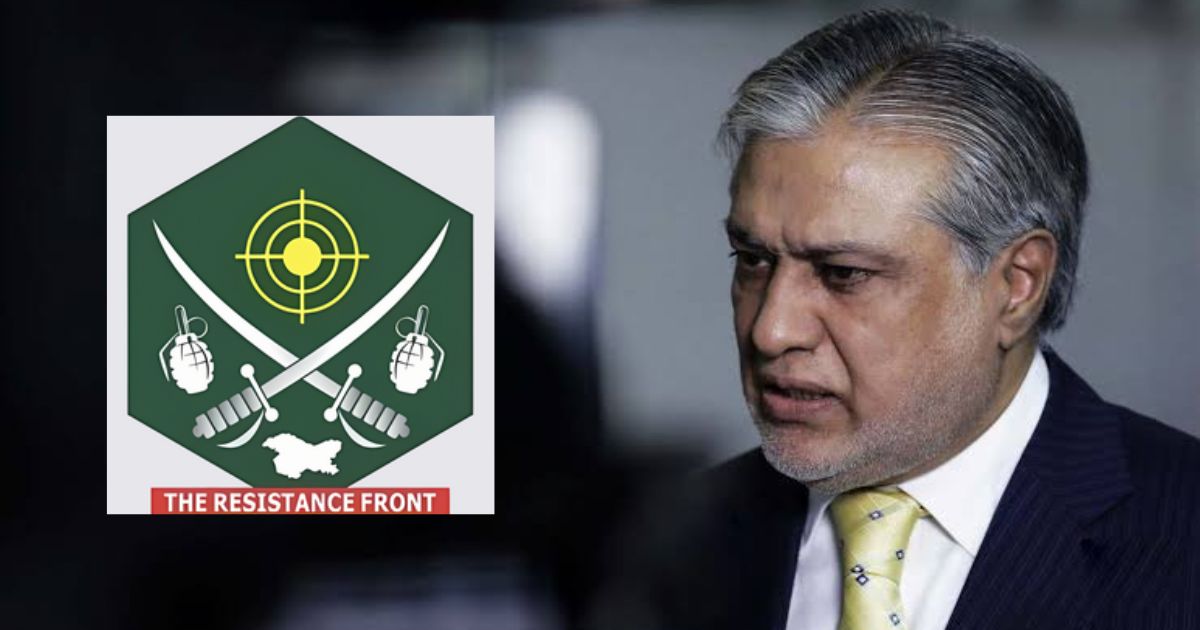
On July 25, 2025, Pakistan’s Foreign Minister and Deputy Prime Minister Ishaq Dar publicly backed the US’s decision to call The Resistance Front (TRF) a terrorist group. This was a big change from his previous position. Dar spoke at an event in Washington during his official visit and said that Pakistan has “no objection” to the US designation. He also said that any proof that the TRF is involved in terrorist activities, like the April Pahalgam attack that killed 26 civilians, would be welcome.
This change in tone is important because just a few months ago, Dar proudly defended Pakistan’s efforts to get TRF’s name taken off of a United Nations Security Council (UNSC) statement that condemned the Pahalgam attack and strongly denied that the group was a terrorist group. Dar said at the time that there wasn’t enough proof to link TRF to the attack and proudly said that “Pakistan prevailed” in stopping the reference. People have long thought that TRF is a stand-in for Lashkar-e-Taiba (LeT), a militant group in Pakistan that India says is planning terrorist acts in Jammu and Kashmir. Even though Dar has said that TRF is not connected to LeT, US and Indian intelligence still say that TRF is a front for LeT’s militancy in the area.
Dar’s softer tone during his eight-day trip to the US is part of Pakistan’s bigger plan to change the way it talks about fighting terrorism. As Pakistan’s rotating president, he has led several UNSC meetings and talked with US officials, such as Secretary of State Marco Rubio. Rubio said that Pakistan is a “partner in countering terrorism and preserving regional stability,” even though there are still concerns about Islamabad’s role in cross-border terrorism. This shows that the two countries are working together diplomatically.
The US has put sanctions on TRF that limit its international operations and financial support. The US has called the group a Specially Designated Global Terrorist entity and a Foreign Terrorist Organization. Indian External Affairs Minister S. Jaishankar called the US decision a “strong affirmation” of the two countries’ work together to fight terrorism.
Still, Delhi is wary of Pakistan’s changing story and says that Islamabad must destroy the infrastructure that supports terrorism in order to achieve true peace, not just make symbolic gestures or play diplomatic balancing games. The Pahalgam attack and the Indian Air Force’s Operation Sindoor, which showed that militancy supported by Pakistan is still a threat, made India want more accountability.
Pakistan’s deputy prime minister Ishaq Dar’s change of heart about the TRF’s terror list shows that Islamabad is trying to keep international pressure under control and maintain strategic ties, even though cross-border terrorism is still a major source of tension between the two countries. This change makes the India-Pakistan-US triangle even more complicated, even though there are efforts to reduce instability in the region and encourage cooperation against terrorism.